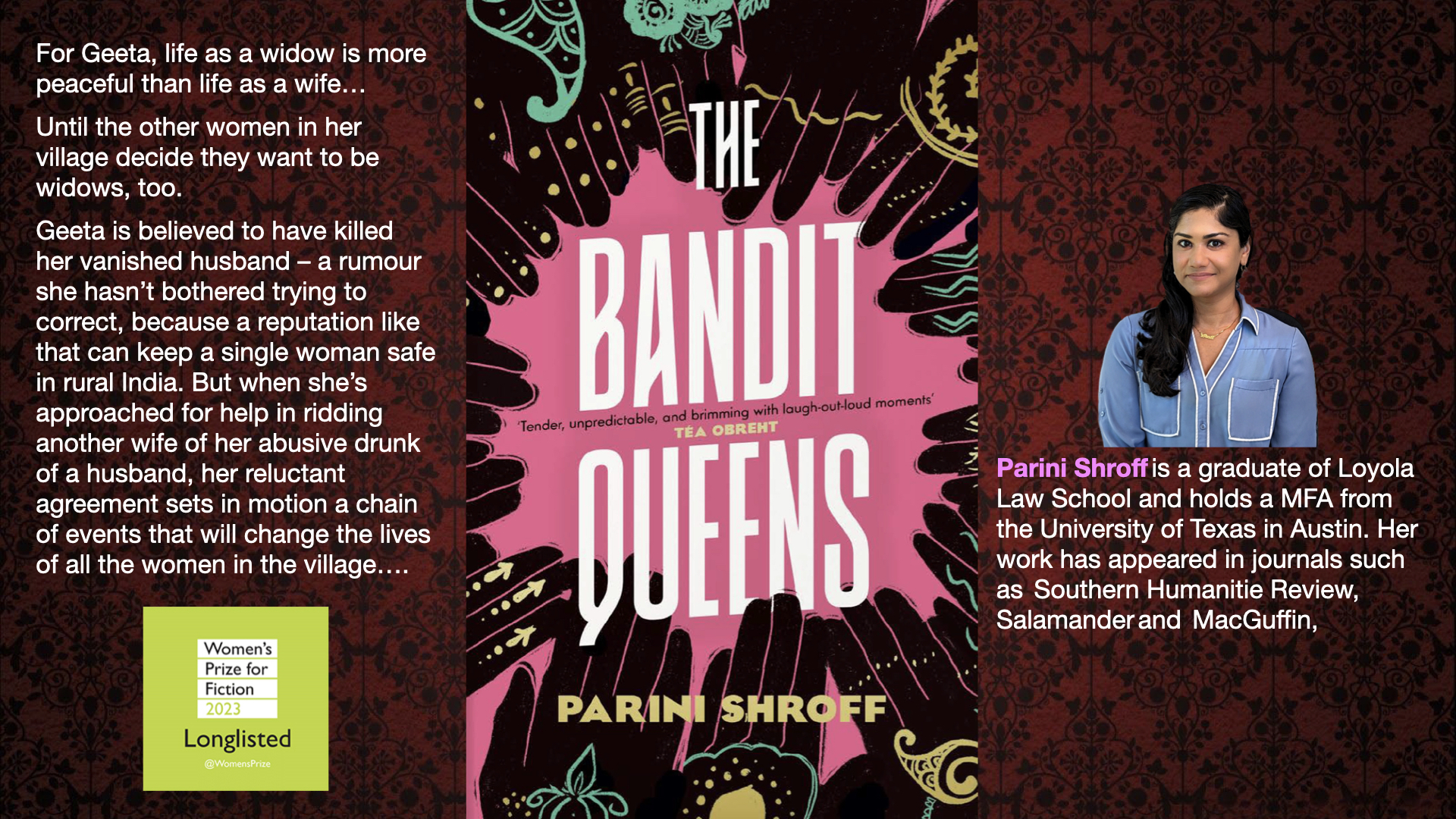
I picked ‘The Bandit Queens’ from the 2023 Women’s Prize For Fiction Longlist because I’m a sucker for a ‘solve the patriarchy problem by killing off the patriarch who is causing you problems‘ kind of book. It seems like good advice to me. If you can get away with it. I was thinking of books like ‘How To Kill Men And GetAway With It‘ by Katy Brent or ‘Sweetpea’ by C. J. Skuse.
I went into ‘The Bandit Queens’ expecting to find the same narrative of ‘female killer getting away with it’ playing out in a village in rural India. Although there are similarities, that’s not what ‘The Bandit Queens’ is really about.
Firstly, Geeta, the main character, is not really a killer. She is an abused wife who has not corrected the belief held in her village that she ‘removed her own nose ring’ by killing her vanished husband. She’s not a slick, confident Black Widow, gleefully reducing the number of terrible men in the world. She’s a woman who still bears the scars of emotional and physical abuse and who wants nothing more than to live in safety and be left alone.
Secondly, this is not just the story of Geeta’s struggle. Geeta quickly finds herself collaborating with three other women from the village who, together, are the Bandit Queens of the title.
Thirdly, although the story centres around the consequences of the physical and emotional abuse of women, it also looks at other issues that shape the lives of the village women: social exclusion based on gender or religion or caste, childlessness, motherhood, the marginalisation of women by the patriarchy, the negative impact of the dowery system, and the rivalries between the women themselves.
So, what is the book about?
To me, it was mostly about women coping with the problems in their lives, many of which stem from the men in their lives, and discovering that they are stronger than they thought, especially when they can find ways to collaborate.
The story is clever and suspenseful and shot through with dark humour. It doesn’t shy away from describing the abuses that women are subjected to but it doesn’t sensationalise them either. The storytelling is engaging and vivid.
The book has a strong opening that brought me swiftly inside the situation and then gave it a twist before taking a breath and expanding my understanding of the main characters.
The writing was subtle and credible. It describes a world well outside my experience but I found myself believing completely in the people that I met there. The dialogue is perfect – distinctively Indian but still accessible to people like me.
What I loved most was the way the story brought the four main women to life. Geeta is a wonderful creation and I found myself hoping that things would work out well for her even when I couldn’t imagine how that outcome would be achieved. I enjoyed seeing her grow in confidence as she recovered from the effects of a marriage that had left her physically and emotionally damaged and socially isolated.
I also liked Geeta’s childhood best friend, from whom she became estranged after her marriage. She is the only woman in the book who enjoys being a wife. She’s also an unstoppable powerhouse, with tremendous energy and a constant urge to organise everyone.
Then there is the woman who asks Geeta, as someone with proven husband-killing skills, to help her to kill her own abusive husband. She turns out to be quite a piece of work, someone much closer to the sociopath I’d been expecting to read about. She’s hard to like but very easy to believe in.
Finally, there is the woman Geeta and her friends would not normally meet, an Untouchable matriarch who deals with all the dead bodies in the village – human and animal – and who is not at all what Geeta expected.
The men in the story are also well-drawn. Some of them are predators the world would be better off without. Some of them are just weak. A couple of them are actually nice. For the most part, their attitudes towards women are toxic and so much a part of who they are that the men themselves are quite untroubled by them, blaming the women for any consequent problems.
I admire Parini Shroff’s ability to balance her storytelling so that, although difficult issues were central to the narrative, the book never became a tract. The plot had enough surprises and enough suspense to keep me turning the pages eagerly and the growing depth of character development kept me invested in the women and what happened to them.
‘The Bandit Queens’ is a rare kind of book: accessible, entertaining, truthful and thought-provoking. It’s a remarkable achievement and an astonishing one for a debut novelist. I hope that Parini Shroff continues to write. I’ll certainly be there to buy her next book.
 Mike Finn's Fiction
One thought on “‘The Bandit Queens’ by Parini Schroff – highly recommended.”