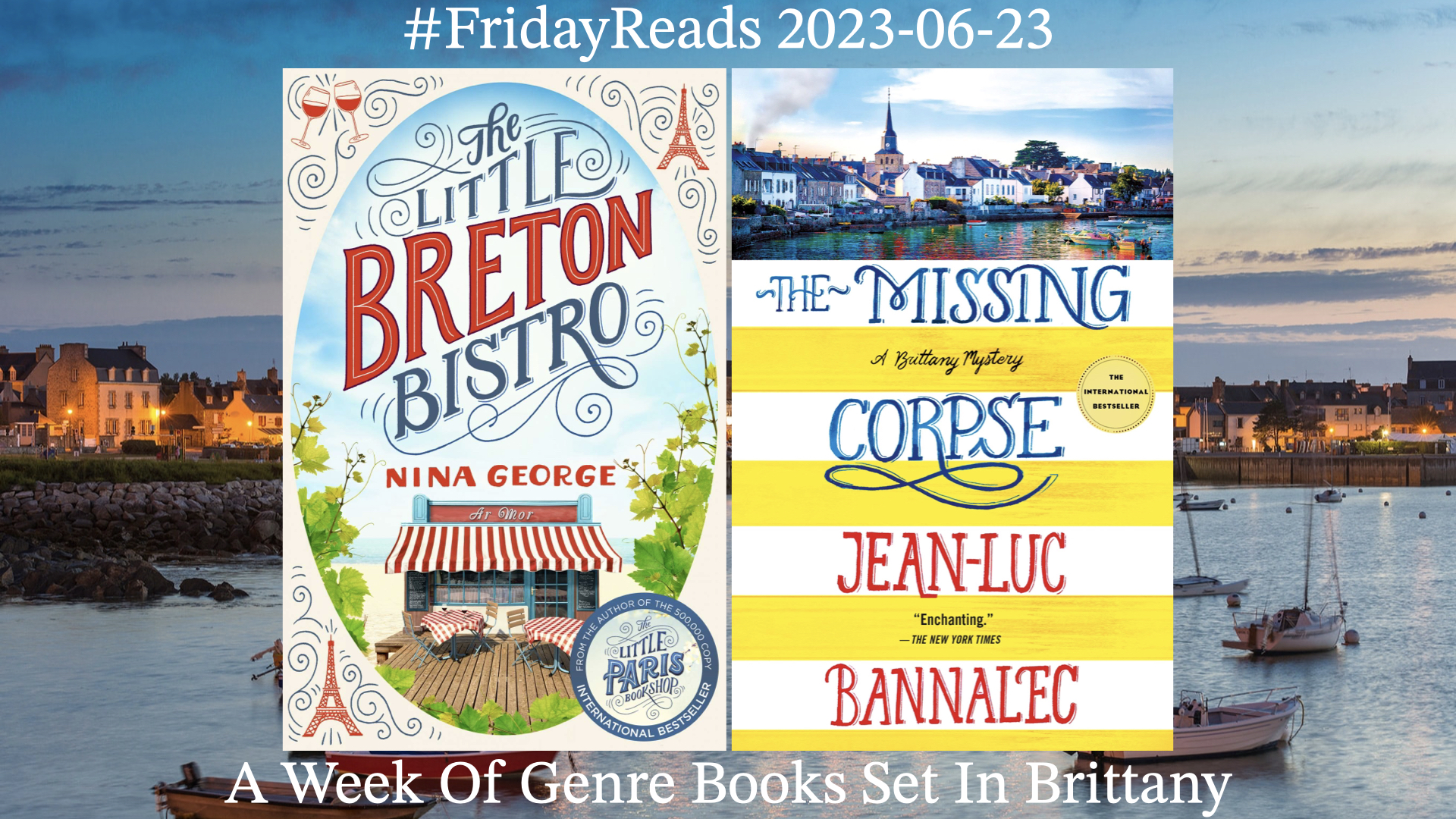
I’m taking a short break on the coast of Brittany this week. It will be my first time off the island since I returned to the UK in 2018. I’m looking forward to hearing French spoken again and spending time by the sea.
I should have plenty of time to read by the sea, and while getting to Brittany and back by train and boat, so I went looking for some genre books set in Brittany and available in English as ebooks.
I found one book that looks like a cosy romance but which I suspect is actually a mainstream story about a woman who is taking control of her life. The other book is part of a Brittany mystery series.
To my surprise, both of the books I picked were written by German authors and then translated into English.
I’m hoping they’ll keep me entertained and help me absorb more of the Breton spirit during my trip.
‘The Little Breton Bistro’ by Nina George (2010)

I wasn’t entirely sure what to expect of this book. The marketing for it sent very different messages, depending on which market I looked in.

The English version is the one on the left. With that folksy, mid-brow, France-as-a-tourism-cliché cover and that cheerful title, ‘The Little Breton Bookshop‘, it screams: I’m a cute, cosy romance. Curl up with me and escape to a better place.
The cover of the American version, the one in the middle, seems to say I’m a serious piece of women’s fiction set in the old world yet changing the title to Little French Bistro suggests that the publishers weren’t sure that their readers would know what Breton meant.
The German version, the one on the right, is harder for me to assess because I don’t know the market well. The cover doesn’t look highbrow but It doesn’t scream cosy and there’s no reference to anything French. The title literally translates into Moonplayer which suggests to me someone taking a chance.
So I decided to skip the covers and go to the text. As soon as I read the first three paragraphs, I knew I wanted to read the book. Here they are:
“It was the first decision she had ever made on her own, the very first time she was able to determine the course of her life.
Marianne decided to die. Here and now, down below in the waters of the Seine, late on this grey day. On her trip to Paris. There was not a star in the sky, and the Eiffel Tower was but a dim silhouette in the hazy smog. Paris emitted a roar, with a constant rumble of scooters and cars and the murmur of Métro trains moving deep in the guts of the city.
The water was cool, black and silky. The Seine would carry her on a quiet bed of freedom to the sea. Tears ran down her cheeks; strings of salty tears. Marianne was smiling and weeping at the same time. Never before had she felt so light, so free, so happy. ‘It’s up to me,’ she whispered. ‘This is up to me.’”
George, Nina. The Little Breton Bistro (p. 8). Little, Brown Book Group. Kindle Edition.
The English publisher’s summary told me that ‘Marianne longs to escape her loveless marriage‘ and ‘throws herself in the Seine‘ on a trip to Paris. It didn’t tell me that Marianne is a sixty-year-old German woman, married to a man who has made her unhappy for so many years, that suicide seems like a release. I want to know what Marriane, who speaks no French and whose only life decision so far was to die, does next.
I recommend visiting Nina George’s website. I picked up this video there, of her speaking about ‘The Little French Bistro’ to an audience at the Politics and Prose Bookstore in Washington. It’s a little long (an hour) but it’s fun and it made me more eager to read the book.
‘The Missing Corpse’ by Jean-Luc Bannalec (2021)
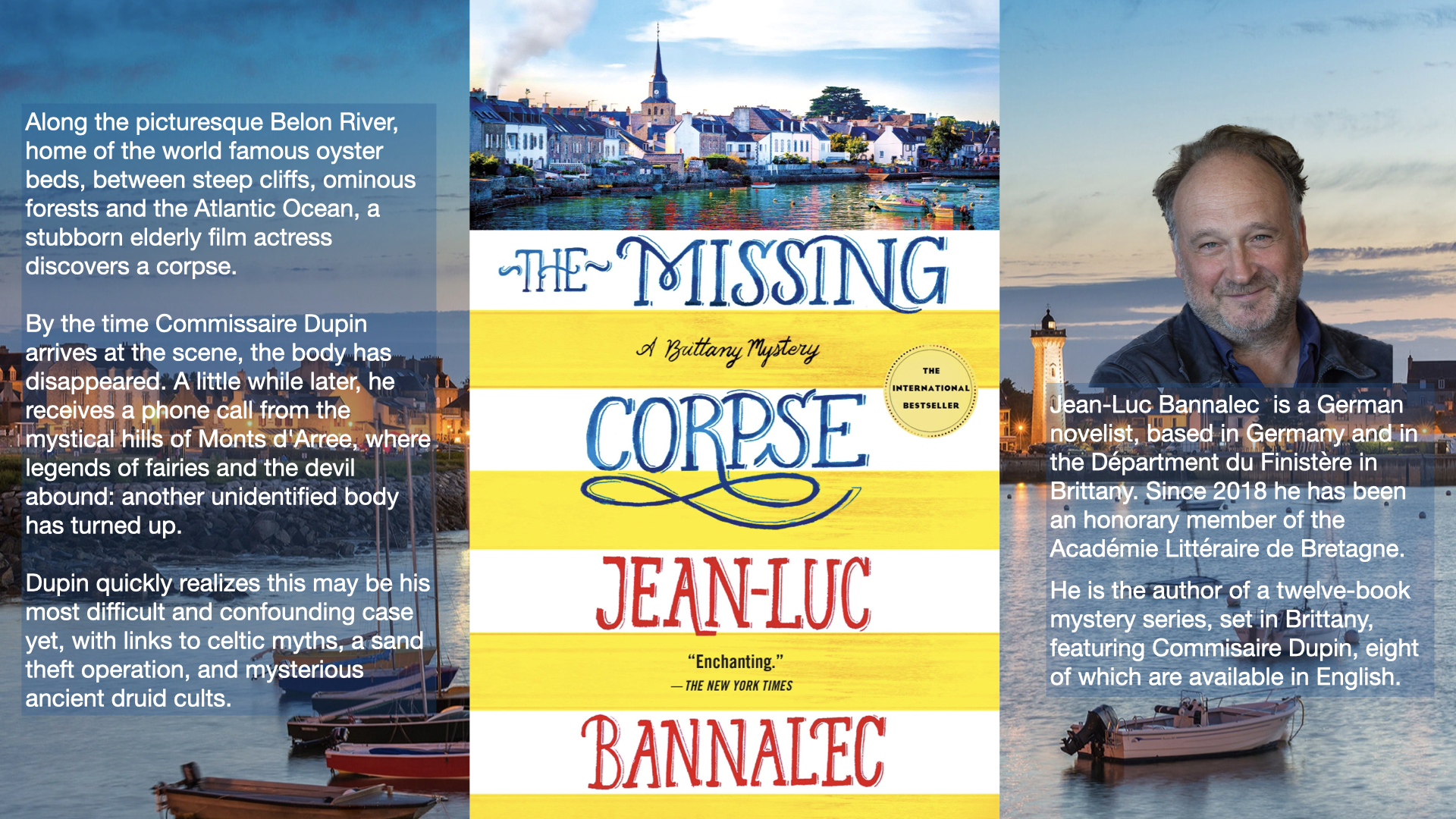
I wish the publishing industry was more willing to invest in translations and had a better process for dealing with digital rights. Jean-Luc Bannalec is an example of where things need to improve.
A German writer who spends a lot of time in Brittany, his work sells well in Germany and France but he isn’t pushed in the UK.
He’s written a series of mysteries set in Brittany and featuring Commissaire Dupin. Currently, the series stands at twelve books, only eight of which have been translated into English. Only five of the English language texts are available as ebooks and only two of them have made it to audiobook. Why does this happen? What gets in the way of releasing an ebook version of a book you’ve already published in paperback?
Anyway, the upshot is that I’m starting the fourth book in the series, ‘The Missing Corpse’ because the earlier ones aren’t available as ebooks.
I’m hoping that the book works well as a starting point for the series, and has an interesting plot and a strong sense of place. If it does, I’ll be back for more.
 Mike Finn's Fiction