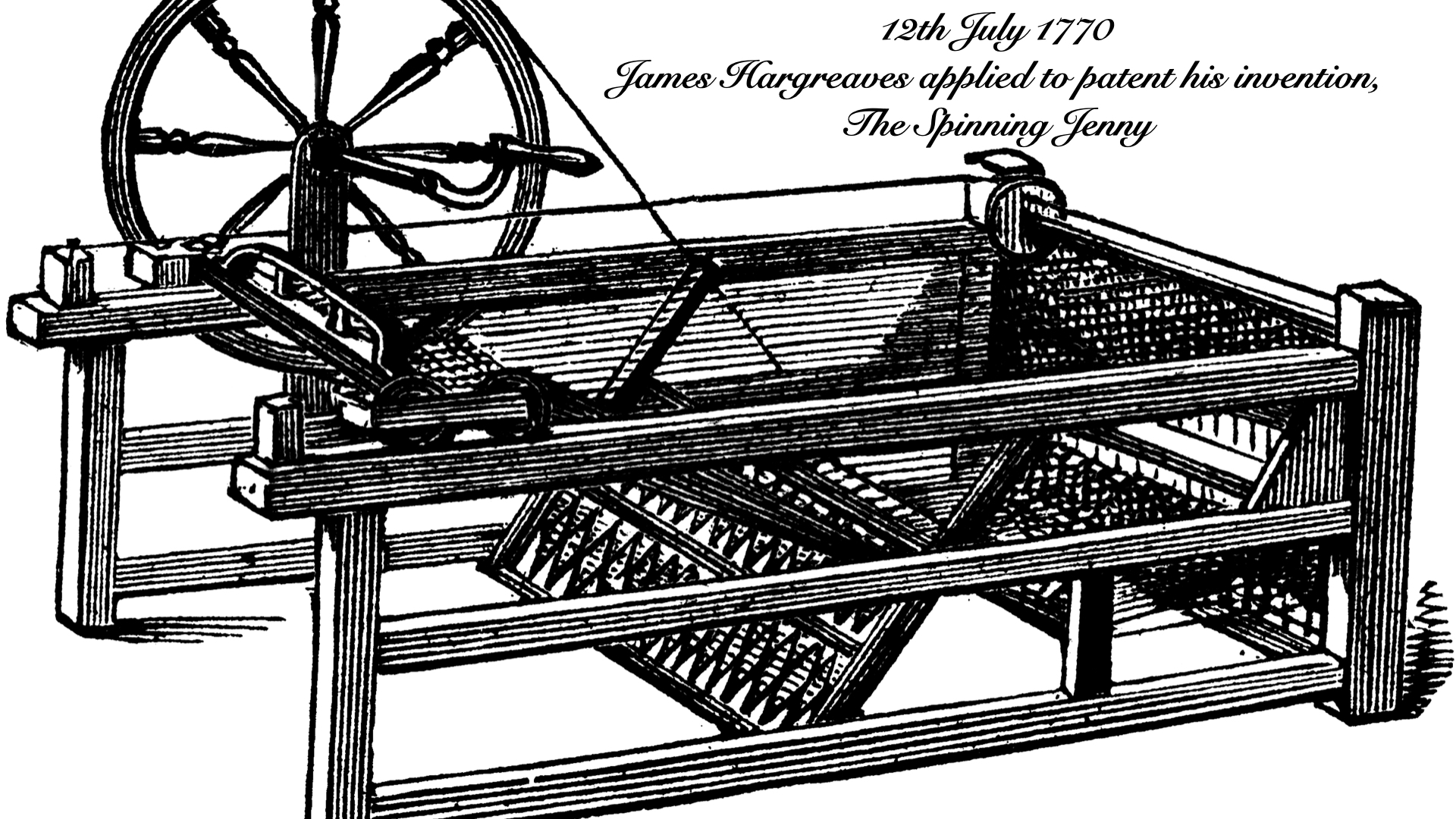
253 years ago today, James Hargreaves applied to patent his newly invented engine-powered spinning machine, the Spinning Jenny, which could spin eight spools simultaneously. Later versions allowed 120 spools to be spun simultaneously.
Why was this a big deal?
At school, fifty years ago now, I was taught that this was one of the inventions that triggered The Industrial Revolution.
We spent as much time studying ‘The Causes Of The Industrial Revolution’ as we did studying ‘The Causes Of The French Revolution’ as if the two were alternative paths chosen by the two nations.
The basic story of The Industrial Revolution that was told to me was that the steam engine was applied by clever men (often with no land and little education) to make great progress in transportation, mineral extraction and manufacturing which transformed Britain into the leader of the industrial world.
At the time, we were never asked to consider if this was a good thing or even if it was an inevitable thing. We were told that this great change came at the cost of significant social disruption as people moved from the land to towns and that some Luddites had tried to Stand In The Way Of Progess but it was clear that those who stood in the way of progress were doomed to be run over as Modern Britain was formed.
I look back at it now and wonder why I didn’t ask more questions.
These days, I’d never let that The Industrial Revolution branding pass unchallenged.
It’s a great piece of marketing. It has the gravitas of something inevitable, one of those undisputed Good Things in our history. It sounds like a populist movement making a concerted effort to overthrow something. It bands together a series of events and gives them an identity that makes them seem as if they were all leading to a predictable outcome – A Better Britain.
Imagine if it was called ‘The Rise Of The Technology Barons‘ or ‘The Great Disruption‘ or ‘The Destruction Of Rural Britain’.
To my older, more disappointed eyes, The Industrial Revolution brand looks like a deflection.
If it was a revolution, it was one with no manifesto other than profit. The only thing being overthrown was the ability of skilled men to make a decent living while working at home with their families.
The brand image deflects from the realisation that the enforced introduction of new technologies made a few clever inventors and the money men who backed them fabulously rich without challenging the Landowning class, while turning the rest of us into wage slaves living in filthy thrown-together towns. It created a workforce of poorly paid, poorly protected women and children working in unsafe and unhealthy conditions.
We’re encouraged to learn from history but we’re fed that history in packaged chunks that we regurgitate for grades.
If we really want to learn from history, we need to encourage discussion topics like:
“How could the use of technological innovations in the late 18th and early 19th century have been regulated so that industrial growth was matched by a growth in social infrastructure – housing, education, public health?”
In the hope that things had improved in the past fifty years. I went to look at what English children are taught today and found this video among the secondary resources from BBC Teach for History KS3 / GCSE: The Industrial Revolution
It’s certainly more engaging than the materials my teachers had available. Some of the messaging is new. No one mentioned that The Industrial Revolution led to a massive use of non-renewable, polluting energy when I was at school. The overall message is still one of the March Of Progress.
 Mike Finn's Fiction