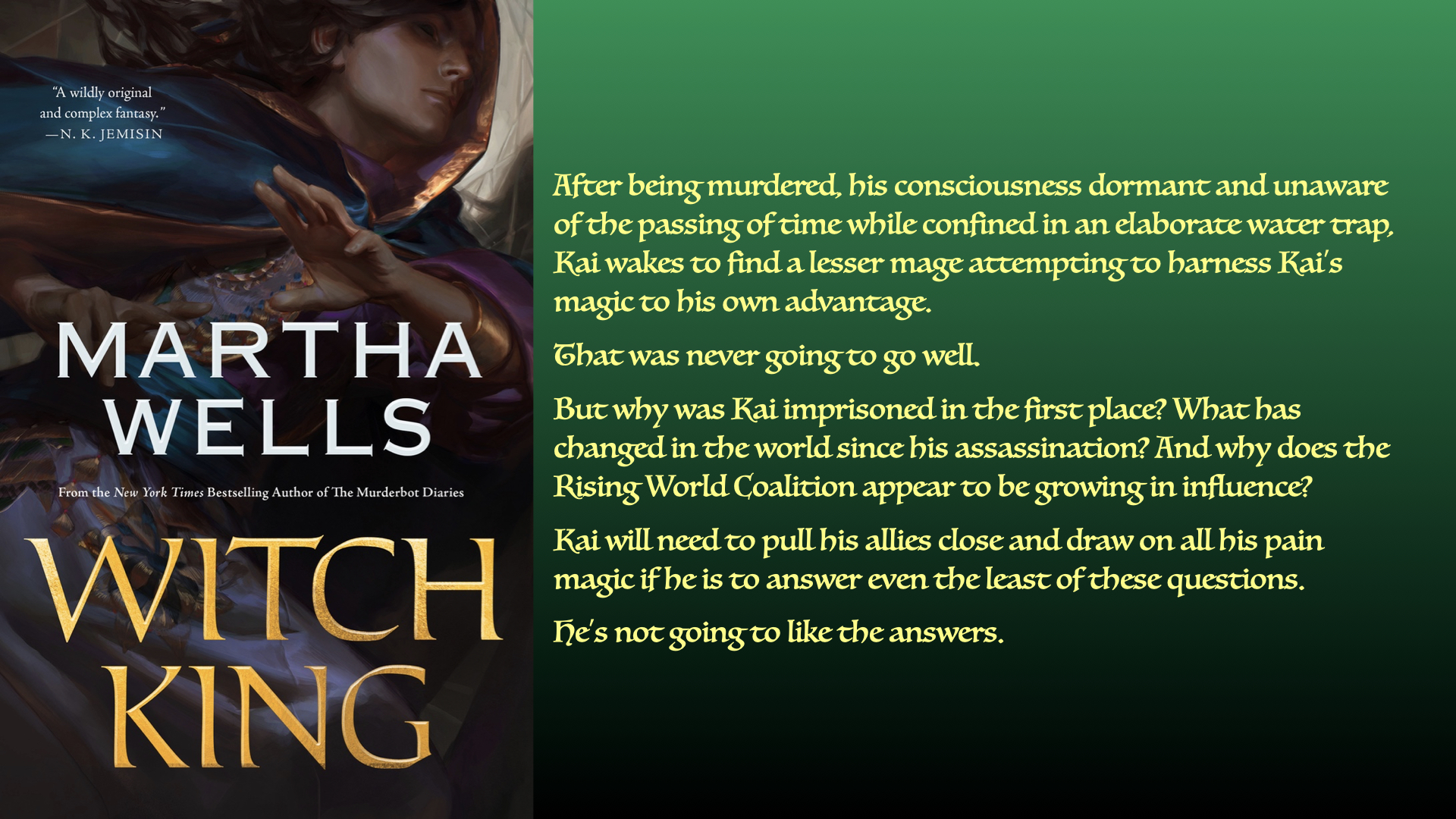
Four things stood out for me about ‘Witch King”. the scale of the imagining, the discipline of the storytelling, the bleakness of the destruction, and the empathy and engagement that Martha Wells builds for her non-human and sometimes truly frightening main character.
The scale of this imagining in ‘Witch King’ is vast and richly textured. Martha Wells has created a world filled with complex cultures, each with its own language, history and traditions, The list of characters is long, their names are difficult to pronounce or even remember and I wondered at first if I could keep track of them all.
Martha Wells dropped me into the middle of this vast ocean of imagination that she’d created, but she didn’t leave me to drown. The discipline of her storytelling kept me focussed on the fate of a small number of characters who made the world real and relevant and gave it scale. The story didn’t meander, like a tour group floating down a river, taking in the magnificent intricacy of the world. Instead, it used a mystery to drive the action from the first page. The main characters wake abruptly to discover that they’ve been captured and held in a death-like stasis for some time. The central questions of ‘Who did this to us and why and what has happened to our missing team member?’ drove the immediate action.
It was a storyline birthed in vivid violence that immediately established how powerful and dangerous the captured characters were. It displayed the magic they had at their disposal and it introduced from the beginning the idea that these people had been betrayed by someone close to them.
In most fantasy books, the ‘Find-Our-Friend / Discover-The-Traitor’ premise would have been enough to power a quest filled with conflict and mystery but Martha Wells doesn’t stop there. She adds a second timeline, set sixty years earlier, that provides the context for current events. It tells of what brought the three main characters together and how the world came to be as it is. It also does something quite rate in Epic Fantasy, it provides a way of showing how the characters have developed by juxtaposing them as they are now and as they were then.
Many fantasy stories are based on a struggle between the ‘forces of darkness’ and the ‘forces of light’. I often struggle with that, especially when the good guys spend a lot of their time destroying the cities of the bad guys. Martha Wells changed the dynamic. The struggle here is simpler and leaves no room for moral debate. This is a story of invasion and genocide. The bad guys are called the Hierarchs. They possess the magical equivalent of Weapons Of Mass Destruction that the magic of the other cultures cannot stand against. Their power literally comes from death and they set about extinguishing whole populations, occasionally enslaving people that are useful to them in the short term. These guys are the equivalent of the White Men turning up on the shores of America. Their agenda is conquest or colonisation, it’s ruthless asset stripping.
Martha Wells uses the genocidal threat posed by the Hierarchs to pitch a David-versus-Goliath story of rebellion. She gives that story more power by placing at the heart of the rebellion three people who would normally be seen as threatening outsiders by the rest of the people who they are fighting to save. Telling the story through the eyes of one of these outsiders was what made ‘Witch King’ work for me.
The ‘Witch King’ of the title is called Kai. He’s not typical hero material. He’s a demon from an underworld dimension who can only live in this world by occupying a human body. He’s almost impossible to kill. He can eat human life with a touch. His eyes are entirely black. His social skills are poor to non-existent. Yet he is the heart of this book. As the story unfolded, I found myself surprised and impressed by his compassion, his endurance and his relentless commitment to his friends and allies. The evil in this book is depressingly familiar and plausible. It’s Kai who feeds hope and makes it possible to believe that things can get better.
‘Witch King’ works well as a standalone book. It’s cliffhanger-free and tells a satisfyingly complete story. Even so, I hope that there’s a sequel. I’d like to know more about Kai and his world.
 Mike Finn's Fiction