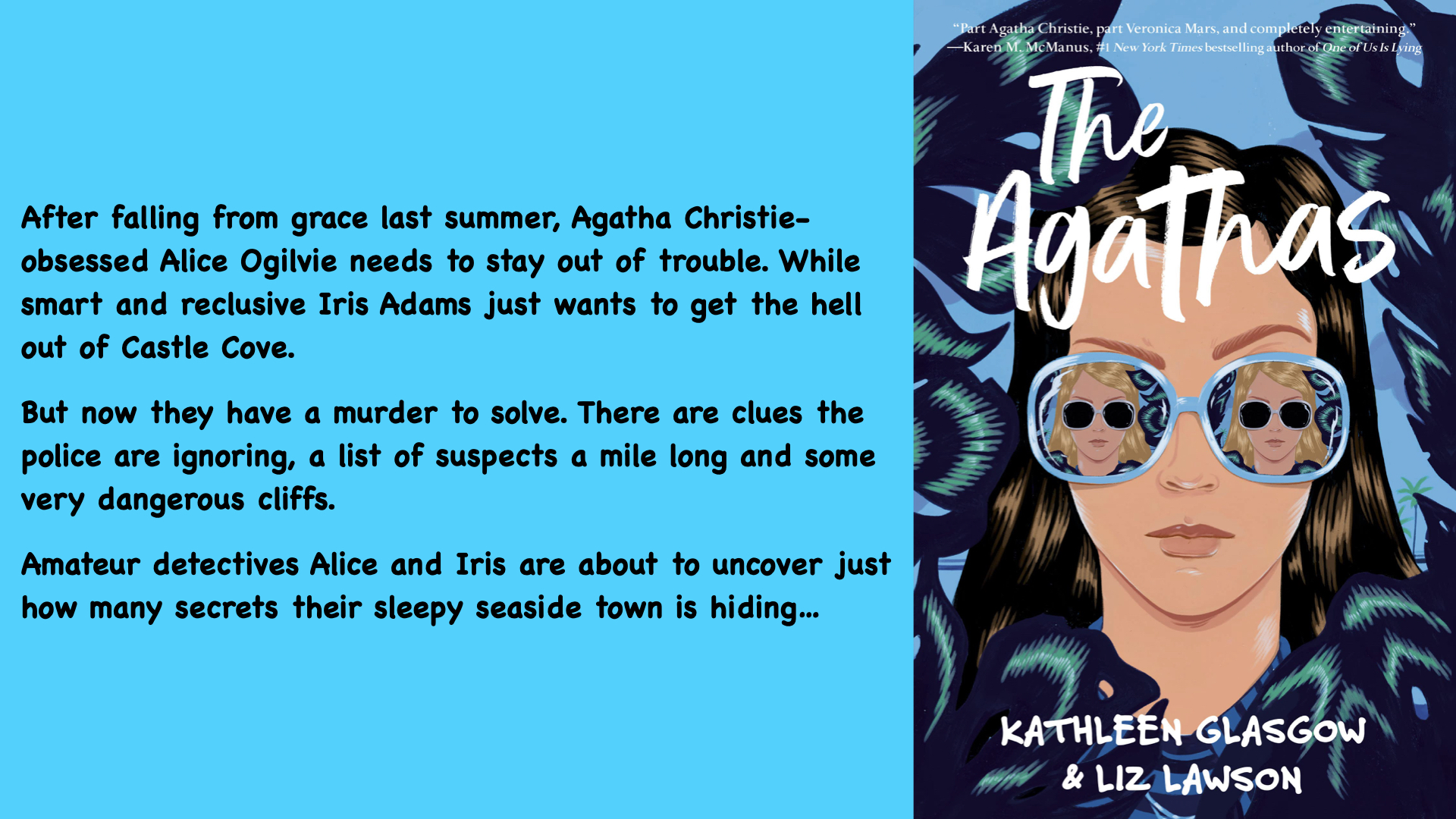
I itched to buy ‘The Agathas’ when I first saw it. The cover was amusing and the title was intriguing. My finger hovered over the ‘Add to basket’ button. I didn’t buy it because it had two red flags. Firstly, it’s written by two authors. I know that can work, Ilona Andrews and James S A Corey prove that, but it often doesn’t. The second red flag was the Young Adult label. I’m just too old for most young adult books, especially ones set in American High Schools which are as remote from my personal experience as attending Hogwarts and even harder to believe in. Eventually, positive reviews from people who I trust tempted me into givng ‘The Agathas’ a try and I’m very glad they did.
‘The Agathas^ was a ‘Wow!’ of a book. Pure fun from beginning to end.
All the High School tropes from Veronica Mars were there but they were transformed by how well the two main characters, Alice and Iris are drawn and by the way the plot drives the development of their unlikely relationship. It also helped that Alice and Iris had both watched Veronica Mars and were aware of the parallels.
Then there’s the Agatha Christie overlay, which is introduced because Alice spent part of the previous summer reading Christie’s books. It decorates the plot with Christie quotes and encourages Alice to believe in the viability on amateur sleuthing. It also delivers the occasional Easter Egg like naming the school counsellor Westmacott, which was one of Christie’s lesser-known pen names.
What pulled me into the book was that it was told from two first-person points of view in alternating chapters. This gave me an intimate picture of how two girls at the same school: Alice, recently exiled from the elite inner circle of rich kids and Iris, a high-achiever from a poor home who is part of a group of self-declared oddballs who are virtually invisible to the elite, see themselves and each other. Having two points of view allowed more action to be covered and for each of the girls to have a different take on what was going on. It was also an effective way of adding to the tension by flipping points of view at key moments. I loved that each of the girls had a distinctive voice and way of thinking. I listened to the audiobook version where the ‘two voices’ aspect of the story was highlighted by having two narrators, one for Alice and one for Iris.
The mystery that Alice and Iris eventually become invested in solving is complex enough to be interesting without being too complex to be plausible. The mystery only provides half of the framework for the book. The other half comes from the slow reveal of the recent histories of Alice and Iris, both of whom are hiding secrets about things in their lives that make them unhappy and sometimes, a little ashamed.
As Iris and Alice gather evidence to solve the mystery and as they learn more about each other, they each realise how different the reality of the lives of the students around them are from the image the students project.
To me, this was the best kind of Young Adult book. The teenagers sounded and acted like teenagers and they remained the driving force for the plot but circumstances forced them to take a more adult view of events. It also helped that the adults who involved themselves were credible and did sensible things rather than being presented as obstacles to be overcome or worked around. Even the police, who were not sold on the idea of teenage amateur sleuths working on a murder case, especially ones who were closely linked to the case.
‘The Agathas” was an excellent read and a wonderful audiobook. I’ve already downloaded the second book, ‘On The Night In Question‘.

Kathleen Glasgow (left) is the author of Girl in Pieces, You’d Be Home Now, and How to Make Friends With the Dark.
Liz Lawson (right) is the author of The Lucky Ones.
They are the coauthors of the mystery series, The Agathas and The Night in Question.
 Mike Finn's Fiction