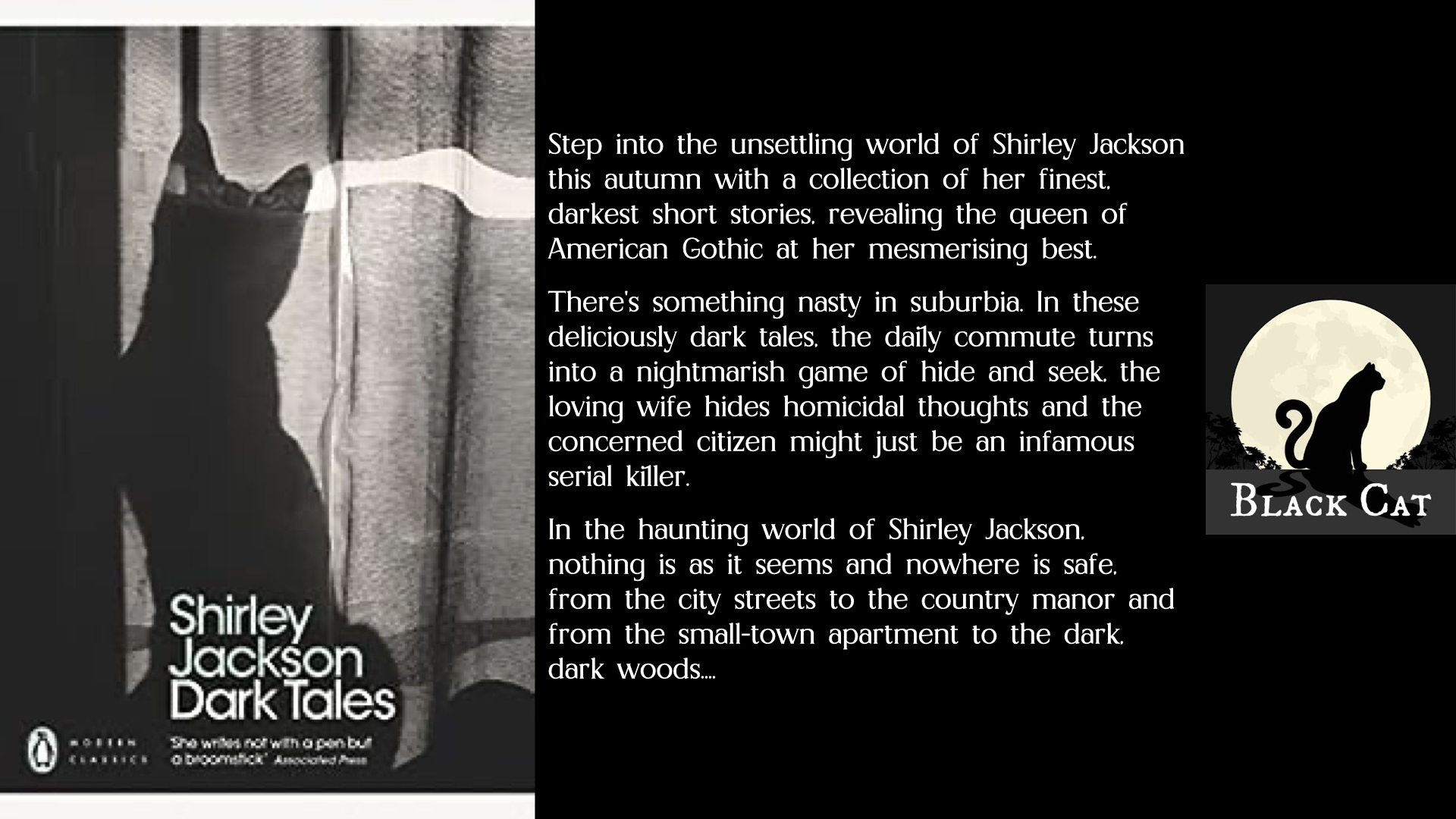
I’ve been meaning to read something by Shirley Jackson for some time. I’d meant to start with her best-known novel, ‘The Haunting Of Hill House‘ but my perception of it has already been coloured by the 1963 movie ‘The Haunting‘ which scared the hell out of me in my teens, so I decided to start with a collection of her short stories.
The title ‘Dark Tales’ is a clue to the broad scope covered by the seventeen stories in the collection.
They’re not horror stories. They’re not built to make the hairs on the back of your neck stand up, at least, not at first.
They’re stories that you recognise immediately as being a little ‘off’ in a way that disturbs you even though you can’t name the source of your unease and the longer that inability to name what is wrong continues, the more disturbing the stories become.
These are stories that wear ordinariness like a mask. It’s an ordinariness that you immediately distrust, a normality that triggers a sort of uncanny valley response that is quietly unnerving.
These stories have barbs that bury themselves in your imagination, making them hard to forget. This a partly because each story has something dark and surprising curled around its heart, partly because I spent so much energy trying to work out what was ‘off’ about each story (think about how tiring it is to be constantly looking over your shoulder for something you know is following you but which you never catch a glimpse of) and partly because some stories never fully explain themselves, leaving my imagination wrestling with the unease that they’ve left behind
I recommend this collection to anyone who wants to read stories that will unsettle and discomfort them and make them think about the darkness that waits below the surface of the things we think of as normal.
I’ve commented on each of the stories below. I don’t think there are any spoilers but some of the comments will make more sense once you’ve read the story.
The Possibility Of Evil
The title warned me to look for evil, even though all I was seeing was an old spinster lady walking through the small town that her family has lived in for generations and stopping to talk with the people she meets on the way to the shops. Slowly, I started to suspect where the evil lay. It was shocking and surprising and unpleasant. It was also misleading, for the most evil thing came from an unexpected source, right at the end of the story. It was a small thing in some ways but deeply, heartlessly cruel and it made me see that the small town held more possibilities for evil than I had considered.
Louisa, Please Come Home
This story has a pleasant, upbeat tone. The narrator thinks well of herself and the story shares and celebrates her success and cleverness. Yet, all the way through, I kept waiting for the second shoe to drop. For the bad thing to happen. For the flaw in her success to be revealed. The resolution, when it came, wasn’t what I expected. The tragedy at the heart of the story was in what was lost and how it had been lost. It was a tragedy that was amplified because I could see that, in a less dramatic form, it was the kind of loss that often befalls families and which they can do nothing about.
Paranoia
This story didn’t work for me. It was disturbing without being satisfying. I’d have liked to have skipped it but the prose acted like flypaper and kept glued to it to the end. This was the first story with a man as the main character and I found that I didn’t believe in him so I struggled to care about what happened to him. I also had the impression that Shirley Jackson didn’t like him and was enjoying doing the writer’s equivalent of sticking pins in the voodoo doll of his character.
The Honeymoon Of Mrs Smith
This is a great example of the ordinary made strange in order to reveal a darkness that lurks in the corners of the lives of many women. It left me with a lot to think about.
It’s a slight, lightly-told but very affecting story about a woman who has surrendered herself to her fate and is almost grateful to have done so and about her neighbours who can see what’s coming but who take no action either because they are embarrassed, or they’re worried that they might be wrong, or because they think the woman ought to know better. The darkest secret of all, the one they won’t admit to themselves, is that they want to be right about what will happen next.
The Story We Used To Tell
This story smells of resignation and hopelessness, although the source of the despair can’t be seen at first. It was a smell that became so much part of the background that, as I got caught up in what I thought was a familiar plot told in a new way, I let myself ignore it. Which is why, when the source of the despair became clear and all hope died, I shook my head and thought: “Well, I was warned, but still, I didn’t expect…’
It’s another story that makes me think that Shirley Jackson’s stories are traps that she leads her readers into, like a malign will-o’-the-wisp.
The Sorcerer’s Apprentice
I didn’t get this one. It felt like a sketch for a painting not yet begun.
Jack The Ripper
This is a dark story, made more terrible by being told as if it were a simple narrative of everyday life. I almost believed the ‘There’s nothing to see here but a wannabe good Samaritan, folks’ pitch but by now I’m watching for clues to the twist I know will come and I found myself unable to let go of this sentence:
“It was long past midnight, and the streets were as nearly deserted as they ever get; as the man went down the dark street he stopped for a minute, thinking he saw a dead girl on the sidewalk”.
That was enough to have me asking: “Why is he walking down these dark, empty streets so late at night and why would he assume the girl was dead?”
Shirley Jackson floats questions like those the way a fly fisherman drops a lure.
The part that stuck with me the most was sliding the photo into the corner of the picture frame. It was so domestic on the surface and so twisted underneath.
The Beautiful Stranger
Well, this was weird. Like a poem that sparks an emotional reaction that I can’t map directly to the text that created it. I felt this woman’s longing for change, her need for freedom and her distress as she starts to lose her grip and yet the details of the story make no more sense than a dream that you awake from with relief.
All She Said Was Yes
This is a great example of how to tell a story through the eyes of a narrator even though it’s a story the narrator herself can’t see.
The woman telling this story thinks well of herself yet, with almost every other sentence, shows herself to be petty-minded and selfish. There’s no real malice there but there’s also only the illusion of kindness and compassion. She has created a worldview, with herself at the centre, that is so robust that it has become a hermetically sealed bubble, impervious to any data that is inconsistent with her beliefs.
Mischievously, Shirley Jackson places a girl at the centre of this story who has a gift for seeing the future but, as it’s a future that the narrator doesn’t want to be true, it remains invisible to her.
What A Thought
Ever had an outrageous thought pop, unbidden, into your head? A thought that you’d like to disown but if it’s not your thought then whose is it?
Here’s the thought that popped into Margret’s head as she flipped through the pages of her book, sitting with her husband after dinner:
“She knew that if she asked her husband to take her to a movie, or out for a ride, or to play gin rummy, he would smile at her and agree; he was always willing to do things to please her, still, after ten years of marriage. An odd thought crossed her mind: she would pick up the heavy glass ashtray and smash her husband over the head with it.
Jackson, Shirley. Dark Tales (Penguin Modern Classics) (p.94) . Penguin Books Ltd. Kindle Edition
Watching what she did with the thought or, perhaps, what it did with her, was fascinating.
The Bus
I was hooked by that mix of anger, impotence, exhaustion and vulnerability that travelling sometimes brings with it. Where it ended up took me by surprise. This would have made a great Twilight Zone episode.
Family Treasures
This is so slight, told with a light touch and deftly avoiding any of the most obvious outcomes and yet it manages to dissect the dynamics the privacies, privileges and rivalries of a college dorm. I liked the odd but credible shape of the main character’s grief and the way she used her social invisibility to undermine the people who discounted her.
A Visit
This story starts with a marked change in style. I love the long, liquid sentences of the first paragraph in which words seem to cascade over one other. Here’s the text:
The house in itself was, even before anything had happened there, as lovely a thing as she had ever seen. Set among its lavish grounds, with a park and a river and a wooded hill surrounding it, and carefully planned and tended gardens close upon all sides, it lay upon the hills as though it were something too precious to be seen by everyone; Margaret’s very coming there had been a product of such elaborate arrangement, and such letters to and fro, and such meetings and hopings and wishings, that when she alighted with Carla Rhodes at the doorway of Carla’s home, she felt that she too had come home, to a place striven for and earned. Carla stopped before the doorway and stood for a minute, looking first behind her, at the vast reaching gardens and the green lawn going down to the river, and the soft hills beyond, and then at the perfect grace of the house, showing so clearly the long-boned structure within, the curving staircases and the arched doorways and the tall thin lines of steadying beams, all of it resting back against the hills, and up, past rows of windows and the flying lines of the roof, on, to the tower – Carla stopped, and looked, and smiled, and then turned and said, ‘Welcome, Margaret.’
Jackson, Shrilly. Dark Tales (Penguin Modern Classics) (p.126). Penguin Books Ltd. Kindle Edition
I love the unease that runs through this story, like a draft of cold air around the ankles or something that can be seen only from the corner of one’s eye or a smell, unidentifiable but unpleasant and out of place.
The ending is very clever. It left my imagination howling. It also left me feeling as if I’d never quite be able to step away from that story.
The Good Wife
At the end of this, I don’t know how much was real and how much was imagined but the smell of jealousy spreading like gangrene through a marriage was unmistakable.
The Man In The Woods
This one did nothing for me. I suspect there’s a link to ancient myths that I’m missing but my imagination could find no traction in this fairy tale.
Home
An odd thing to say about a ghost story perhaps, but this one made me smile. Not that it’s humorous or whimsical but because I think it’s the first ghost story I’ve read where I can imagine everything happening in the scary but low-key way it did in the story.
The Summer People
I love how this slips slowly from quaint to threatening to doomed with a chilling lack of melodrama.
 Mike Finn's Fiction
What a great post, Mike! I’ve just made my way over to catch up your blog. I am putting this on my personal wish list – I’m a huge Shirley Jackson fan.
LikeLike
THanks, Christine, I think this should be on the shelves of anyone who loves dark short stories. The made me wish I could wirte like her. I hope you enjoy them when you get to them.
LikeLike