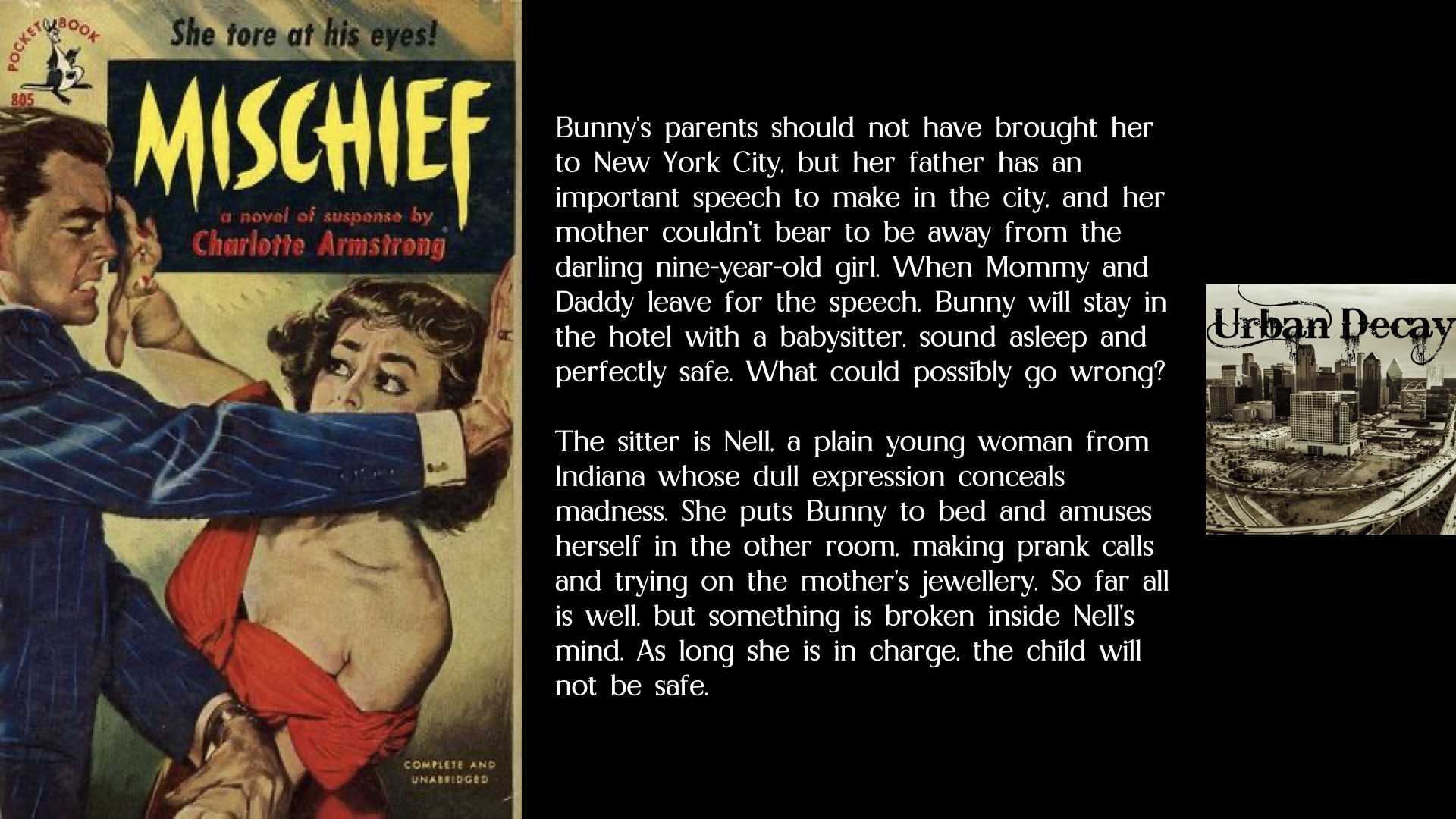
Wow, this was good! It’s a tightly focused, tense, suspenseful, unpredictable tale of a single evening of threat to a nine-year-old girl from an unstable and sometimes violent babysitter.
The first couple of chapters, which set up the situation, felt a little slow, partly because the description of the happy family seemed a little saccharine to my jaded eyes and partly because I had to adjust to a 1950s white middle-class American version of what constituted a happily married couple. Once the babysitter was in play, everything changed. I became completely absorbed in the action and was on the edge of my seat until the end.
The story takes place in a downtown hotel on a night when an out-of-town couple are attending a formal dinner at which the husband is the main speaker. The couple have booked two connecting rooms, one for themselves and one for Bunny, their nine-year-old daughter. They’ve arranged for Bunny’s aunt to come to the hotel and sit with her until they get back. The aunt cancels at the last minute and, desperate to get to the dinner, the husband hires Nell Munro, the nineteen-year-old niece of the garrulous but deferential guy running the elevator, as a babysitter. The mother thinks the girl is a little odd but puts it down to shyness. The couple leave and the psychotic nature of the babysitter starts to emerge.
It starts when Nell catches the attention of a man in the room opposite hers and invites him over for a drink. His name is Jed Towers. It’s his last night in town. He’s just returned to his room after an argument with his girlfriend. He’s angry and, when he sees Nell in the window opposite his, thinks he’s found a way to rescue the evening.
What happens next lived up to the title Mischief, or at least what that word originally meant: playful malice resulting in misery. Charlotte Armstrong has created a truly chaotic and threatening situation where any sense of control or normality is a delusion. You know bad things are going to happen but you don’t know what or when. What makes this more threatening is that there is no rational motive behind these actions, making them unpredictable and sinister.
I liked that the agent of this chaos comes not from the large angry man but from a small woman with strong urges and no concept of consequences. Nell isn’t evil. She’s more like a force of nature: like an avalanche or a flood or a lightning bolt.
For the most part, I didn’t like Jed Towers. But then, he didn’t like himself much either. He’s angry and bitter and tends to let his temper get the better of him, but Armstrong didn’t write him off. She gave him a brain and a conscience (even if he kept the latter locked away most of the time because he saw it as a weakness). Towers eventually realises that something is off about Nell. He sees her as living entirely in the present tense. I liked the way he thought through the implications of that:
“It crossed the level of his mind where slang was not the language that there is something wild about total immersion in the present tense. What if the restraint of the future didn’t exist? What if you never said to yourself, “I’d better not. I’ll be in trouble if I do”? You’d be wild, all right. Capricious, unpredictable . . . absolutely wild.”
Armstrong structured the chapters of the story so that we see the actions from multiple points of view: Jed Towers who is slowly becoming aware that he’s gotten himself into trouble and should leave but who can’t bring himself to abandon the little girl, Jed’s girlfriend who has come to the hotel to try and rescue their relationship, the timid but concerned librarian from the room opposite Bunny’s who knows something bad is happening to the little girl and Bunny’s mother, who, when she should be basking in the reflected glory of her husband’s well-received speech and f, is growing increasingly anxious about her daughter. Thankfully, we never get inside Nell’s head. Seeing her from the outside was disturbing enough.
Armstrong maintains the tension in the story by switching between points of view at key moments, leaving each line of action in suspense while letting the reader see that the lines of action are going to converge and that the result is likely to be a dramatic and probably violent collision.
I had a lot of fun with this book. I felt as if I’d found a new Hitchcock movie to watch. One made more exciting because I didn’t know how it would end. When I finished it, I felt exhilarated. It was a tense, perfectly paced story that was exciting and unpredictable and yet still thoughtful.
I want to read more of Charlotte Armstrong’s novels. I’ve already downloaded A Dram Of Poison. which won the Edgar Award for Best Novel (1957).
Charlotte Armstrong Lewi was an American writer. Under the names Charlotte Armstrong and Jo Valentine she wrote twenty-nine novels, as well as short stories, plays, and screenplays and published three poems in the New Yorker magazine..
She also worked for The New York Times‘ advertising department, as a fashion reporter for Breath of the Avenue (a buyer’s guide), and in an accounting firm.

 Mike Finn's Fiction
One thought on “‘Mischief’ by Charlotte Armstrong – a wonderfully tense 1950s thriller”