
I recently saw this schema for organising the books in my library:
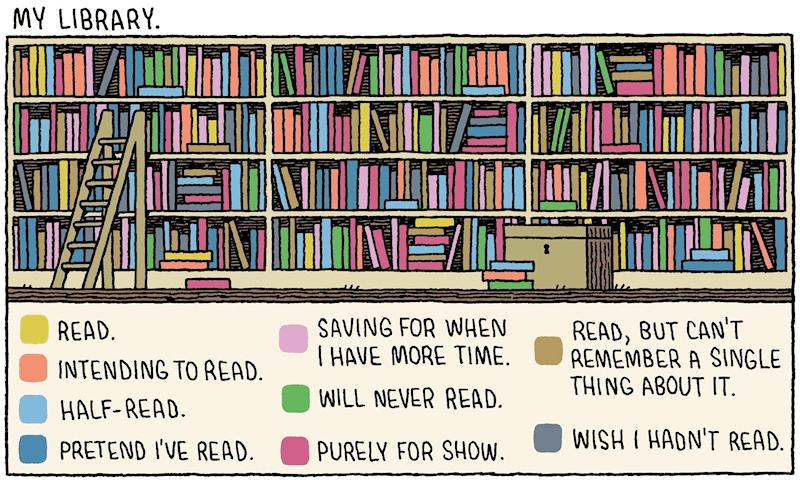
The ‘READ, BUT CAN’T REMEMBER A SINGLE THING ABOUT IT’ catagory got me wondering about how many of the books I read in year really stick in my memory.
To answer the question, I decided to go back a decade and see if any of the books I read in 2013 still stand out for me. I found five that are still very fresh in my memory so I thought I’d share them here.

A Secret Rage is one of my favourite Charlaine Harris novel. It’s a hard-hitting, unflinching look at what rape is, what it does to the people it is inflicted on and to the people around them.
The rape scene is brutal and vivid without being exploitative. The descriptions of the impact of the rape, of the rage it produces, of the scars it leaves, of the bravery needed to face it and the love needed to respond to it are emotionally hard-hitting because they feel authentic and unfiltered.
This is a novel with an agenda: no woman deserves to be raped and no rapist should be allowed to go unpunished.
It is also a story about how women can help and support each other or how they can inflict more pain through shame and blame.
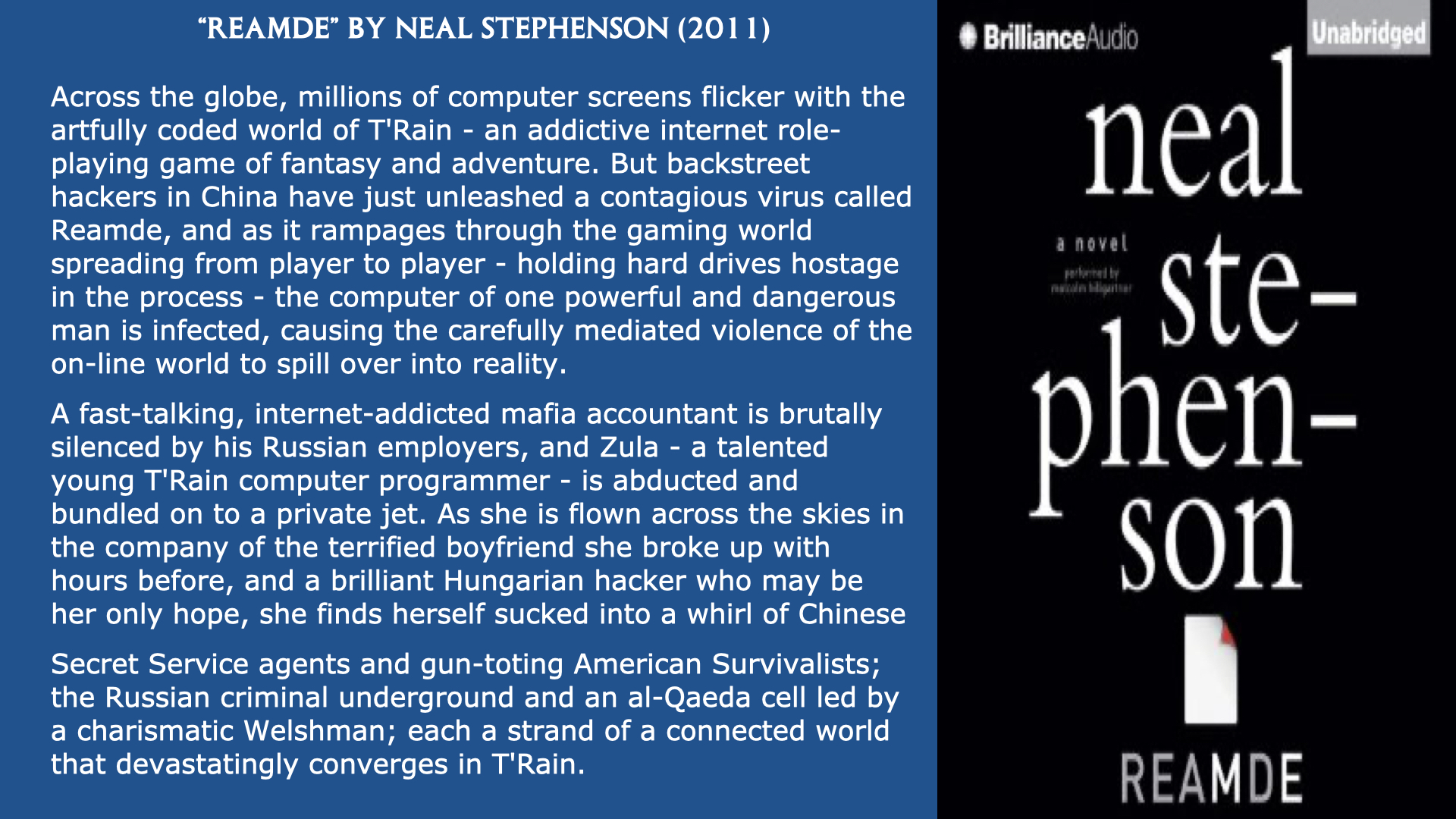
Reamde is more than 34 hours long and I still regretted reaching the end. The opening chapter reads like something from John Irving or Richard Russo. It establishes Richard Forthrast, online war game billionaire and former smuggler, in the context of his Iowa farming clan family which covers the American spectrum from “American Taliban” Freemen, living off the grid, through Vietnam vets working the farms to Zula, Richard’s adopted Eritrean niece. The home team here is American in all its flavours, but the game is played, both online and in real life, on a global stage, stretching through Canada, China, and the Philippines, with characters from the Russian, the UK (a half-chinese British spy, a Scottish fraudster and a black Welsh Jihadist), Hungary, and China.
The plot is complex but clear and its twists and turns are driven as much by the characters as it is by the underlying situation. The themes are rich and rewarding: the links between the cyberworld and real life, the nature of money and power, the clash of cultures between the West and the rest, the power of friendship, the limitations of money and the value of honour in uncertain times.
In the end I wondered if the on-line game was really so important to it all. Then I slapped my forehead, gave the obligatory Simpson’s “Duh!” and realised that that was perhaps Stephenson’s main message: of all the kinds of reality that are out there, the one that matters most is the one where you do anything you have to to make those you love safe.

The Bone Season was a publishing sensation in 2013 but I thought it lived up to the hype. It is a rich, complex book filled with original ideas, vivid characters, powerful emotions, gritty realism and page-turning action.
Shannon’s alternative future Britain is fully thought through and skilfully evoked. She weaves her tale from a deep understanding of the politics of hatred and fear and the fundamental evil of slavery and brightens it with new ideas on the nature of magic.
What makes the book truly exceptional is the character of Paige Mahoney, brave, dangerous, more than a little broken but fundamentally good. She is easy to care about and root for. Her way of seeing the world is humane without being in the least bit soft. Her bravery comes from a refusal to submit to fear or to be treated as anything less than human. Even when everything has been taken from her, she holds on to the power that comes from knowing what she values and what she is prepared to do to protect it.

Rivers Of London was my first encounter with a series that I’m still following eagerly ten years later. What attracted me to the book was how deeply rooted it was in contemporary, multicultural, London, with a strong sense of place and of history that is polished and intensified through the lens of the tongue-in-cheek political correctness of the Metropolitan Police, and garlanded with figures from London myth who are at once as modern and as ancient as the city itself.
Wit was sprinkled like hot sauce throughout this books with references to contemporary fiction (Black Adder, Twilight, Harry Potter, Coronation Street), colourful similes, clever wordplay and a well-developed sense of the absurdity of daily life.
It was an optimistic, civilized, book, filled with chaos and compromise and unspoken agreements and recognition of subtle affiliations. Our hero does the right thing by being himself, taking care of his friends, showing pride but being respectful and muddling through until the job is done. I found the whole thing wonderfully British, or at least, how I would like being British to be.
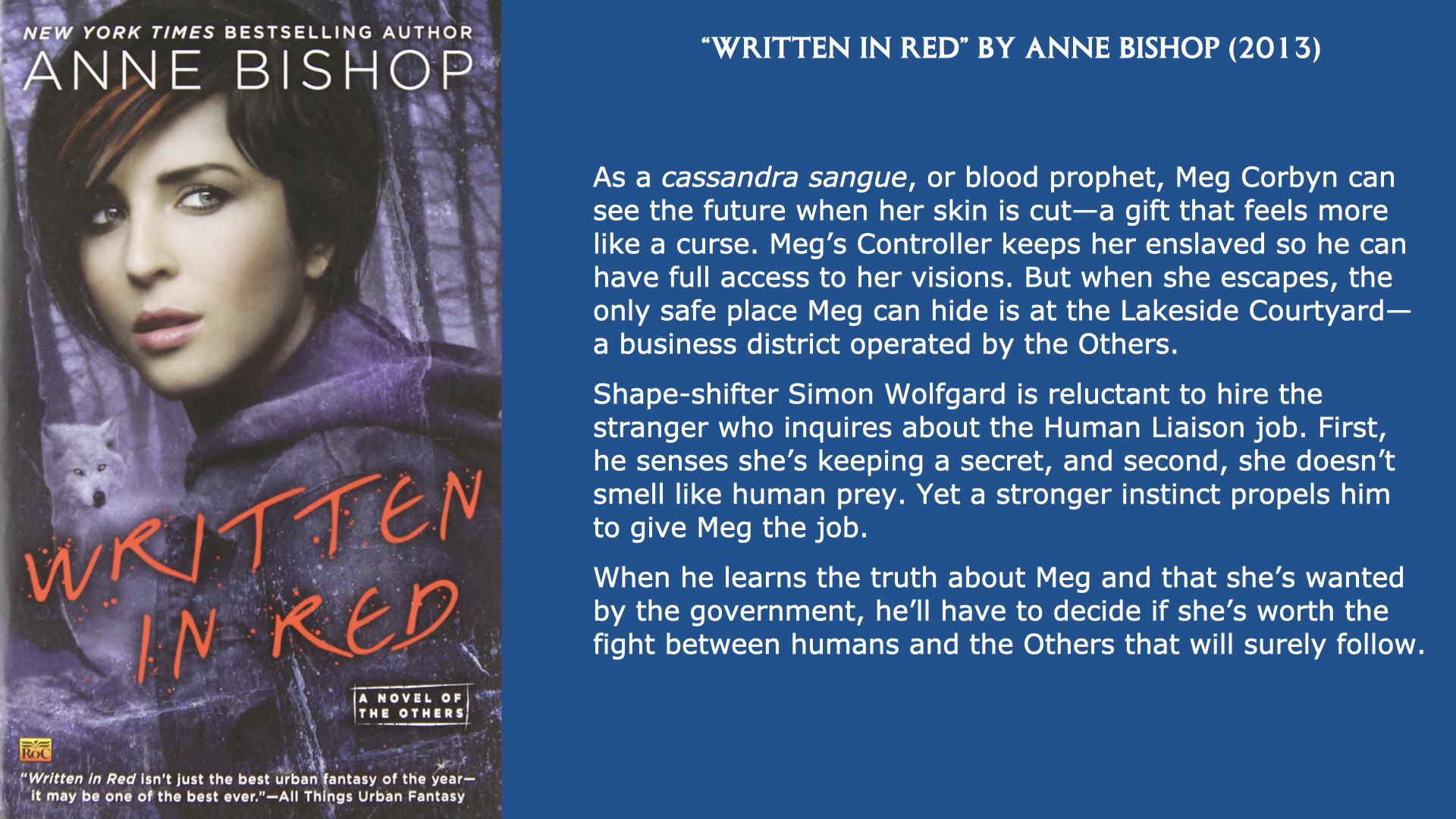
Written in Red was my favourite book of 2013. I fell immediately and deeply in love with Meg Corbyn and the world of the Others and I read every book in the series and in the Lake Silence series that followed it.
In my view Written In Red is closer to classic science fiction than it is to urban fantasy. Anne Bishop isn’t writing about supernatural creatures roaming city streets. She’s created an alternative reality, imagined the way good science fiction should be: starting with two small changes to our familiar reality – humans are not at the top of the food chain and shapeshifters are not only real but dominant – while keeping everything else the same and then working through the consequences. She then delivers complex, credible, I’m-hungry-to-know-more world-buidling in simple prose. But what makes this book unmissable is the way she made her world real to me by creating characters I cared about and putting them in peril.
The Others in “Written In Red” can be described as werewolves or vampires or even werecrows but Anne Bishop only uses the familiar tropes to twist away from them. The Others are not humans who shift into wolves. They are wolves who occasionally choose to put on human skin. The Others are fundamentally alien. They literally eat humans that displease them. They are fiercely loyal to each other. They have a strong sense of pack or flock or hierarchy. They are civilized but they are not at all like us.
The plot is driven by an act of kindness by the Others. They take Meg Corbyn, a homeless waif with a secret into their Courtyard as their “Human Liaison” and the history of the world starts to pivot. Meg is engaging vulnerable, empathetic, curious, kind, and dutiful. Her innocence is explained by her sequestered life as a cassandra sangue, a woman who can see the future if her is skin is sliced. That she is kind and extremely likable is explained only by the fact that she is Meg.
Anne Bishop’s alternative reality is as dark and threatening as an ancient forest. Immediately after reading the book, I might have said that the darkness came from the constant threat the Others pose to humans, but the darkest image lingering in my imagination is Meg’s razor: the one with her number on it, the one that was used to slice her skin to force her visions, the only thing she carried with her to her new freedom. The razor is a source pain and pleasure, a sign of slavery and a badge of honour, a bone-deep fear and a heart-felt desire. The razor and all it means, makes Meg Corbyn much darker than she first appears to be. In many ways it brings her closer to being one of the Others and makes her disturbing as well as engaging.
 Mike Finn's Fiction
Great idea for a post!
LikeLiked by 1 person
Thank you
LikeLiked by 1 person
Have you read Before You Knew My Name? Your comments on A Secret Rage make me think you might appreciate it.
Also, great idea for a post.
LikeLike