
Stephen King is one of those rare authors who can produce large numbers of long novels and multiple collections of short stories. It seems to me that the two forms require different skills and approaches from writers. Stephen King seems to revel in the challenges each form presents.
I enjoy his novels but I particularly admire his short stories. I love their originality and discipline and King’s skill at pulling me into even the strangest ideas and making them feel not just possible but likely. Perhaps my favourite thing about his short fiction is that each story has its own voice, usually linked to the experience of a main character. The range of voices the stories have is very wide. Sometimes I fall in love with the voice or feel as though I shared part of a friend’s life. Sometimes I disdain or even despise the voice and hope the person gets what’s coming to them but even then, I feel as though I’ve met someone real.
The If It Bleeds collection is 449 pages long and has only four stories, with the title story taking up almost half of the book. I enjoyed all of them so I’ve reviewed each story below.
I recommend the audiobook version. The narrators, Will Patton, Steven Weber, and Danny Burstein, did a wonderful job of bringing the voice of each story to my ear and my imagination.
I’ve put If It Bleeds first even though it’s the third story in the book because it seems to me that this is the work of Stephen King’s heart.
It’s a thriller that runs with the idea, “What if there was more than one creature like The Outsider praying on humanity, only with slightly different abilities and needs?”
It’s a great story with lots of tension, more than a few surprises and a growing sense of threat. It starts with heartbreaking carnage and moves on to an investigation of the kind of TV news reporter jackal that is always to be found at the sites of tragedies, pushing microphones into the faces of the grieving and the shocked and asking them how they feel.
What animated the story and kept me engaged and needing to know more was the involvement of Holly Gibney. In the Author’s Notes at the end of the book, Steven King says that he’s fallen in love with Holly, which is why she had moved from what was meant to be a minor character in Mr Mercedes to a major figure in four novels by the time he was writing If It Bleeds and it seems to me that this story is powered by Steven King’s desire to find out more about her by seeing how she would handle her first solo case.
That worked for me. I find Molly Gibney fascinating. Her quiet. her focus and her bravery make her compelling. They also make her vulnerable, which is a major source of anxiety in the story as she insists on repeatedly putting herself in harm’s way. It also makes her hard to predict. I was blindsided by the plan she executed and was tense through the whole thing,
I listened to If It Bleeds on a long car journey that wasn’t quite long enough to finish the story so my wife and I spent the rest of the evening listening to the conclusion of the story. I’m now looking forward to reading King’s latest book Holly which is sitting in my TBR pile.
This story made me smile. Yeah, I know that may seem odd when the story has echoes of The Fall Of The House Of Usher with an iPhone ringing in the coffin of a recently buried man, but the tone of the story is nostalgic and is as much about a man looking back on his youth and recapturing his sense of hope and possibility as it is about him feeling disturbed by the supernatural or guilty about the violence that he unleashed.
Stephen King has a knack for capturing the moments in a person’s life that mark the point where they took a decision or committed an act that redefined or perhaps revealed who they were. He does it here beautifully. I love that he didn’t rush, that he let me share the fairly ordinary life of a young boy in a small town who ends up getting to know the rich old man in the big house before anything strange happened.
Then he swept me forward on a wave of nostalgia for the times (which I remember well) when the iPhone was a new invention, pushing the Blackberry to one side and putting the Internet and all the possibilities that it offered, into everyone’s pocket. It was fun watching the young boy and the old man imagining the emergence of things that we now take for granted.
I loved that the young boy had no agenda and the old man was not an early-adopter tech fanboy but an old-time businessman able to spot an opportunity and squeeze the value out of it. The relationship between the two of them was unusual but plausible and touching in its way.
Only when all of this was in place did King add the woo-woo factor and when he did, it wasn’t a sudden flip into the supernatural, it was more a slow slide into the unexplained. The events were ambiguous enough to be open to interpretation. The interpretation that the boy placed on them, the actions that he took and the accountability that he accepted were the things that defined the sort of man he was trying to be.
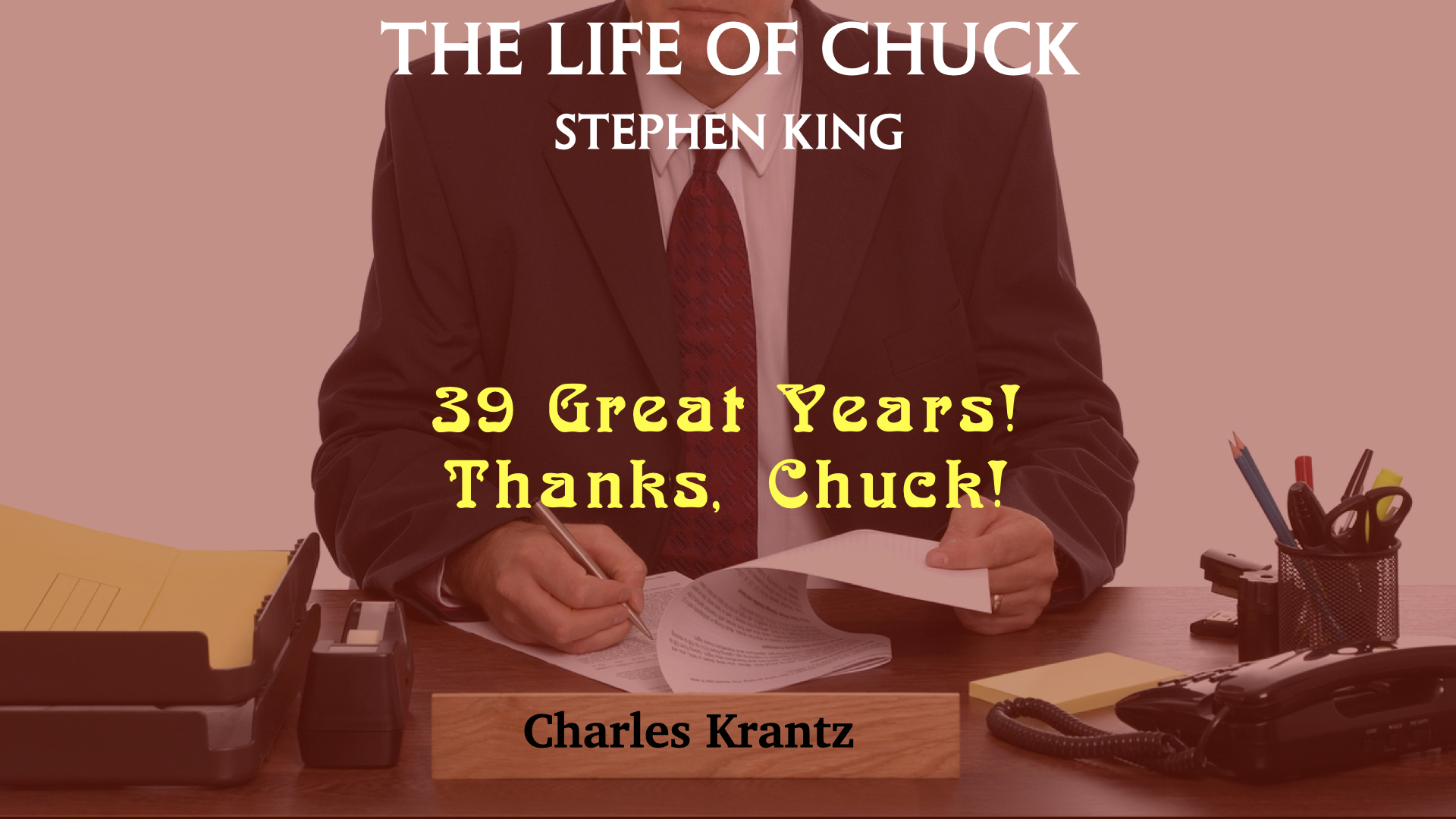
The Life Of Chuck is a bracelet linking three story gems about Charles (Chuck) Krantz. They start at the end of his life and move backwards towards his childhood. I wasn’t sure at first that the linkages worked. Each story worked well, each was very different to the others in terms of tone and content and each burrowed into my imagination. In the end, I decided that the linkage, the idea that each life contains a whole world, that when a person dies, a library burns, did work and that I quite liked being made to think about it rather than have it spooned to me.
The first part of the story reminded me of some of Ray Bradbury’s Science Fiction. Something strange and potentially apocalyptic was going on. All the now familiar signs of the end of life as we know it were there and I thought I was on familiar ground except, like the people in the story, I couldn’t figure out the ubiquitous presence of a message saying ’39 great years!Thanks, Chuck!’. To work it out, I had to expand my thinking and step outside the framework of an apocalypse and then I was left going, ‘Wow! What an idea.”
If the story had ended there, it would still have been memorable but it went on and became even better.
The middle section was a joy. It showed me Charles Krantz at a moment that may have been the apex of his experience. Charles, a middle-aged accountant in the big city for a conference encounters a busker drumming in the street and, with uncharacteristic spontaneity, gives himself up to dancing. I don’t dance, I’ve never had the knack of it, but Stephen King made me feel as if I could dance and lose myself in the music and create a moment that was joyful beyond words. A small act of magic. At the end of it, I wanted to say, “Thanks, Chuck!”.
The final section shows the orphaned teenage Chuck living with his grandparents in their old Victorian house with a cupola that is always kept padlocked shut, which his grandmother won’t speak of and his grandfather speaks of only once and with deep regret, when in his cups. The cupola and what it contained was where the woo-woo factor came in. It was another fascinating idea, made more powerful by the depth of the relationships between Chuck and his grandparents and it linked back to the first story in an unexpected and thought-provoking way.
Mike Flanagan is currently making a movie version of The Life Of Chuck, starring Tom Hiddleston. I struggle to imagine how this story could be adapted to the screen but Stephen King and Mike Flanagan share the writing credits so something interesting should come out the other side.
Rat was a story that I admired but struggled to like because I disliked the main character and I spent the entire story inside his head.
Rat is the story of a writer who has never been able to make the jump from short story to novel writing. Previously, this failure has destroyed his mental health and put his marriage and his home at risk yet, when an idea for a novel springs fully formed into his imagination one day, he becomes obsessed with it and has to head up to a remote cabin in the woods to get the novel on paper.
I admired the story for three reasons.
Firstly, it’s an up-close and personal exploration of the mental health problems that come from a cocktail of obsession, performance anxiety, self imposed isolation. I didn’t like the guy. He was selfish, pompous, lied easily and often to his wife and himself and he didn’t seem to be able to learn from his experience or to take responsibility for his actions. I couldn’t feel sorry for him. At times I wanted to slap him. Even so, Stephen King helped me to see that a lot of what was going on for him was a form of mental illness that he conflated with creativity and refused to seek help for.
Secondly, I enjoyed King’s description of the experience of trying to write a novel. I could feel some empathy with the writer’s desire to get his idea from his head onto the page. I knew that his claim that the idea was so clear in his mind that writing the book would be “like taking dicatation” was self-deception. I enjoyed the way King showed the work involved even when you’re in the zone, the words are flowing freely and the story is taking on a life of its own. Then, when the writer fell into the creativity pit, unable to climb out because he could not choose between the many different ways in which an idea could be expressed, I saw how writing could twist from a flow experience into a form of self-torture and how creativity could become mental illness.
Finally, I admired the Rat of the title. Mostly, I liked the ambiguity around whether it was real or partly real or just an artefact of the writer’s mental illness. Like the writer, I couldn’t quite settle on which of these options was true. What made me smile at the end of the story was the realisation that, in all the ways that matter, the writer was the rat.
 Mike Finn's Fiction
Great post
LikeLike
Thank you.
LikeLiked by 1 person
Welcome
LikeLike