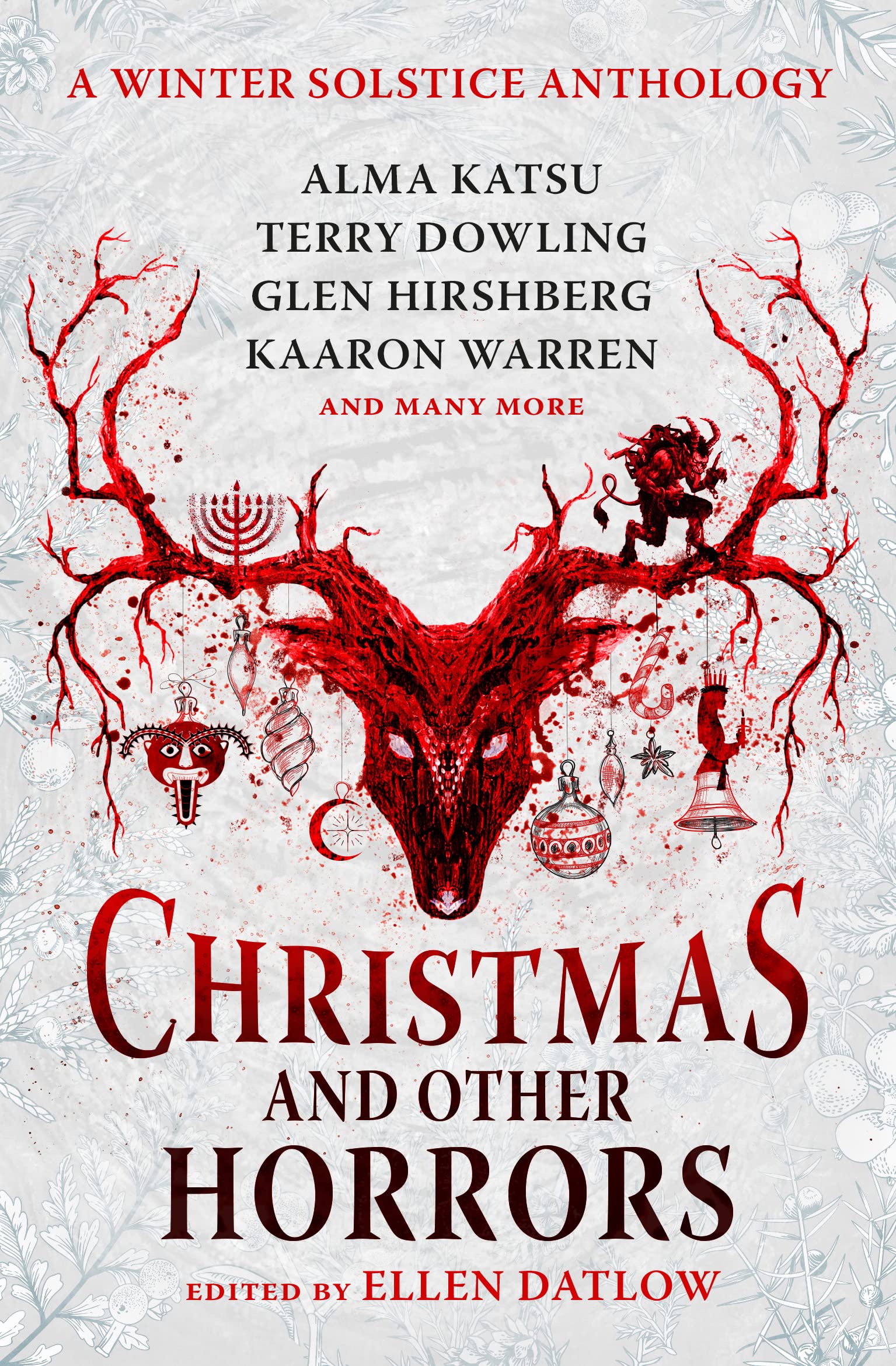
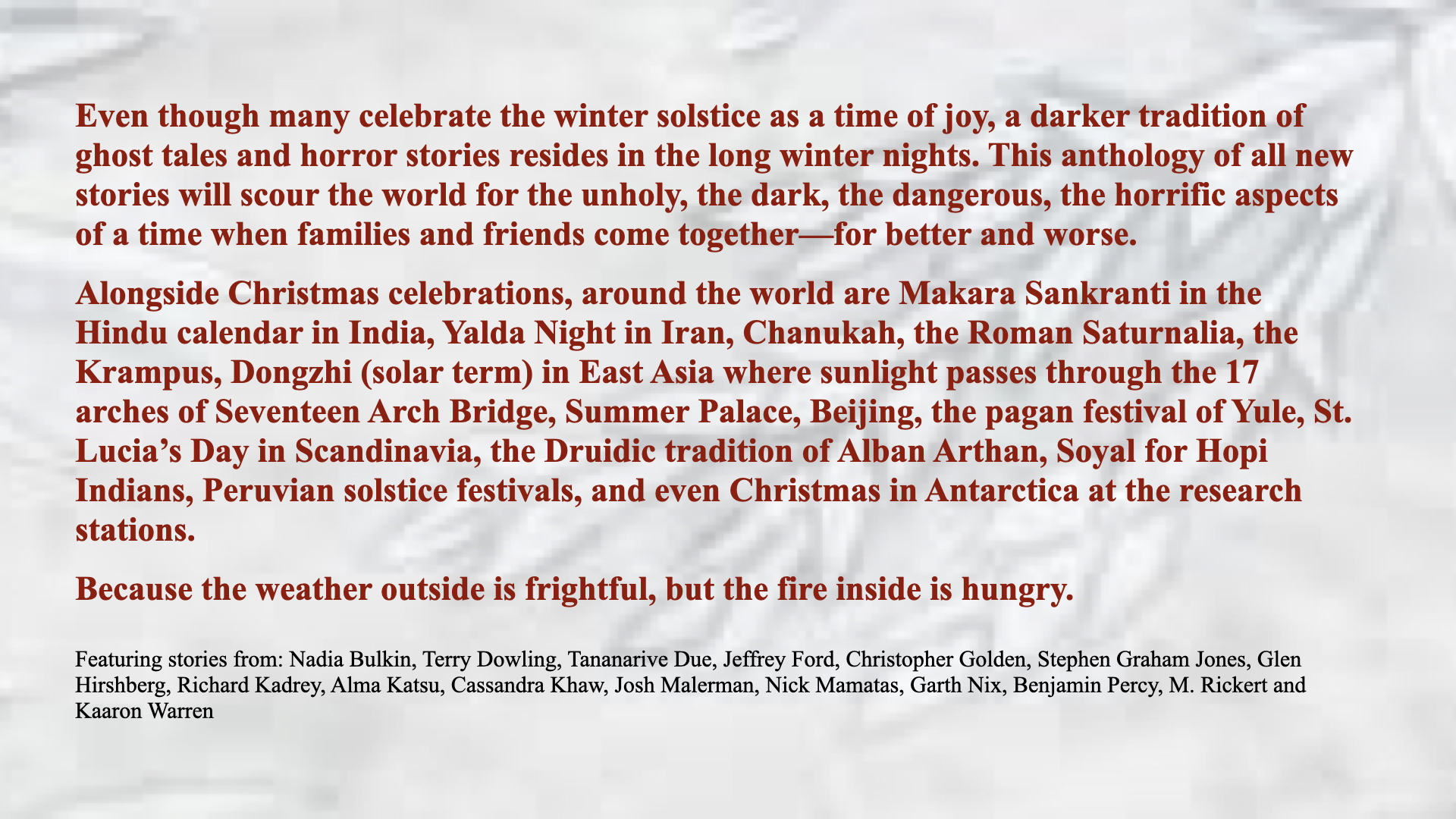
I ordered this book as soon as I heard about it. It was just as good as I’d hoped it would be but, like all the wonderful Christmas food, there turned out to be more of it than I could consume over Christmas. So here I am, on the day after Epiphany, looking back with pleasure on the nine stories that I read and packing away the rest to light up (or should that be darken?) next Christmas.
In this post, you’ll find a brief review of each of the first nine of the seventeen stories in the anthology. My favourites were by Alma Katsu, Terry Dowling, Glen Hirshbeg and Richard Kadrey.
I hope they encourage you to have this book in your stocking next Christmas.
‘The Importance Of A Tidy Home’ by Christopher Golden
In the first hours of 6th January 1973, in the freezing snow-covered streets of Salzberg, two homeless men encounter the Schnabelpertchten and learn the importance of keeping a tidy home on 12th night.
Lots of atmosphere in this shiver of a tale. It’s filled with strong, dark, blood-splattered images that speak of winter and fear. I liked the suspense of not knowing whether either homeless man would figure out how to survive.
‘The Ones He Takes’ by Benjamin Percy
So what does happen when you end up on Santa’s naughty list?
This is a dark idea, slowly revealed. Perhaps my palette is jaded but it didn’t gain traction with me, maybe because I couldn’t connect with the parents or their child. Santa, on the other hand, him I could easily imagine.
‘His Castle’ by Alma Katsu
Wassailers get more than they bargained for when they visit a remote Welsh cottage occupied by a couple who aren’t the tourists from London that they seem to be.
I loved this. It’s one of those stories where you know something is off from the start and the pleasure comes from watching the facade of normal being sliced away to reveal something abnormal and very dangerous beneath.
The pacing is perfect. The story is a heady mix of magic and social injust and violence that I found deeply satisfying.
‘The Mawkin Field’ by Terry Dowling
In the days leading up to the Summer Solstice in rural Australia, a strange driving by sees a working fridge in a farm field, chairs set next to, it facing up the hill, away from the road, to where the sun will set behind the trees. Is it an invitation? a puzzle? a lure? or perhaps a signpost for those who know how to read it? He stops to find out.
I loved the atmosphere of this tale about scarecrows and what they’re really for. There is an irresistible mixture of menace and acceptance and curiosity and wonder.
I like that the man in the story is aware of the strangeness that he’s stepped into and of all of the dark places that scarecrow tropes take strangers travelling alone and yet he chooses to keep coming back and to shape his story just as the story shapes him.
I admire that this story manages to be both subtle and vivid and that it stays cliché-free.
‘The Blessing Of The Waters’ by Nick Mamatas
What do you do when a Greek Orthodox priest doubts the relevance of the time-honouored rituals to appease the gods that his congregation brought from Greece to New York generations ago and cancels the Blessing Of The Waters in Long Island Sound
I’m not a fan of Lovecraftian stories like this one. I struggle to believe in old gods with tentacles threatening the world. But then, I’m an atheist so no gods worry me much.
To my surprise, I enjoyed this story, not so much for the horror aspects as for the way the story slowly slid me in an unexpected direction.
The hook caught me: Gus a Greek Orthodox priest, is drinking coffee in his kitchen late at night in the midst of winter, when he is visited by his mobbed-up son-in-law who has escaped from prison to come and talk with him.
Initially, I saw things from Gus’ point of view and was ready to assign all kinds of reckless and selfish motives to his son-in-law. Then, bit by bit, my perspective changed and I saw Gus quite differently.
‘Dry And Ready’ by Glen Hirshberg
A mother, daughter and grandmother travel to carry out a family Hannukah tradition that honours the memory of the grandfather. But not all of them see the ritual or the grandfather in the same way
I’d have bought the anthology just for this story. It’s beautifully written, finely nuanced and manages to be dark and disturbing without leaning heavily on the supernatural.
I love the way the relationships between the three generations of women were revealed through the mother’s thoughts and the daughter’s and grandmother’s actions, Although the three of them have travelled together to perform a familiar ritual, it’s clear that they all see the ritual and the man it’s focused on differently and those differences drive strong emotions.
For me, this story gave some interesting insights into how families form and hold memories and how rituals and traditions extend the reach of family lore between the generations. Most of all, it showed me how the bonds between these women are stronger than the pressures forcing them apart.
‘Last Drinks At Bondi Beach’ by Garth Nix
Does Bondi Beach say vampire to you? It might after reading this.
This one didn’t do it for me. It felt like a treatment for an episode of some TV Horrifying Tales show than a real story. The storytelling was focused on a big reveal that held no surprises for me. The characterisation was minimal. The ideas were fine. The location worked. Some of the scenes were vivid enough to be a mental storyboard. Overall though, it seemed insubstantial to me
‘Return To Bear Creek Lodge’ by Tananarive Due
Christmas isn’t fun when your mother drags you to the isolated home of the ailing grandmother who you are deeply afraid of. It’s worse when you discover the unnatural company your grandmother keeps and the hold she has over you mother and your uncle.
One of the reasons I bought this anthology was to get my first taste of Tananarive Due’s writing. ‘Return To Bear Creek Lodge’ left me hungry to read more of her work but dissatisifed with this particular story.
I loved the voice of the main character in this story. He felt real and immediate and was easy to engage with. All the scenes were vivid and the content was beyond creepy. I particularly liked the way the story showed how pain and guilt are passed between generations by the lies that are told and the truths that are silenced.
But…
…it didn’t read like a story to me. It read like a chapter from a novel. I like a story to have a beginning, a middle and an end, even if they’re not in that order. This was almost all middle. I was dropped into a boy’s experience of an event. It was a vivid and disturbing experience but it went nowhere. The ending, which moved from boy to young man, felt like a tidy-up rather than a conclusion. I could see this as a piece an author might write to get inside the head and the backstory of a key character in a novel but that doesn’t, for me at least, make it a good short story.
The Ghost Of Christmases Past’ by Richard Kadrey
What happened to Laura twenty Christmases ago that left her with a bite mark on her arm and a Christmas ritual of nailing shut her doors and windows and loading her shotgun? I didn’t guess but I enjoyed finding out.
This was a lot of fun. Gory, nasty, dark, impossible to resist fun. I had to know what happened to Laura to make her this way and what would happen to her this Christmas when she faces the ghost of Christmases past.
For me, everything worked in this story: the pacing, the imagery, the plot twists and the dark central idea, one common across many cultures but no less disturbing for that.
If ‘A Christmas Carol‘ has a dark shadow, a Black Peter to Dickens’ Santa Claus, then this is it.
 Mike Finn's Fiction