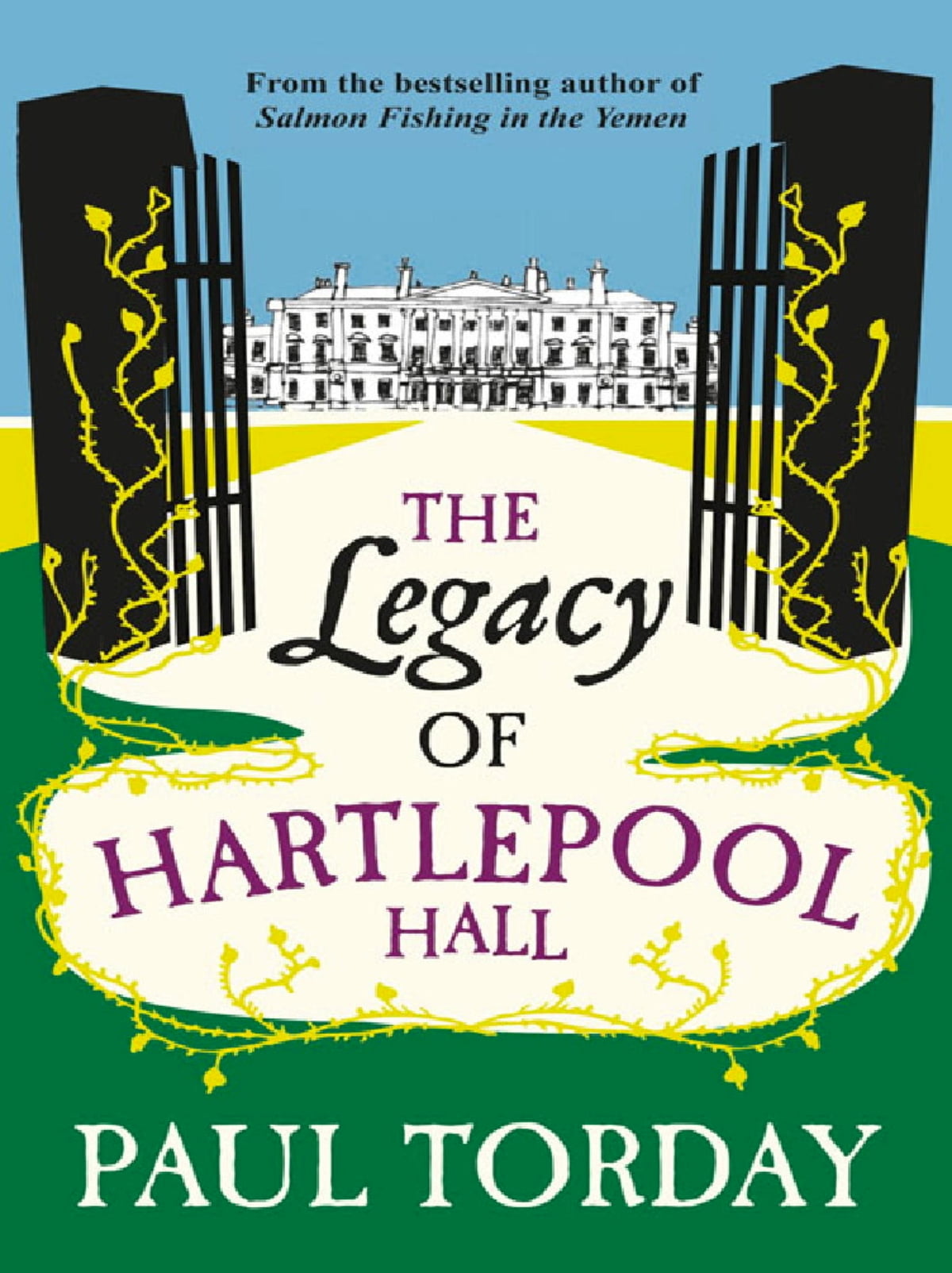
Ed Hartlepool has been living in self-imposed exile for five years, but with a settlement regarding his inheritance looming, he must return to his ancestral seat, Hartlepool Hall.
On his return, he discovers that his father has left him, along with the house, a seven million pound tax bill, two massive overdrafts, an 80-year-old butler, and a vast country estate that is creaking at the seams. Not only that, but there is a strange woman in residence – Lady Alice – who seems to have made herself very much at home.
With the debts mounting, it seems that Ed’s only recourse is to turn to his friend Annabel’s new boyfriend, a property developer who plans to turn Hartlepool Hall into luxury flats and a golf course. But can Ed save his inheritance without such a drastic move? And is Lady Alice really the person she claims to be?
‘The Legacy Of Hartlepool Hall‘ gave me more to think about than I’d expected. It rose above simple satire, declined to take sides in the class war and delivered instead a very human picture of what a legacy from previous generations can do to those born into wealth that is steadily declining. It is hard for me to summon empathy for the struggles of a middle-aged man born into wealth, who has never done anything with his life, not even gained an understanding of the sources and limits of his wealth.
Ed Hartlepool is too bland a man to be dislikable and too lazy a man to garner much sympathy but Paul Torday succeeds in making him a man who is free of malice and greed and who may, eventually, build a life for himself over which he exerts some agency.
I enjoyed the quiet humour of the book exposes absurdities without poking fun at everyone I admired the way it calmly lays out the lives of the rich and those who feed on them, like a butterfly pinned to a board.
The book has some darker moments. One of the main characters goes through a trauma that I initially thought stole her sanity from her. Later, it seemed to me that the trauma revealed who she really was and what she wanted.
I had wondered if this was going to be a sort of comic thriller, with Ed discovering his business acumen and coming up with a plan to make everything better. Paul Torday had something else in mind.
Although it uses gentle humour throughout the book, ‘The Legacy Of Hartlepool Hall‘ sets out to deliver a reflection on inherited wealth and the unsustainable expectations and duties that the current generation faces.
Ed’s struggle to deal with the accumulated debts of the Hartlepool estate shows how, in the course of the last three generations, his family has actively declined to acquire the skills and work ethic that generated the fortune in the first place. The Hall that was built as a vanity project providing concrete evidence of what the family had achieved has become an atavistic burden that binds the family so tightly to the past that they are unable to build a future.
The book also looks at how the expectation of inherited wealth tests the character of the people receiving it. Ed finally comes to the realisation that he might enjoy the freedom that comes from letting go of Inost) of his wealth and living a (financially secure, work-free) middle-class life. One of his friends, who is also waiting to inherit wealth is effectively enslaved by the wait and eventually cracks under the stain.
This is a gentle, well-observed book populated with characters that I recognised and believed in, that, in a low key often humorous way, questions the benefits of transmitting substantial weakth across generations.
 Mike Finn's Fiction