
Science Fiction was the first genre that I fell in love with. I started in the mid-1960s, before the first Apollo flight, back when it was thought that astronauts might not survive passing through the Van Allen Radiation Belts. The first novel I remember was ‘Blast Off At Woomera‘ (1960) by Hugh Walters, what we would now call a Young Adult book, about the first manned space flight. I’ve been hooked ever since.
I feel like I’ve been neglecting SF recently so I’ve been going through my TBR, looking for SF books that I haven’t gotten around to yet. This week I’ve picked out two Military SF books which have been on my shelves for a decade or so. They’re both by authors who I’ve read and enjoyed before, they’re both decades old and they both kick off series, one of which now stands at eighteen novels.
One of the things that I like about Military SF from this era is that it tends to be relatively bloodless (yeah, I know blood would boil in space and then freeze so there wouldn’t be a lot of splatter to see anyway) with the focus being on strategy and cunning and sometimes even talking to the enemy as a route to victory.
Both of the books I’ve picked are Space Operas designed to entertain rather than to be a platform for deep thought, so I’m looking forward to binging on tension, intrigue, creativity and a sheer bloodyminded refusal to lose.
‘On Basilisk Station’ (1992) by David Weber
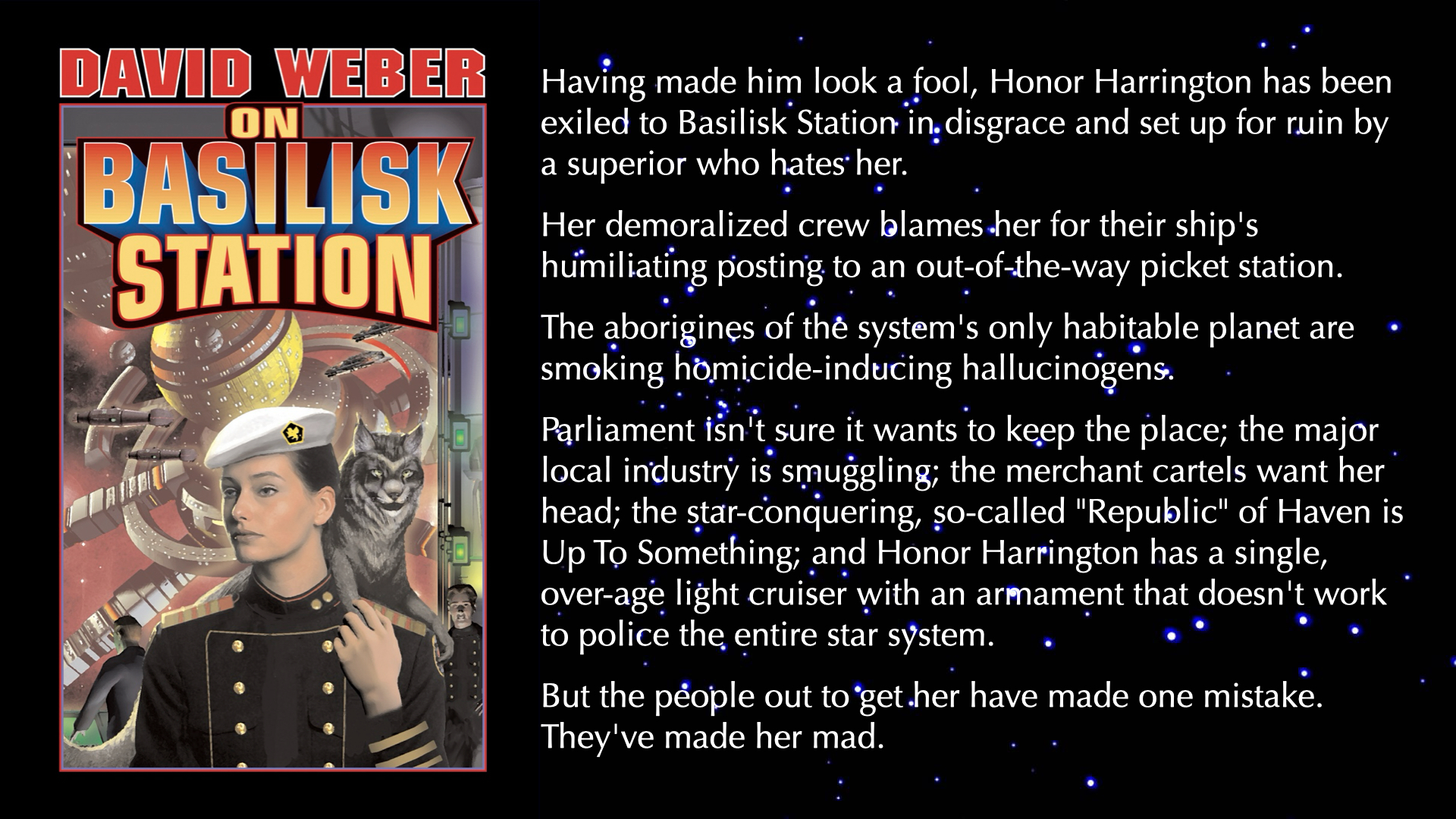
I somehow missed David Weber in the 90s. I discovered his writing in 2013 when I read the first two books of the Star Kingdom / Stephanie Harrington series ‘A Beautiful Friendship’ (2011) and ‘Fire Season‘ (2012). These are Young Adult books that are a prequel to the Honor Harrington series that David Weber is best known for. I also acquired the first two Honor Harrington books in 2013 ‘On Basilisk Station‘ (1992) and ‘The Honor Of The Queen‘ (1993) but, despite my enthusiasm, eleven years have passed without me reading them. Thanks to my 2024 TBR Challenge, I’m going to change that now and dive into a Space Opera that was published when Star Trek TNG was on our screens.
There are seventeen Honor Harrington books so, if this series grabs me, I could be reading it for the rest of this decade.

David Weber is an American science fiction and fantasy author. He was born in Cleveland, Ohio in 1952. Weber and his wife Sharon live in Greenville, South Carolina with their three children and “a passel of dogs”. With a blue-collar, science-fiction-loving father, a college English teacher mother (who also owned her own ad agency in the 70s), and a life-long love for history, he was clearly predestined to perpetrate a whole host of military science-fiction (and fantasy) novels and anthologies. Previously the owner of the small advertising and public relations agency he took over from his mother, has written science fiction full-time for thirty years. He is probably best known for his Honor Harrington series, from Baen Books, and his Safehold series, from Tor.
‘Probability Moon’ (2000) by Nancy Kress
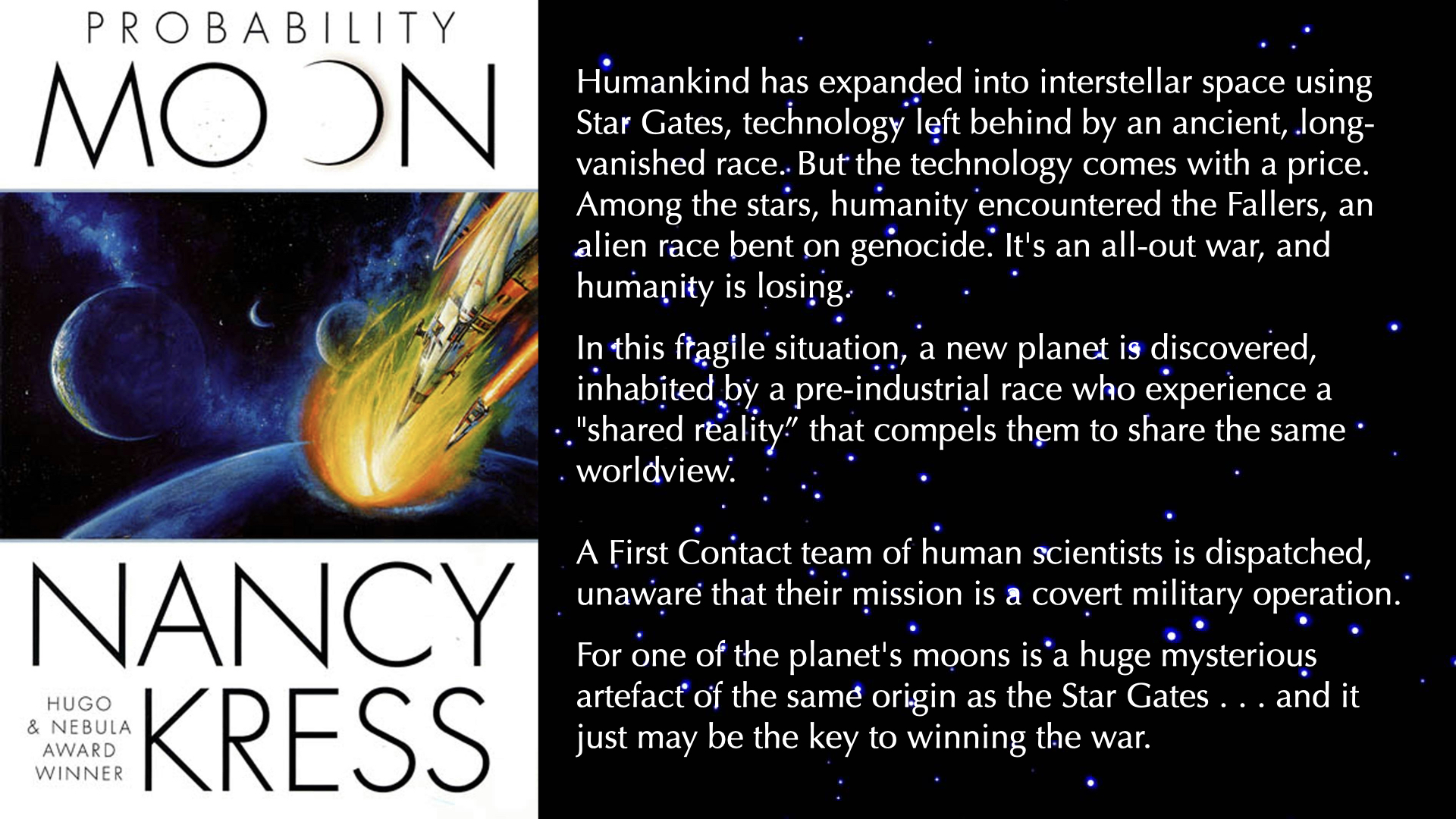
I’ve been reading Nancy Kress since her 1991 novella ‘Beggars In Spain’ won the Nebula. Her Science Fiction has always been leading edge in terms of her ideas and human in terms of its scale. Recently, I’ve become interested in her Climate Fiction, starting with her short story “A Hundred Hundred Daisies” in John Joseph Adams’ powerful anthology, ‘Loosed Upon The World’ and then her innovative novella ‘After The Fall Before The Fall During The Fall’.
‘Probability Moon‘ has been languishing in my TBR pile since 2015. I’m hoping that it will deliver a good Space Opera and open up a trilogy for me with ‘Probability Sun’ (2001) and ‘Probability Space’ (2002).
Nancy Kress is an American writer of Science Fiction. She is the author of twenty-seven novels, three books on writing, four short story collections, and over a hundred works of short fiction.
Her fiction has won six Nebulas (for “Out of All Them Bright Stars,” “Beggars in Spain,” “The Flowers of Aulit Prison,” “Fountain of Age,” “After the Fall, Before the Fall, and During the Fall,”and “Yesterday’s Kin”), two Hugos (for “Beggars in Spain” and “The Erdmann Nexus”), a Sturgeon (for “The Flowers of Aulit Prison”), and a John W. Campbell Memorial Award (for PROBABILITY SPACE).
Her work has been translated into Swedish, French, Italian, German, Spanish, Danish, Polish, Croatian, Korean, Lithuanian, Chinese, Romanian, Japanese, Russian, and Klingon, none of which she can read.

 Mike Finn's Fiction