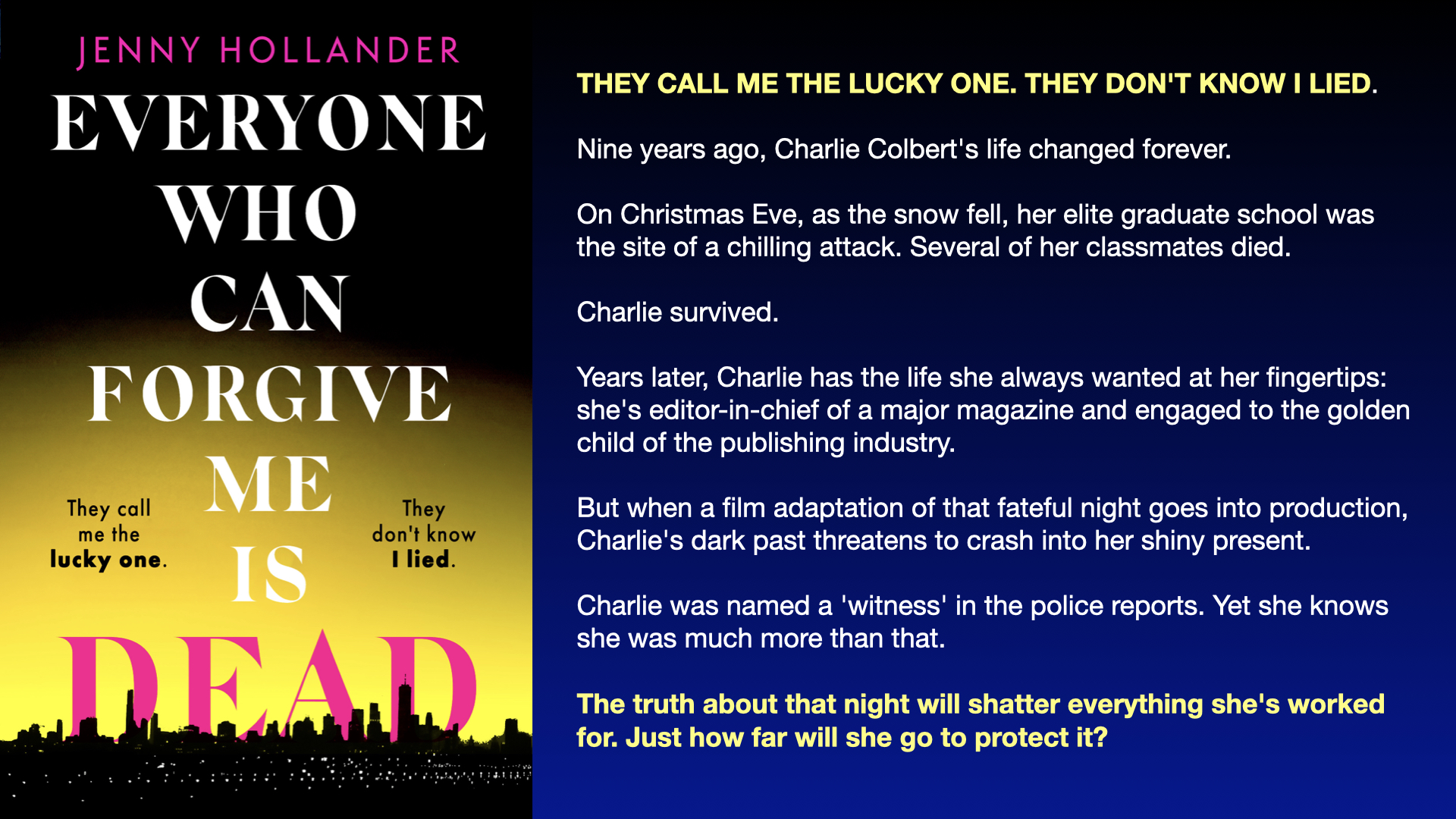
I had high hopes for ‘Everyone Who Can Forgive Me Is Dead‘. I loved the gothic sound of the title. It spoke to me of irredeemable sin and deep guilt. I liked the idea of the story being told through the eyes of a Brit making her living on the US East Coast because it offered so much scope for cultural dissonance, especially when the English-middle-class-girl-made-good is engaged to a New-York-one-per-center. I also liked that this debut novel drew on the experience of the author, at least in terms of settings, so, in addition to a good plot and a lot of tension, I was hoping for relatable characters, an insider view of both the work and academic environments and a strong sense of place.
I actually got everything that I hoped for. The main character, Charlotte (Charlie) Colbert is riven by guilt. The level of disdain that Charlie’s soon-to-be mother-in-law feels for Charlie could freeze the planet and the novel delivers an insider’s view and a strong sense of place.
So why did I set this novel aside at 33%?
I was overwhelmed by Charlie’s anxiety.
The story is told as a first-person account from Charlie’s point of view, albeit with a dual ‘Now’ and ‘Then’ timeline. Being inside Charlie’s head was stressful. Her anxiety was constant.
I could see that I was supposed to empathise with Charlie and feel sorrow for the way that anxiety was crippling her but that wasn’t how I felt.
I didn’t like Charlie.
She saw her new, ‘Now’, life as something that she’d earned through hard work and she felt aggrieved (although not surprised) that the life she’d created was being put at risk by a lie she’d told a decade earlier. The problem I had was that her ‘Now’ life seemed to me to be an invention, a comforting pretence designed to distract her from the harm her lies did a decade earlier.
Of course, I don’t need to like the main character of a story to enjoy a book but I do need to be able to live in her head if she’s the one telling the story. I found that I couldn’t do that.
‘Everyone Who Can Forgive Me Is Dead‘ was an intense well-told story but it was too unremitting for me and there was nothing to compensate me for putting up with the stress. I didn’t like Charlie and, by the time I was a third of the way through the book and still had nothing but vague hints about who did what to whom and why in the notorious ‘Scarlet Christmas’ that is the source of Charlie’s guilt, I found I didn’t care enough to hang around and find out. What I wanted more than anyhing else was to get Charlie’s anxious, self-deceiving, guilty voice out of my head.
It’s possible, perhaps even likely, that the things that led me to abandon this book are exactly the things that will make it irresistible to fans of psychological thrillers. Take a listen to the audiobook except below and make your own mind up.
 Mike Finn's Fiction