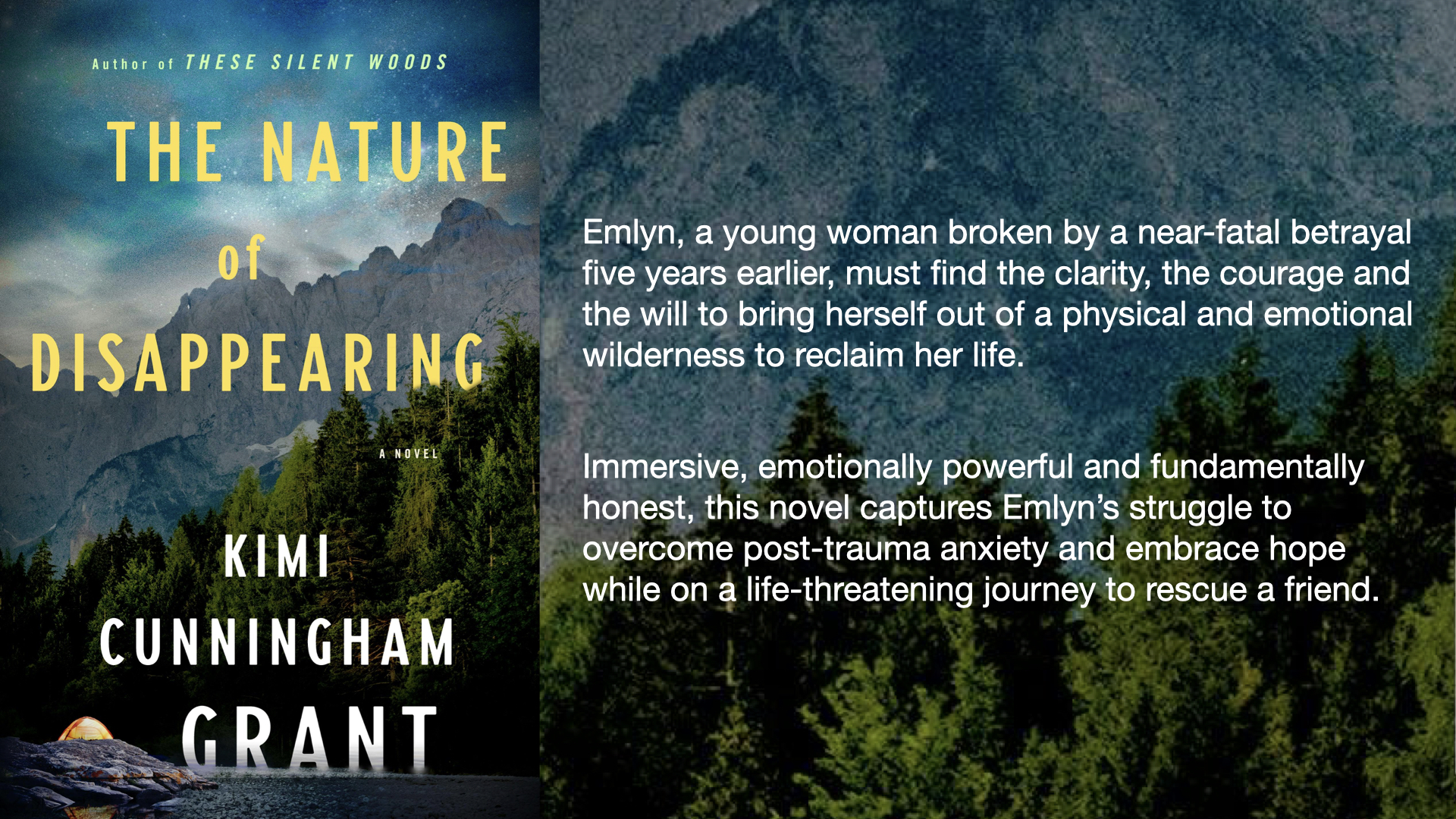
I received an ARC ebook version of ‘The Nature Of Disappearing’ in return for an honest review.
In her afterword, Kimi Cunningham Grant says that her title for this book, before the marketing folks replaced it, was ‘Wilderness‘. Having read the book, ‘Wilderness‘ sounds like a perfect fit as hysical and emotional/spiritual wildernesses provide the landscape for the book. I still have no idea what ‘The Nature Of Disappearing’ means. It sounds like something generated in a blue sky session tasked with coming up with a title that sounds intellectual in an unthreatening way while hinting at danger and mystery.
The physical wilderness is almost a character in its own right. It’s described in a way that made me want to put my boots on and head for the forest while also reminding me of how indifferent that landscape is to me and my needs and how easily I could come to harm.
Emlyn, the main character, is comfortable moving through the Idaho wilderness. She’s a fishing guide and a competent tracker who knows how to survive alone in the wild. When we first meet her, she still trying to navigate her way out of an emotional/spiritual wilderness that she has inhabited since having a near-death experience after being betrayed by a friend. Although Emlyn can confidently read sign well enough to track people through the forest, she no longer trusts her ability to read the people around her well enough to trust them. Her life has been fractured, leaving her adrift, uncertain and anxious.
What I admired most about this book was that Kimi Cunningham Grant managed to create a physical journey fraught with danger, laced with mystery and culminating in life-threatening violence that also pushes Emlyn to find the clarity, courage and will to bring herself out of the physical and emotional wilderness and reclaim her life. The journey was immersive and tense but also found room for reflection that gave the events meaning beyond simple survival.
The story is told as a present-day narrative, enhanced with scenes from Emlyn’s past. I liked that the start of the book didn’t rush to action. It built a context by mapping personal histories and seeding a sort of retrospective foreboding regarding a yet-to-be-specified-in-detail life-changing incident in which Emiyn was betrayed. The narrative keeps approaching it sideways as if peeking at it through its fingers. The aim here isn’t to tantalise the reader by withholding key information as a traditional thriller might but rather to reflect how we actually deal with painful things that we know and want to forget.
The first half of the book spends a lot of time getting to know the cautious, withdrawn, emotionally fragile person that Emlyn is now and is learning who she was five plus years earlier at college when she formed a close friendship with her charismatic friend, Janessa and fell in love with Tyler, the man who she’d expected to spend her life with but who we know betrayed her. I found myself deeply engaged with Emlyn both before and after the big betrayal. I liked her honesty. I loved that she wasn’t perfect and was aware of her own faults. That she didn’t always know why she did things when she was doing them, She would do harmful things that she knew she would probably regret but in the moment of doing them she wanted to cause harm or at least wanted it enough not to stop herself. It felt true. It also made me want to go: “No, no, no! Don’t say that.”
By the second half of the book, the dual timelines (Now and 5 Years Ago) started to amplify each other, building tension and increasing the sense of imminent disaster. I found Emlyn’s rising anxiety hard to distance myself from or dismiss. Her fragility and her uncertainty and her history of being broken made being close to her unsettling.
The most unsettling thing was her awareness of her own uncertainty. It wasn’t indecision. She understood that deciding wouldn’t be enough. Metaphorically, she was walking a cliff path in fog, knowing that it’s the step after the next one that’s uncertain and may perhaps be fatal.
The only thing that Emlyn is certain of is that if Janessa, from whom she has become estranged, is missing in the wilderness, then she will go and find her, even if it means travelling with Tyler the man who derailed her life five years earlier.
The complex and conflicting relationships with Janessa and Tyler strengthened the narrative. The mystery around why and how Janessa went missing was a good one. The denouement was violent, credible, unexpected and satisfying.
If you’re looking for a book with a wilderness setting, a mystery to solve, a dramatic finale and which manages to get you thinking about trust and hope and how we see ourselves and each other, then ‘The Nature Of Disappearing’ is the one you want. It will be published on 18th June 2024.
Kimi Cunningham Grant is the author of These Silent Woods, Fallen Mountains, and Silver Like Dust.
She has twice won a Dorothy Sargent Rosenberg Memorial Prize in Poetry and received a Pennsylvania Council on the Arts fellowship in creative nonfiction. She lives with her family in Pennsylvania.
Her new novel, The Nature of Disappearing, will be published on 18th June 2024. You can preorder it here.

 Mike Finn's Fiction