
This week, I’m reading two crime novels set in England in the 1930s. One of them is the second book in a series that I started earlier this year. The other is a newly published first book in a series.
Their publishers classify these novels as historical fiction. I classify them as pastiches because I don’t see how you can write or read a contemporary crime novel set in England in the 1930s and NOT be comparing it to the classic Golden Age Mysteries as you go long.
When I read actual Golden Age Mysteries, my Inner Pedant is always on the lookout for the things that were taken for granted when the book was written but which jar against what we take for granted today. That might be racist slurs, unconscious but pervasive misogyny, imperialist values or the acceptance of a class system in which servants become invisible.
When I read pastiches, my Inner Pedant is on the look out for echoes of, references to or conscious deviations from the things taken for granted in Golden Age Mysteries and the anachronisms that show that the period has been poorly researched or that modern mores have shaped the behaviour of the characters in an unlikely way.
I’m hoping these pastiches manage to summon the spirit of the times, reference the traditions of the genre and acknowledge that the modern gaze sees things differently. If the writer can do all that and provide an entertaining plot populated with engaging characters, I’ll be happy.
‘Mortmain Hall‘ (2019) by Martin Edwards
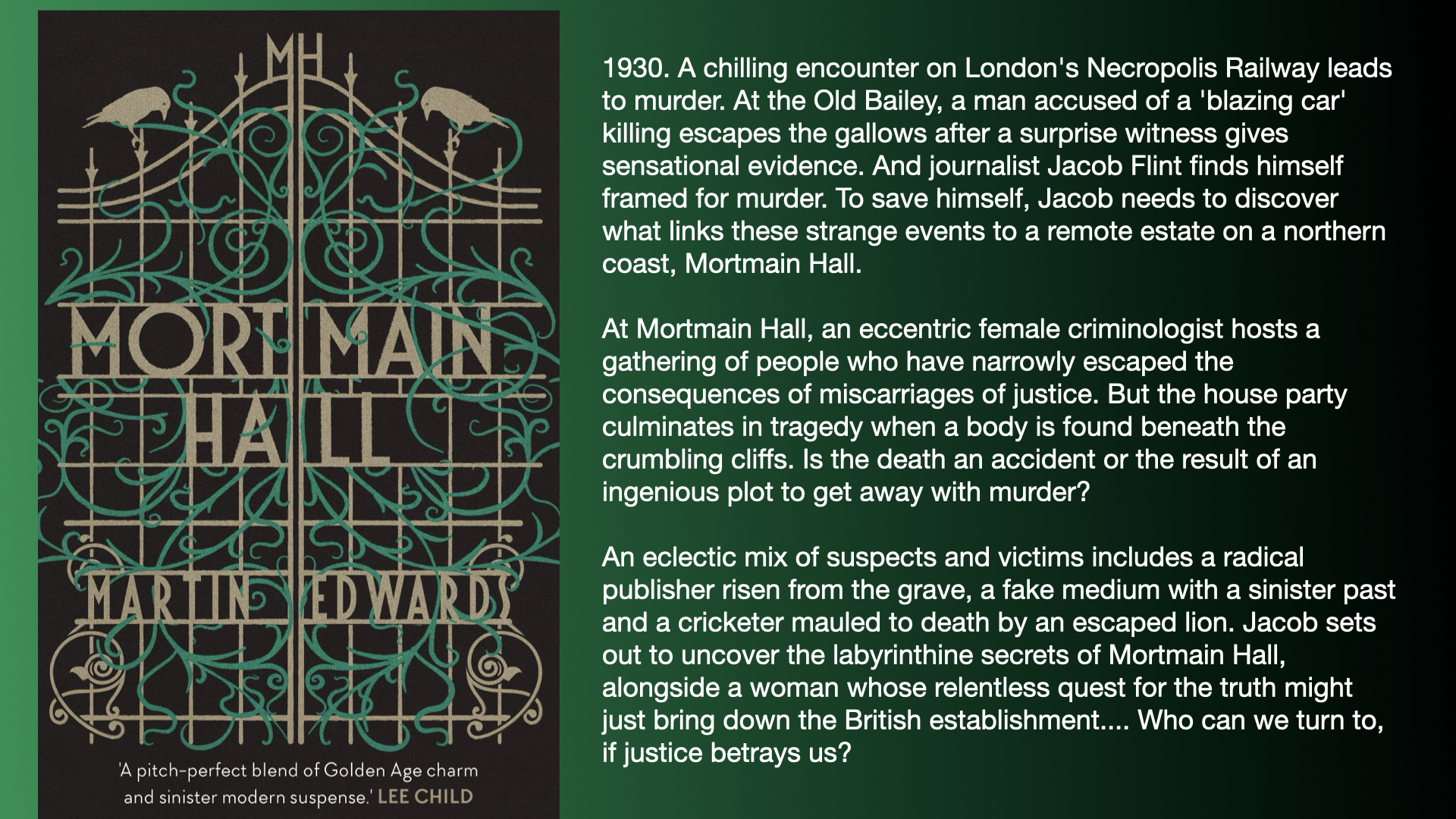
‘Mortmain Hall’ should be a safe bet as an entertaining read. Few people know as much about Golden Age Mysteries as Martin Edwards and he showed in ‘Gallows Court‘, the first book in the Rachel Savernake series, that he knows how to deliver a good period thriller.
I’m hoping that ‘Mortmain Hall‘ persists with the slightly-darker-than-you-might-expect-from-a-Golden-Age-Mystery tone of the first book and that Rachel Savernake continues, with her signature calm malice, to find creative ways to revenge herself on the British Establishment.
Martin Edwards was born at Knutsford, Cheshire and educated in Northwich and at Balliol College, Oxford University, taking a first class honours degree in law before qualifying as a solicitor. He published his first legal article at the age of 25 and his first book, about legal aspects of buying a business computer at 27; after thirty years as as an equity partner of his firm, he is now a consultant. He is married to Helena with two children (Jonathan and Catherine) and lives in Lymm. A member of the Murder Squad (see links section) collective of crime writers, Martin was the longest-serving Chair of the Crime Writers’ Association since its founder John Creasey. In 2015 he was elected eighth President of the Detection Club; his predecessors include G.K. Chesterton, Dorothy L. Sayers, and Agatha Christie. He is Archivist of the CWA and of the Detection Club and consultant to the British Library’s Crime Classics.

‘D Is For Death‘ (2024) by Harriet F. Townson
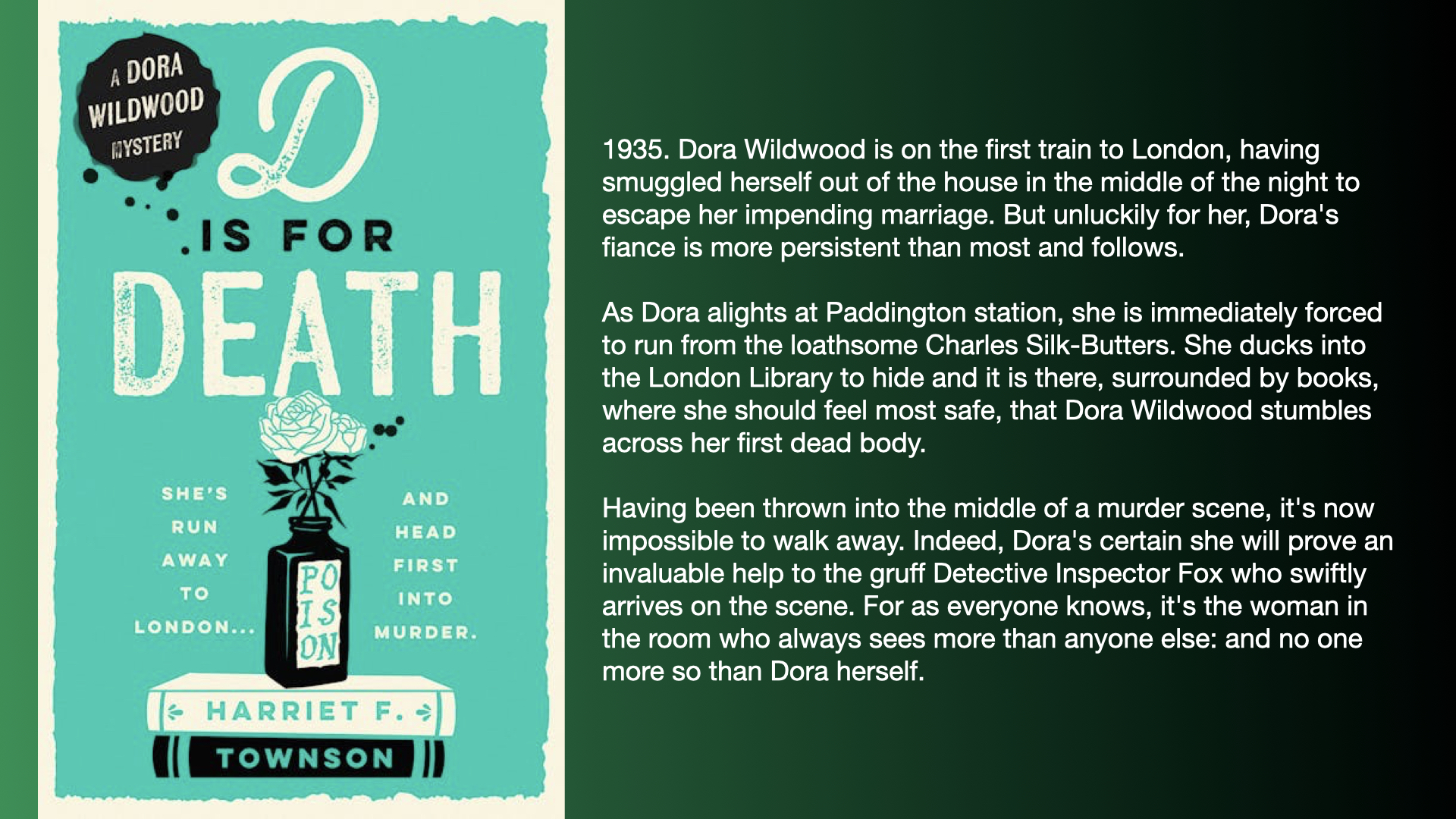
I’m expecting ‘D Is For Death‘ to be a lighter, cosier mystery than ‘Mortmain Hall‘. Where Rachel Savernake is the embodiment of retribution emerging from darkness in search of blood, Dora Wildwood is a hope-filled innocent venturing into the wide world in search of adventure.
Harriet Evans, known for her contemporary romance novels, has adopted the pseudonym Harriet Townson to launch the Dora Wildwood series. I hope this means that this series is an affaire de coeur for the author and that her passion and energy give the book an extra charge.
I hope I like Dora and can believe in her without having to spend a lot of energy suspending my disbelief and silencing my Inner Pedant.
Harriet F. Townson is the pen name of bestselling author Harriet Evans. She has written thirteen novels, several of which have been Sunday Times bestsellers, two of which were Richard and Judy Book Club selections and one which won the Good Housekeeping Book of the Year. She lives in Bath with her family and in her scant spare time rereads Dorothy L Sayers.

 Mike Finn's Fiction