Stay back!
The shadow places shelter secrets that are best left undisturbed. Hear me! Or don’t. For there are those obsessed with uncovering the witcheries that fester in man’s foul heart. There are those who would invoke the awful powers that yet remain in Earth’s cursed places.
Joseph Payne Brenna is such a one. This is his book. Dare you make it yours?
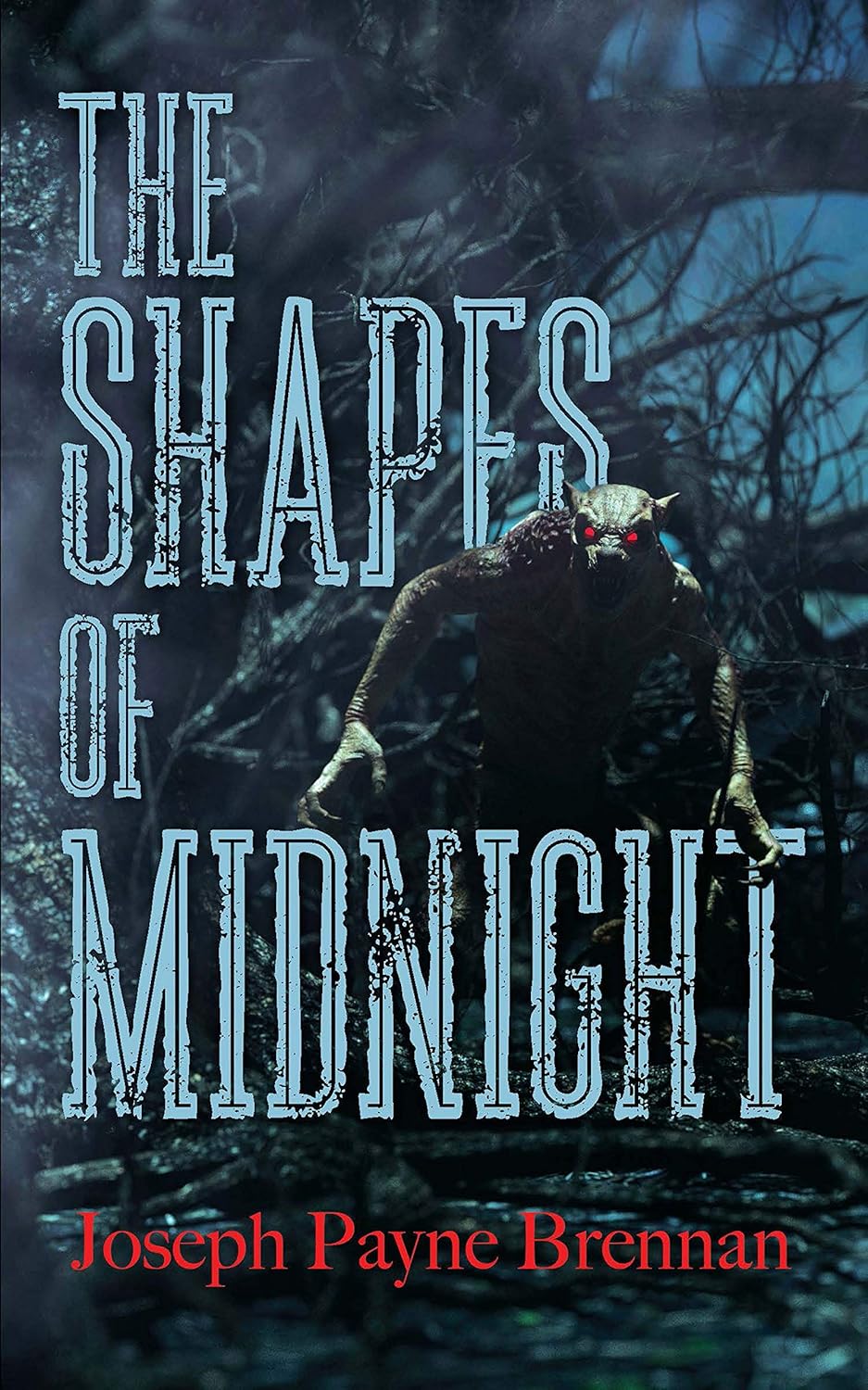
I picked up ‘The Shapes Of Midnight‘ because Stephen King acknowledged Joseph Payne Brennan as a horror writer on whom King had patterned his own stories and because these are stories from an earlier generation of horror writers, that pre-date the saturation of popular culture with Slasher movies and Final Girls and Creature Features.
The ten stories in the collection cover a lot of ground from weird werewolves to calm psychopaths, from gothic castles with dark secrets on stormy nights, to hospital corridors with a deadly stalker. Some of them felt as if I was reading M R James or Edgar Alan Poe. Others felt like they would have been perfect for ‘The Twilight Zone’.
This was a refreshing read that brought me back to the basics of how to tell a horror story in the first-person and deliver anything from unease at the uncanny to fear of the truly monstrous.
I’ve commented on each of the ten stories below.
DIARY OF A WEREWOLF
As the title suggests, most of this story is in the form of a diary written by a werewolf. Set in rural New England in 1958, it describes the descent into violent madness of a man who left New York City on the advice of his doctor who warned that the man’s many ‘dissipations’ would lead to physical and mental ruin, to live in Hemlock House which stands on the edge of a small village amid 300 acres of deep forest. It turns out not to have been a wise choice.
The setting and the content of the story are classic gothic horror. The diary format gives the gothic a modern twist by providing an insight into the man’s mental decline and inherent amorality. The language of the diary seemed to owe more to the start of the century than the middle of it, but this added to the Gothic feel of the story and might be accounted for by the man’s age. What I liked most was that our werewolf’s transformations were mental rather than physical and seemed more like the release of a darkness he’d brought with him to the woods.
THE CORPSE OF CHARLIE RILL
A great example of a simple but effective monster story. The monster here is the reanimated corpse of Charlie Rill. The corpse part is important. This isn’t Charlie coming back to life. This is a dead thing, unnaturally animated. It has no thoughts, no desires. It is powered entirely by an instinctive compulsive to tear apart every living thing it meets. It’s a linear tale of pointless bloody destruction and it is wonderfully, perfectly horrific.
THE PAVILLION
I love the directness and simplicity of this story. The beach pavilion in a winter storm becomes not a pleasure palace but a gloomy, watersoaked, storm-damaged tomb. The main character is slowly pushed from cold-blooded calm to frantic mind-voiding terror by the environment and what he finds, and doesn’t find there. This reminded me of Edgar Allan Poe. I think this is how he might have written a sequel to ‘The Cask Of Amontillado‘ with Montesor returning to check that Fortunato was still behind the wall.
HOUSE OF MEMORY
This story walks the border between it-was-all-in-my-imagination and sometimes-wierd things happen. It’s a low-key personal encounter with an event that rippled the surface of reality as the person understood it and demonstrated the power of obsession.
THE WILLOW PLATFORM
This story had the sort of atmosphere that I expect of an M R James ghost story. Care was taken to base it in a credible contemporary rural locale populated with believable people so as to increase the impact of the supernatural event at the heat of the story. The supernatural element didn’t stir me but I liked the description of the time and place.
WHO WAS HE?
At first, the slight tale of a recuperating man’s strange encounter on the cardiac ward had me shrugging and going ‘Meh… not horror‘ But I kept thinking about it and I realised how jaded my tastes have become. It’s not horror in the horror-movie-made-me-jump way but, if this had happened to me, if I was the man recounting this tale, I know I’d be haunted by it. I think that’s a flavour of horror that’s worth preserving.
DISAPPEARANCE
The punchline to this story is telegraphed about halfway through but that doesn’t really diminish the impact as the story seems really to be about how rural life works – what people accept and what they question and how eccentricity to slide into something darker unremarked.
I admire how the tone of the story pulls the reader into the mindset, establishing the narrator as a reasonable man with a story to tell and inviting you to sit awhile and listen. Here’s how it starts:
“AT THE TIME of Dan Mellemer’s disappearance I happened to be a deputy, and Sheriff Kellington asked me to accompany him when we drove over to the Mellmer place to investigate.”
The rhythm of that sentence, unhurried and full of promise is so perfectly judged that it triggers a “Did I ever tell you about the time that…?’ sense of intimacy.
THE HORROR AT CHILTON CASTLE
This is a full-blown Gothic nightmare complete with a stranger at a deserted village inn, a thunderstorm with fierce winds and flashes of lightning that serve as the only illumination of the Norman castle that lours over the village, a chance encounter leading to a dour mission reluctantly agreed to and a monstrous secret walled-in to a room in the deep bowels of the keep. Wonderful images delivered in straight-from-the-shoulder prose with no compromises.
THE IMPULSE TO KILL
This time the narrator is a psychopath for whom only face-to-face killing can bring relief. What makes the story chilling is that the narrator is not crazed or out of control. He’s calm, patient, cunning and completely convinced that he’s only doing what’s natural. This story has the impact of seeing a shark’s fin cutting through the waves at a beach. It’s not evil or even malicious, just relentlessly, implacably hungry and perfectly equipped to feed.
THE HOUSE ON HAZEL STREET
This is an intriguing and original idea. I liked the set-up and the atmosphere but the ending felt abrupt. It’s an odd story to end the collection on. I’d have used THE IMPULSE TO KILL as the last story, bookending the collection with two murderous narrators.

Joseph Payne Brennan was born in Connecticut, New York in 1918. He worked at the Sterling Memorial Library of Yale University for more than forty years He died in 1990.
He sold many of his stories to ‘Weird Tales‘ magazine. His story collections include ‘Nine Horrors And A Dream‘ (1958), ‘Screams At Midnight‘ (1963), ‘Stories OF Darkness And Dread‘ (1973) and ‘The Shapes Of Midnight’ (1980).
He wrote poetry throughout his life and is best known for his poetry collection ‘Nightmare Need‘ (1964).
He published twenty-three issues of his own magazine, ‘Macabre‘ from 1957-1976.
 Mike Finn's Fiction