Attempting to recover from his harrowing experiences in Mexico, in Land of Wolves, Wyoming Sheriff Walt Longmire is neck deep in the investigation of what could or could not be the suicidal hanging of a shepherd. With unsettling connections to a Basque family with a reputation for removing the legs of Absaroka County sheriffs, matters become even more complicated with the appearance of an oversize wolf in the Big Horn Mountains to which Walt finds himself feeling more and more empathetic.
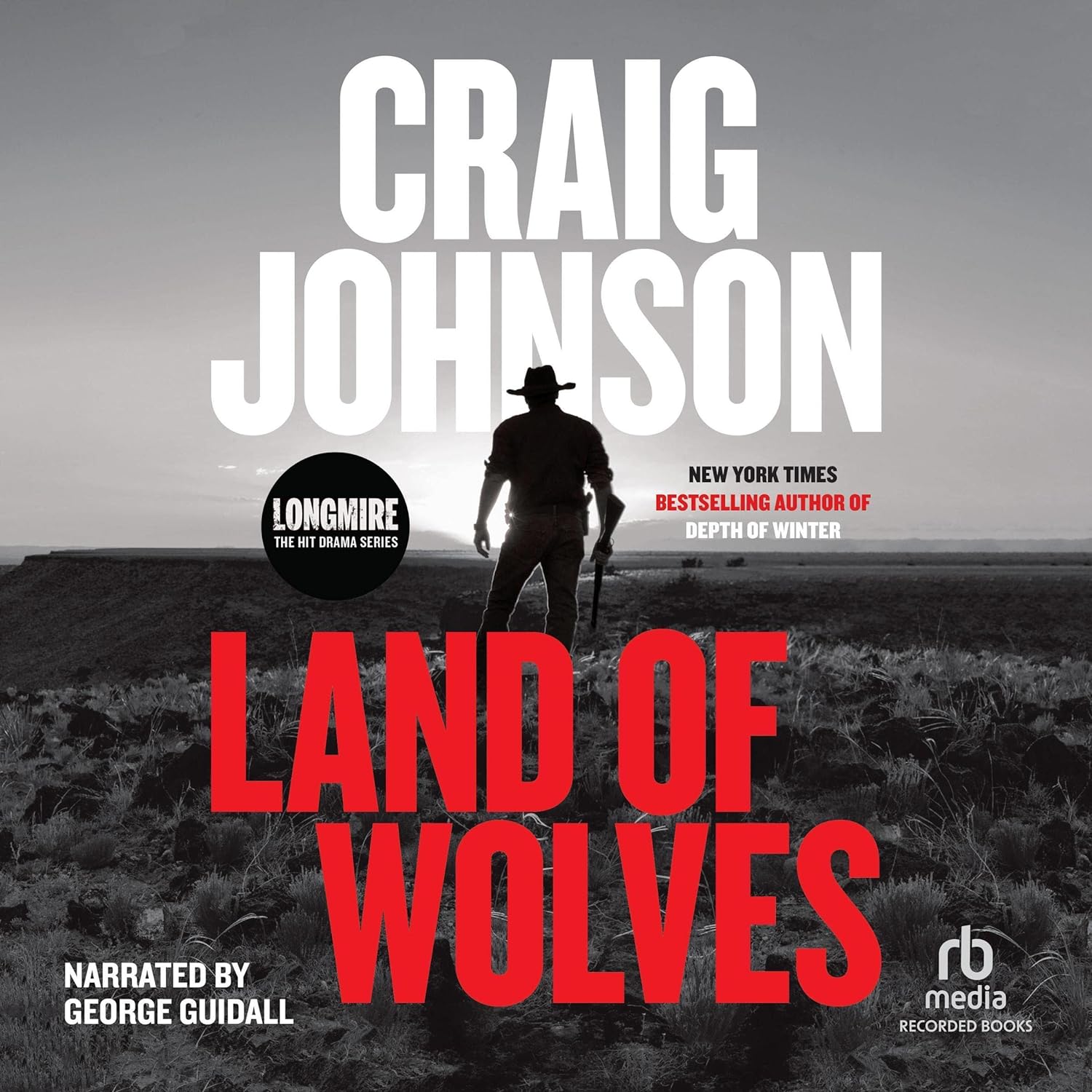
Sometimes, you really can judge a book by it’s cover. This cover is familiar enough to evoke the Longmire brand but it’s grey and a little tired and offers no new incident or symbol to excite a reader’s curiosity. It says, ‘Read Me – I’m a Longmire novel‘ and not much else.
If I wanted to get someone to understand why I read so many Longmire books, I’d point them to ‘The Cold Dish‘ or ‘Another Man’s Moccasins‘ or ‘The Western Star‘ but not ‘Land Of Wolves‘. It’s not that the novel is bad, it’s just that it’s only of interest to someone who is already a Longmire fan.
‘Land Of Wolves‘ is the first book after Walt’s traumatic, violent, only-I-working-alone-can-save-my-daughter mission in Mexico in ‘Depth Of Winter‘, I was disappointed by ‘Depth Of Winter‘ as a resolution to a long-running story arc and angry with Longmire’s lone-martyr act but even I could see that the violent events of the book would alter Longmire and redefine the series. I went into ‘Land Of Wolves’ wanting to see what those changes were.
One of the things that I liked about ‘Land Of Wolves’ was the quiet, almost gentle way, that Craig Johnson made those changes apparent. At first, nothing much seemed to be different. I thought ‘Land Of Wolves‘ was going to be one of those leisurely let’s-talk-philosophy spirit-quest Longmire books with a bit of Basque culture thrown in to spice things up. After ‘Depth Of Winter‘, I welcomed the return to the familiar and found myself relaxing into the book as I listened to George Guidall’s distinctive voice take me through Walt’s thoughts.
The plot was spun around two investigations, one into the presence of a lone wolf in the mountains and the other into the death by hanging of a shepherd alone in the same mountains. This being a Longmire book, I knew that neither the wolf nor the shepherd’s death would be what they first seemed to be. The unexpected presence of a large wolf was bound to trigger Longmire’s mystical side and the shepherd’s death was bound to lead to dark secrets being revealed. I was happy with that.
The storytelling was slow, almost sleepy, and lubricated by gentle humour. The pace reflected both Walt’s state of mind and his newly-limited physical abilities. The new scar on his face wasn’t the only souvenir he brought home from Mexico. What he did there makes him reassess himself. The head injuries he suffered mess with his memory. The wound in his side limits his mobility and has taken away his stamina. These things combine to produce points when Walt spaces out entirely, disassociating and hallucinating. As the story is told entirely from Walt’s point of view, it’s not surprising that the novel had a distant, slightly confused atmosphere to it.
The plot around both the lone wolf and the shepherd works well, even though Walt is labouring under severe disadvantages that he’s too stubborn to acknowledge.
The real point of the book seems to be to show Walt questioning whether he can or should continue as Sheriff and what he might do, who he might become if he took off his badge.
I’ll have to wait for the next book to find out.
 Mike Finn's Fiction