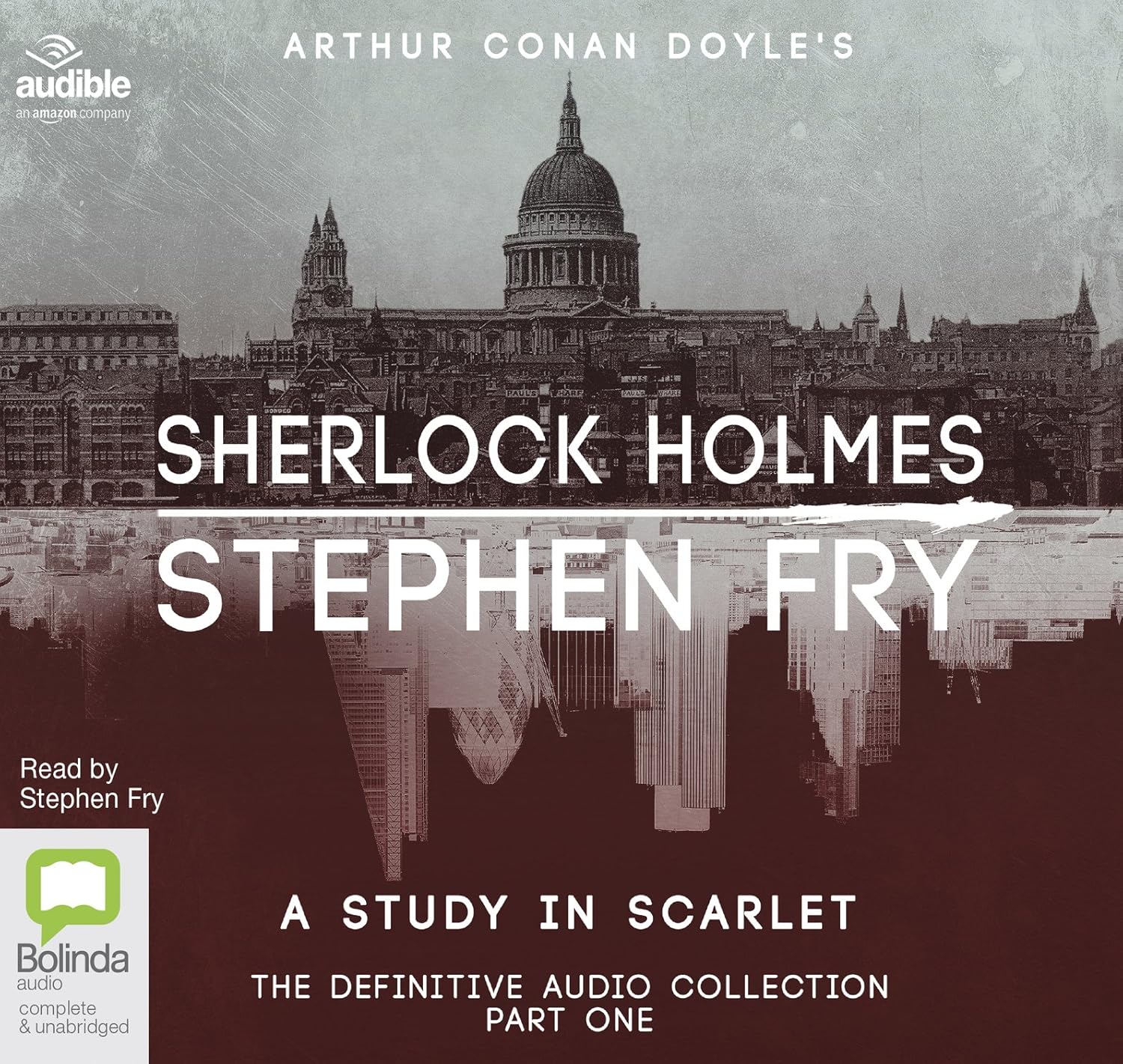
A Study in Scarlet is an 1887 detective novel written by Arthur Conan Doyle. The story marks the first appearance of Sherlock Holmes and Dr. Watson, who would become the most famous detective duo in popular fiction.
When a postwar search for London lodgings introduces ailing doctor John H. Watson to quirky chemist Sherlock Holmes, their collaboration in the art of observation and deduction begins. Congenial flatmates and even better colleagues, the pair is quickly drawn into a case of murder and revenge that has Scotland Yard at their wits’ end.
I sampled a few (fairly unimpressive) Sherlock Holmes short stories a few years ago but I’ve never read any of the novels. The Sherlock Holmes of my imagination was based on movie or TV adaptations or from pastiches like Sherlock as an old man ‘The Beekeeper’s Apprentice‘ or Sherlock as a boy in ‘Death Cloud‘ or Sherlock as a cameo role ‘The Case Of The Missing Marquess‘. When I saw that Stephen Fry had narrated a collection of the Sherlock Holmes novels and short stories, I decided it was time to read ‘A Study In Scarlet‘, the first Sherlock Holmes novel.
The first thing that struck me was that I wasn’t reading historical fiction. The novel was published 138 years ago and the world it described was contemporary to the audience reading it.
The second thing was that the start of the book was about Watson, not Holmes. I knew it would be told from Watson’s point of view but I’d expected something with a tone of ‘Let me tell you about the remarkable abilities of my friend, the great detective‘ whereas, what I got was a more straightforward narrative about an army doctor, who has been wounded and had his health destroyed in the Afghanistan war, trying to make a life as a civilian in London. Sherlock Holmes appears only as a possible roommate who Watson meets when he is looking for affordable lodgings. I was fascinated by the first meeting of these two. Holmes didn’t seem particularly intimidating, just a little over-enthusiatic about his obscure forensic chemistry experiments. The two were equals, not hero and sidekick.
The biggest surprise was that, halfway through the book, when it looks as though Holmes has captured the murderer, we suddenly leave John Watson’s narrative and spend much of the rest of the book amongst the Mormons in the newly founded Salt Lake City. Neither Watson nor Holmes are present. We’ve rolled back thirty years to be spun a tale about how a man and his adopted daughter are pulled into the community of the Latter Day Saints and live amongst them for a decade until circumstances cause them to flee through the mountains in the dark of the night.
This part of the story is historical fiction. Conan Doyle was only twenty-eight when ‘A Study In Scarlet‘ was published. The events he’s describing are set before he was born. He’d never been to Salt Lake City. Doyle was a lapsed Catholic and his knowledge of the Latter Day Saints seems to have come mainly from the anti-Mormon tracts that were popular in London in the 1880s.
Doyle’s Utah story is as melodramatic and polarised as any early Hollywood Western. The Mormons are the bad guys – a cult run by evil old men who rule through covert anonymous violence and who are intent on grabbing land and adding young women to what Doyle calls their ‘Harems’. It is a story of derring-do, good versus evil, wrongs done and vengeance sought. It’s a long way from the expectation I had from the movies of watching Holmes dazzling Watson with his analytical abilities.
Eventually, we resumed John Watson’s narrative to tie the event in Salt Lake City to the murders in London in a slightly clumsy way via a let-me-explain-it-all account from the murderer.
In the very last (and thankfully short) chapter as dramatic as a PowerPoint presentation, Holmes explained to Watson how he worked out who the murderer was.
I’m glad finally to have read the novel that started the Sherlock Holmes phenomenon. I’m also glad it was narrated by Stephen Fry, who gave it his all.
The next novel, published three years later, is ‘The Sign Of Four‘. The first chapter is called ‘The Science Of Deduction‘ so I expect that the See how brilliant I am,Watson? stuff will start there. I’ll be listening to Stephen Fry’s narration again but it may be a while until I get to it.
 Mike Finn's Fiction