At the end of a deadly bear hunt across the wilderness of Northern Sweden, the successful hunters are shaken by a grisly discovery. Across in Kurravaara, a woman is murdered with frenzied brutality: crude abuse scrawled above her bloodied bed, her young grandson nowhere to be found. Only Rebecka Martinsson sees a connection.
Dropped from the case thanks to a jealous rival, she now stands alone against a killer who brings death to young and old, spawned by a horrifying crime that festers after 100 years on ice.
The Second Deadly Sin‘ (2012) is the fifth book featuring Recka Martisson, a prosecutor working in the far north of Sweden, having abandoned her high-powered job in Stockholm to come back to the village she was raised in.
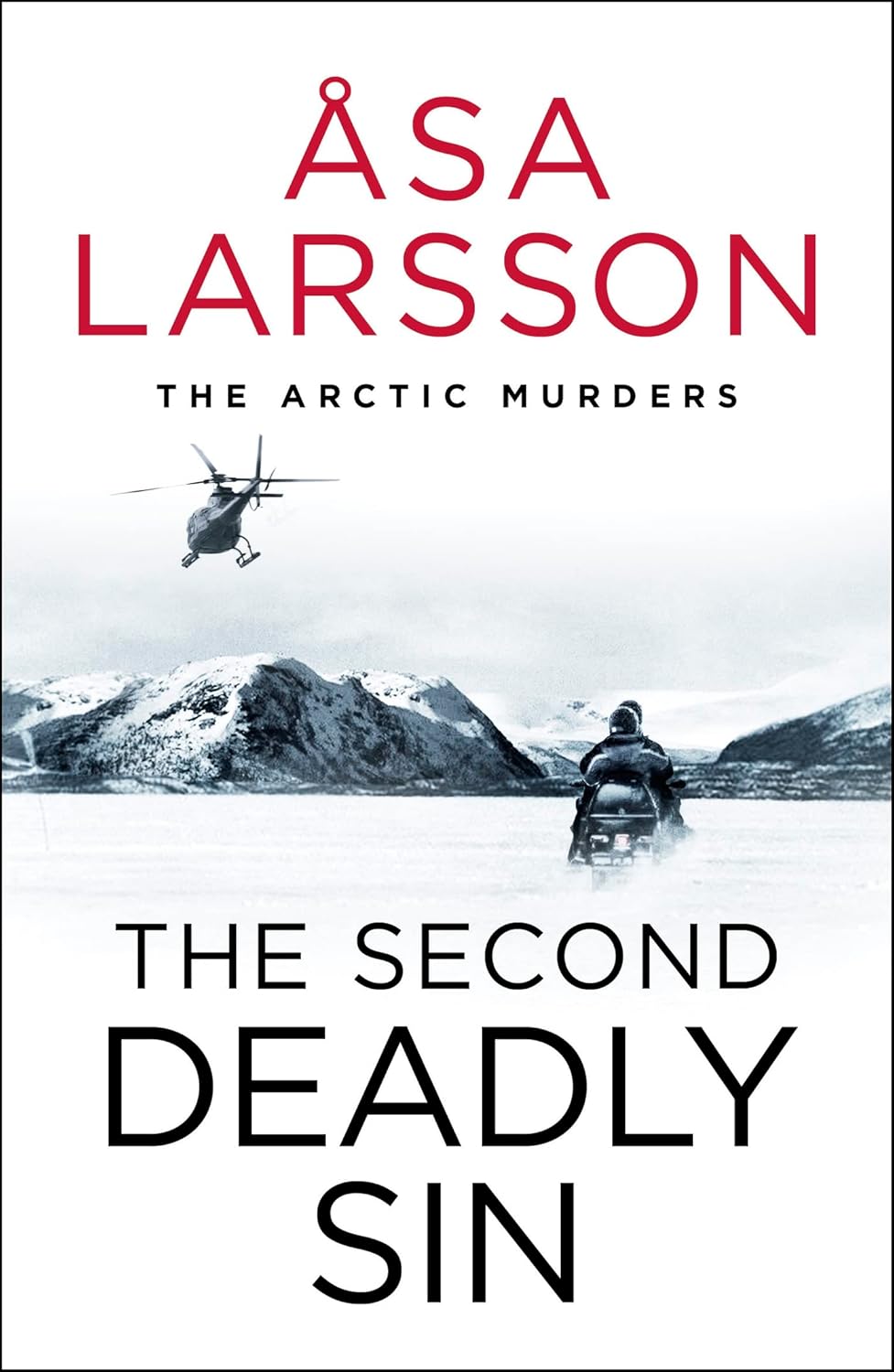
The cover and the publisher’s summary seem determined to represent ‘The Second Deadly Sin’ as a thriller with a long investigator search for the truth against all odds. It sets the expectation of lots of arctic action and derring-do and completely misrepresents what this book is about. The book is filled with violent confrontations and has many moments of high tension but it’s not a book that sets out to thrill the reader. The second deadly sin that gives the book its title is greed. It seems to me that what Åsa Larsson sets out to do is to get the reader to experience and consider the ugly actions and emotions that greed generates in people.
This a dark book, even darker than the ones that went before it. It’s set in two timelines, the present day and the early twentieth century when what is now a quiet village was a booming mining town, dominated by a single employer. Larsson pulled no punches in describing the violence, misogyny, and oppression of the poor. Sadly, her descriptions of the present day show only a superficial improvement.
The link between the early twentieth-century timeline and the present day wasn’t immediately apparent, except as a likely explanation of the motivation for the present-day killings. At times, I resented being pulled away from the actions of the present-day characters who I know well in order to drop back a few generations into a world where violence, greed, poverty, privilege and misogyny were so prevalent that they were taken for granted. Then, bit by bit, I got wrapped up in the story of the doomed efforts a young school teacher trying to make a life for herself in a raw scar of a town set in the beauty of the far north. It was a depressing story, made more so by being entirely plausible.
The present-day timeline delivered a solid mystery and some very tense action. The plot echoed the themes of greed and a sort of structural misogyny which normalises violence against women. The ending was tense, surprising and satisfying.
What I enjoyed even more than the mystery was watching the relationships grow between Martinsson and the police officers and Martinsson’s former boss in Stockholm. I particularly enjoyed the descriptions of the prosecutor who is trying to push Martisson aside. Larsson uses him to give an insight into the self-justifying narrative that an upper-class man with more ambition than ability and with an unassailable belief in his own worth, generates to exonerate himself from all blame.
I immerse myself completely in these books, even when that means being mired in sadness and confronted with ugliness. I think the reason for that is that, in the face of it all, Martinsson manages to retain her empathy and search for a little happiness.
There’s only one book left in the series now, ‘The Sins Of Our Fathers’. I’m almost reluctant to read it because I know it will be my last visit with Rebecka Martinsson.
 Mike Finn's Fiction