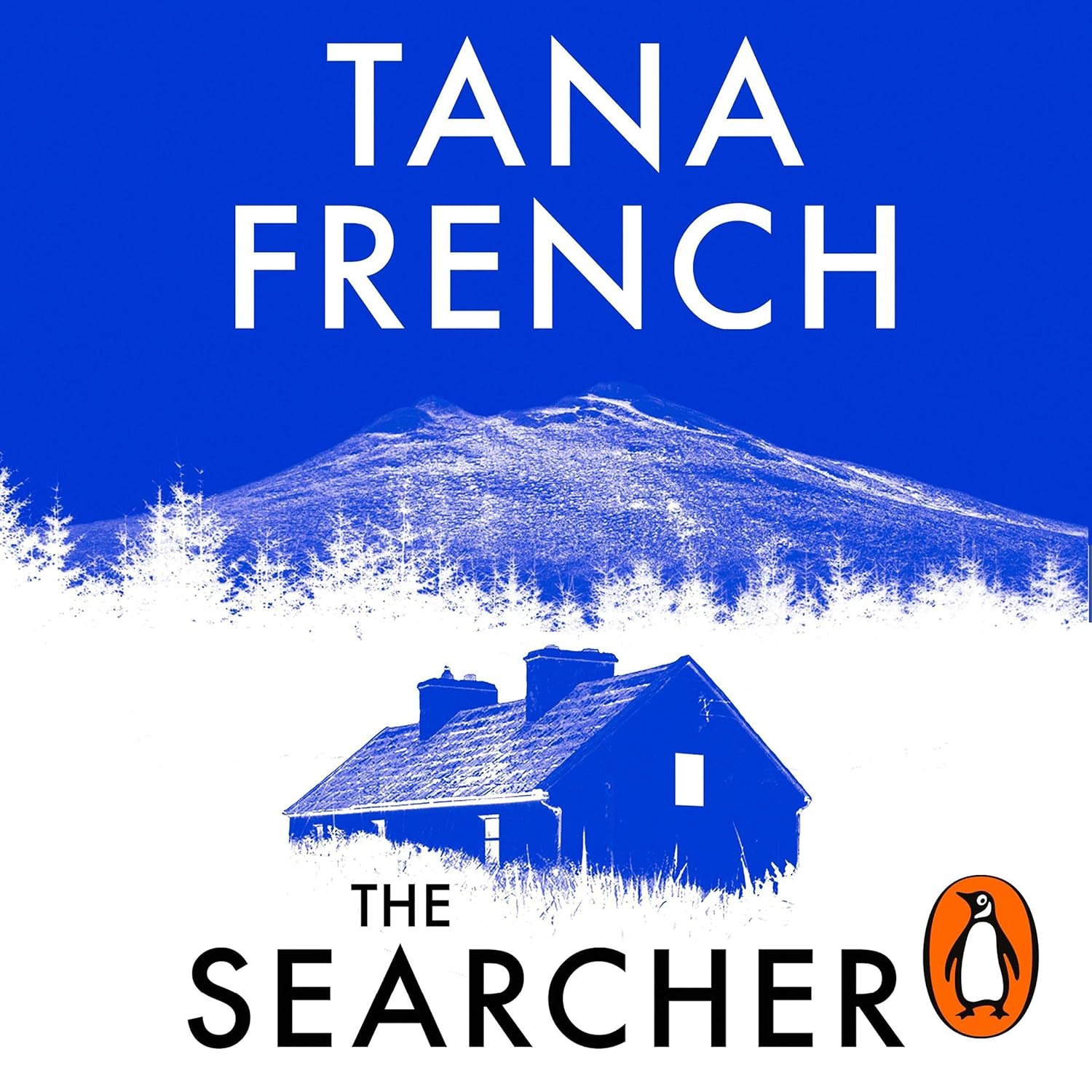
Cal Hooper thought a fixer-upper in a remote Irish village would be the perfect escape. After 25 years in the Chicago police force and a bruising divorce, he just wants to build a new life in a pretty spot with a good pub where nothing much happens.
But then a local kid comes looking for his help. His brother has gone missing and no one, least of all the police, seems to care. Cal wants nothing to do with any kind of investigation, but somehow he can’t make himself walk away.
Soon Cal will discover that even in the most idyllic small town, secrets lie hidden, people aren’t always what they seem and trouble can come calling at his door.
‘The Searcher‘ was my first Tana French novel and I entered it with high expectations. It’s the first book in her latest series. It got good reviews as did the second book ‘The Hunter‘, which came out last year.
I can understand the good reviews. There’s a lot to admire in ‘The Searcher‘. There’s a strong sense of place. The dialogue is pitch perfect. The characters are vividly drawn and are cliché-free. Cal Hooper’s awareness that, as a foreigner recently arrived in Ireland, he doesn’t know what the right thing to do in tense situations resonated with my own experience of living in a foreign country. I liked how Tana French could, in a single scene in the pub, distil the frustation and anxiety of knowing that behaviour that would come naturally at home might not be appropriate but doing nothing also feels wrong. Roger Clark’s narration is masterful – getting the accents and voices right and helping me hear the rhythm of Cal Hooper’s thoughts.
These good things are why I enjoyed frustrationa lot of the four hours of ‘The Searcher‘ that I listened to.
Why am I setting it aside?
Because I can’t stick the slow pace. Glaciers are melting faster than this plot is revealing itself.
I feel like I’ve stepped back into a novel by George Eliot or Arnold Bennet where characters are built by describing every detail of their daily lives from how they button their waistcoats to how they use a soup spoon. I don’t have the patience to sit through another ten and a half hours of this kind of blow-by-blow account of carpentry and painting and the challenges of interpreting what the local small talk is really meant to communicate.
So, well-written and well-narrated as it is, I’m setting this aside and moving on to a book with a less leisurely approach to storytelling.
If you’d like to get a feel for the style of the book, click on the SoundCloud link below and listen to Roger Clark’s performance.
 Mike Finn's Fiction