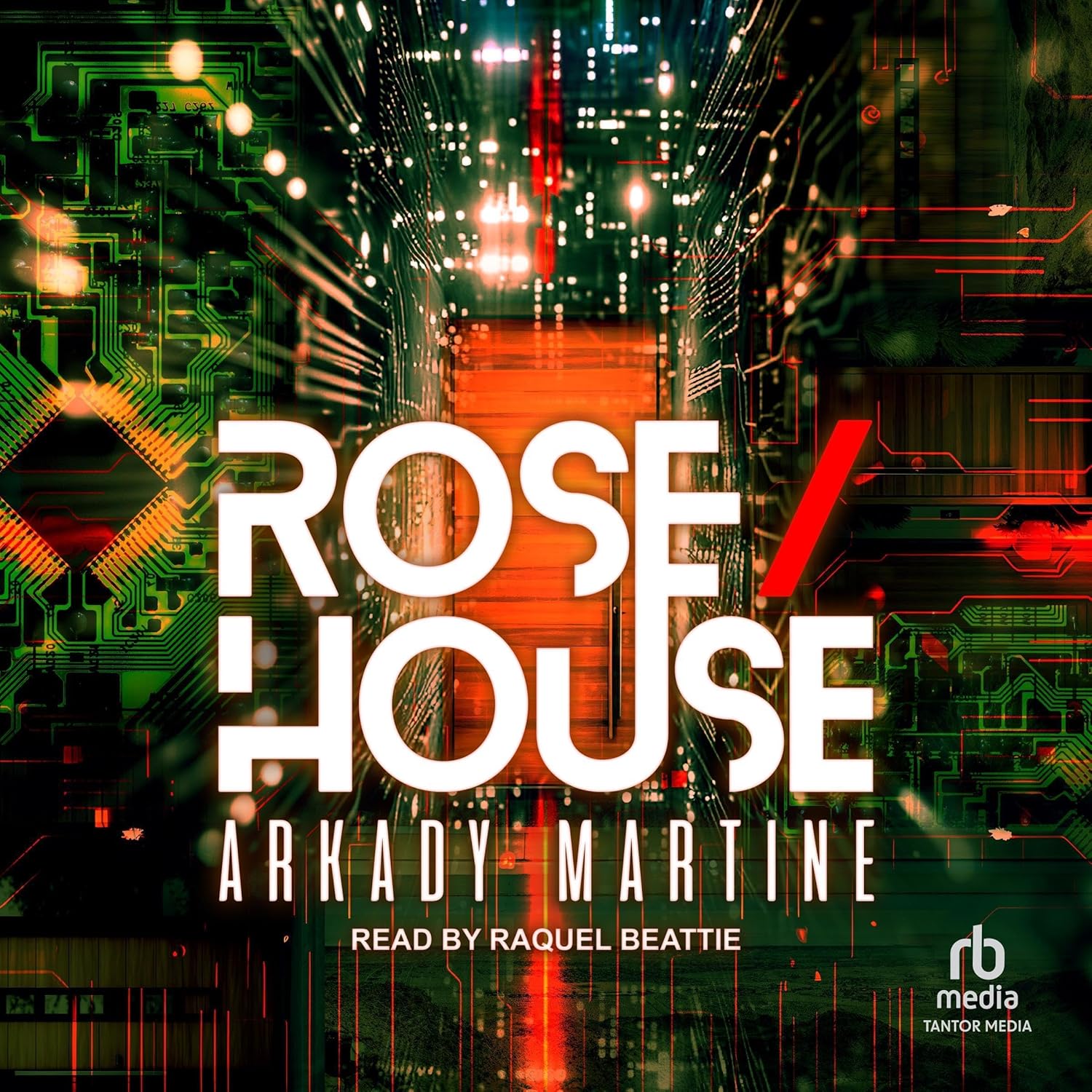
Basit Deniau’s houses were haunted to begin with.
A house embedded with an artificial intelligence is a common thing: a house that is an artificial intelligence, infused with a thinking creature that is not human? That is something else. But now Deniau’s been dead a year, and Rose House is locked up tight, as commanded by the architect’s will: all his possessions and files and sketches are confined in its archives, and their only keeper is Rose House itself. Rose House, and one other.
Dr. Selene Gisil, one of Deniau’s former protege, is permitted to come into Rose House once a year. Until this week, Dr. Gisil was the only person whom Rose House spoke to.
But even an animate intelligence that haunts a house has some failsafes common to all AIs. For instance: all AIs must report the presence of a dead body to the nearest law enforcement agency.
There is a dead person in Rose House. Rose House, having completed its duty of care and informed Detective Maritza Smith of the China Lake police precinct that there is in fact a dead person inside it, dead of unnatural causes-has—shut up.
No one can get inside Rose House, except Dr. Gisil. And someone died there. And someone may be there still.
When I learnt that Arkady Martine, who wrote ‘A Memory Called Empire‘, had published a standalone novella, I put everthing else aside to read it. I love her writing and her complex imagination. ‘The story was as complex and as beautifully written as I’d hoped. Rose House and the people who entered it will haunt my imagination.
‘Rose/House‘ is a darkly compelling novella, set in the near future, about the discovery of a dead body inside Rose/House, a world-famous building that is the shell for a genius loci AI. The building and the AI are effectively a single entity. The technologists think of Rose/House as a building that incorporates an Animated Intelligence. The people in the local area who grew up in its presence refer to the house as a Haunt.
Set in the Mojave desert, miles from the nearest small town, Rose/House has been closed up since the death of the eccentric architect who built it, lived in it and stored his archive in it. It has been a quiescent but menacing presence outside the small town of China Lake for years until the night it calls local law enforcement to fulfil its legal obligation to alert them to the presence of a dead body on its grounds. Unfortunately, it has no legal obligation to let them into the house to investigate further. To gain access, the Deputy has to persuade the only person with access to the house, an estranged former student of the great architect who was bequeathed the role of archivist, to take her inside.
I loved the sense of malignant menace that infused the story. The house feels like the embodiment of the dead architect’s malicious imagination. Three things drive the reader’s growing dread: the mystery around the corpse: who they are, why they were in the house, how they gained access and how they died; the truly inhuman nature of the dispassionate, physically powerful intelligence that permeates Rose House and uncertainty about the motivation and trustworthiness of the archivist.
One of the things I liked most about the book was the way language was used to characterise different ways of thinking. Rose/House is perfectly fluent in English, so it’s clear her word choices are deliberate and carry weight. It’s immediately clear from the dialogue between the Deputy and Rose/House that Rose/House’s thought processes are complex, opaque and alien. Watching the Deputy figure out how to engage with Rose/House was fascinating and just a little frightening. I was left with the impression that to be in sync with Rose/House’s thoughts was to become less human. It felt like a contamination. The archivist and the Deputy who enter Rose/House both start to sound a little like the House. By contrast, the second China Lake Deputy sounds like a good old boy. So much so that, at first I wrote him off as someone who would be of no help to his colleague. Then I realised that his idiolect was a conscious construct, designed to make people underestimate him.
The plot didn’t follow traditional tropes for mysteries or thrillers. To me, it had that sense I sometimes get from stories by Edgar Alan Poe and M. R. James of the slowly dawning but life-changing consciousness of being in the presence of an unnatural entity that has the power to destroy and is indifferent to our survival. The horror comes from recognising our vulnerability and our insignificance.
 Mike Finn's Fiction