New York City, New York.
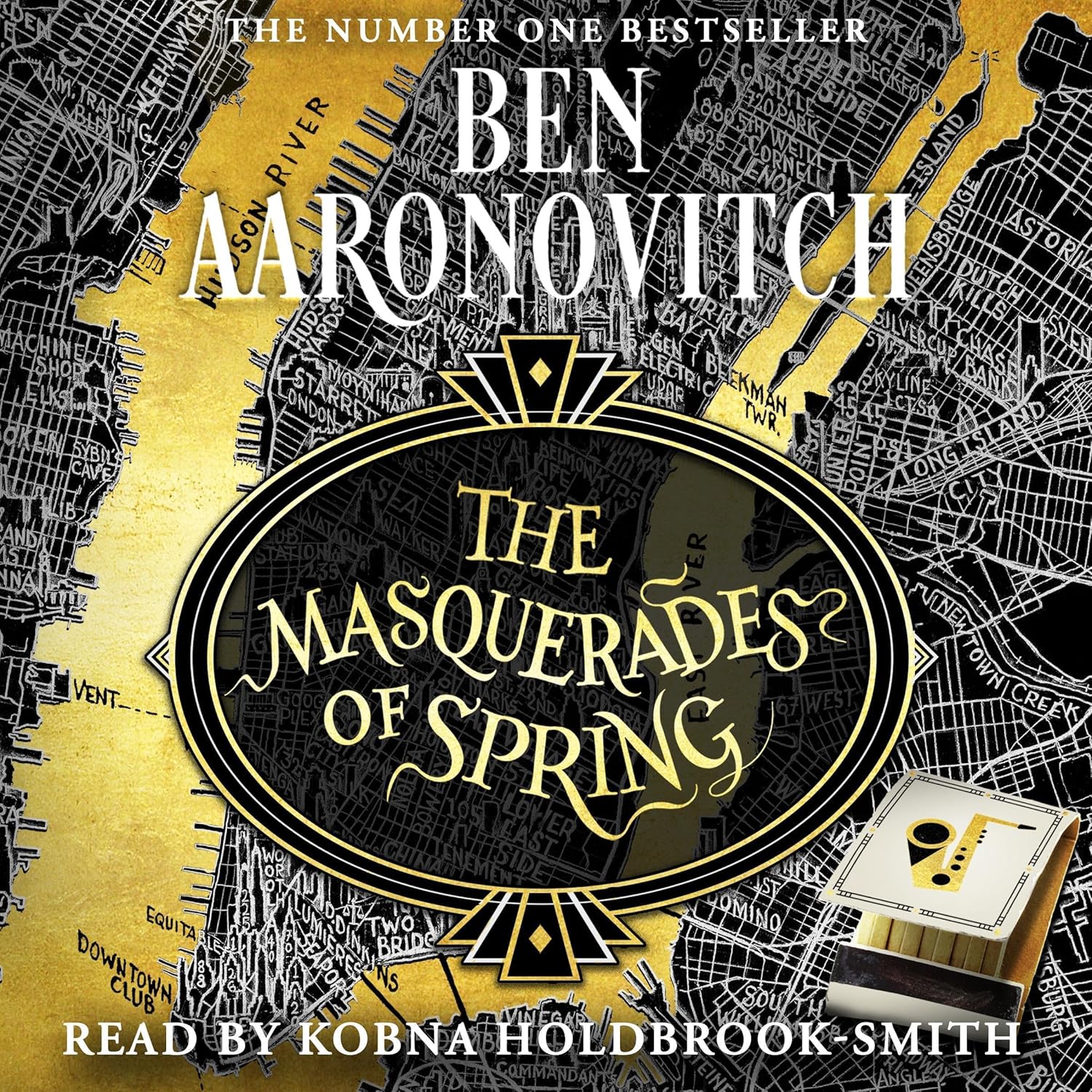
Meet Augustus Berrycloth-Young – fop, flaneur, and Englishman abroad – as he chronicles the Jazz Age from his perch atop the city that never sleeps.
That is, until his old friend Thomas Nightingale arrives, pursuing a rather mysterious affair concerning an old saxophone – which will take Gussie from his warm bed, to the cold shores of Long Island, and down to the jazz clubs where music, magic, and madness haunt the shadows…
I almost didn’t bother with this novella. Jazz does nothing for me and I associate Jazz fans with pseudo-intellectuals trying to be cool. I see nothing romantic about the demimonde of 1920s Harlem, which I associate with the exploitation of the desperate by the predatory rich and, although Jeeves can sometimes make me smile, I find Bertie Wooster annoying. Still, I’ve almost always enjoyed the Rivers Of London books, even the unexciting but mildly entertaining ‘False Value‘, so I gave this a try.
At first, I thought this was going to live down to my worst expectations. The story was told by Augustus Berrycloth Young, an undistinguished recent graduate of Casterbrook, the English Public School where wizards of the right class were trained to use magic and become ‘guardians of the secret flame’, who has fled from London to New York to life a life of leisure where he can enjoy jazz and avoid other people’s expectations of him. Initially, Augustus or Gussie as he styled himself seemed so much an echo of Wooster that he irritated me and I struggled to stay interested in his story. Then, Ben Aarovitch started to work his own magic by turning Gussie into a real person who was, of course, considerably more complex than Wooster,
For me, it started with the description of how Gussie fell in love with Lucy. I saw Gussie and his world differently after that. I stopped labelling Gussie as an intellectually challenged privileged wastrel and saw him as a homosexual man trying to live a fulfilling life in a world that would imprison him for who he was and who he loved. That Lucy was a black man, well known in the Harlem jazz community, gave Gussie an insider’s rather than a predator’s view of the demimonde, a demimonde that, while it offered limited freedom and acceptance to its denizens, still exploited them at every opportunity.
Then Nightingale arrived. A younger, more hands-on, magic-wielding Nightingale. As always, he was a man with a mission and he pulled Gussie into it.
I won’t go into the plot but I think both Nightingale and Gussie came out of things rather well. Their mission was righteous and they were both brave in their very different ways. Nightigale’s mission brought him and, rather reluctantly, Gussie into conflict with some dangerous criminals and worse, with the entitled uber-rich. There was tense action, some remarkable scenes at a Drag Queens’ Ball, car chases and magically enabled derring-do. All in all, it was good fun but good fun with heart.
I listened to the audiobook version of ‘The Masquerades Of Spring’. I thought Kobna Holbrook-Smith did an exceptional job with the voices of the characters and with the tone of his narration. Click on the YouTube link below to hear a sample.
 Mike Finn's Fiction
Wonderful post 🙏🎸
LikeLike
Thank you.
LikeLike