
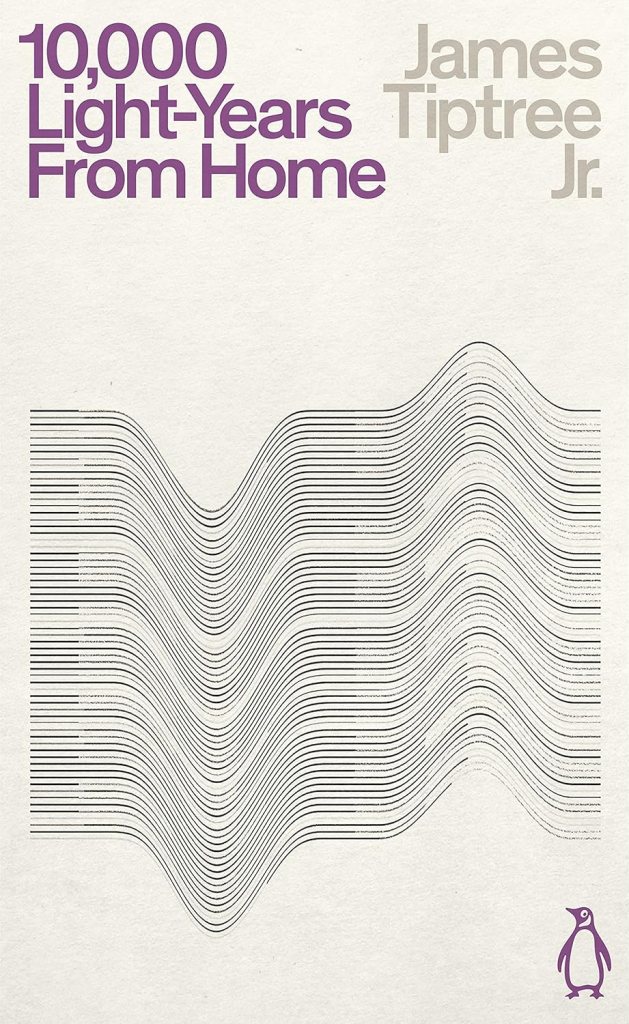
I’m currently re-reading ‘10,000 Light-Years From Home’ (1973) by James Tiptree Jr. It’s a remarkable collection of Science Fiction stories that I first read a few years after it was published I was twenty or so and already a Science Fiction fan of longstanding. I’d Just started to discover what to me was the new wave of women writing Science Fiction: Ursula Le Guin, Vonda McIntrye, Joan Vinge and even Doris Lessing. What I didn’t know back then was that James Tiptree Jr. was, at least in terms of gender, part of that new wave. James Tiptree Jr. was the pen name for Alice Bradley Sheldon,
Fifteen Science Fiction short stories
AND I AWOKE AND FOUND ME ON THE COLD HILL’S SIDE
THE SNOWS ARE MELTED, THE SNOWS ARE GONE
THE PEACEFULNESS OF VIVYAN
MAMA CAME HOME
HELP
PAINWISE
FAITHFUL TO THEE, TERRA, IN OUR FASHION
THE MAN DOORS SAID HELLO TO
THE MAN WHO WALKED HOME
FOREVER TO A HUDSON BAY BLANKET
I’LL BE WAITING FOR YOU WHEN THE SWIMMING POOL IS EMPTY
I’M TOO BIG BUT I LOVE TO PLAY
BIRTH OF A SALESMAN
MOTHER IN THE SKY WITH DIAMONDS
BEAM US HOME
By the 1980’s, James Tiptree Jr’s gender was well-known, although the pen name didn’t change. By then, I was also reading C. J. Cherryh, Pat Cadigan, Sherri Tepper, Kate Wilhelm, and Julian May, so the fact that Tiptree’s muscular prose about alien sex and conflicts between beautiful but merciless female aliens who looked human but were over eight fee tall, didn’t strike me as odd. Maybe that’s why James Tiptree Jr’s bio took me so much by surprise. Here’s what I read at the start of ‘10,000 Light-Years From Home‘:
About the Author
James Tiptree Jr. was the pen name of Alice Bradley Sheldon, whose radical and pioneering science-fiction stories were matched by her extraordinary life. As a child, she travelled widely with her parents and featured in several African-set travel books written by her mother. After attending a finishing school in Switzerland, she embarked on an early career as an artist and art critic. During the Second World War she joined the US Army Air Forces, attaining the rank of major, and then worked for the CIA before moving to a chicken farm in Virginia with her husband. She turned to science-fiction writing as an escape from her PhD thesis on experimental psychology, and chose her pseudonym from a pot of jam. She later explained that: ‘A male name seemed like good camouflage … I’ve had too many experiences in my life of being the first woman in some damned occupation’. Her true sex was kept secret for years. She died in 1987 in what appeared to be a murder-suicide pact with her husband.
The sentence that stood out for me was: “During the Second World War she joined the US Army Air Forces, attaining the rank of major, and then worked for the CIA before moving to a chicken farm in Virginia with her husband.”
I’ve recently read Tess Gerritson’s ‘The Spy Coast‘ in which retired CIA agent, Maggie Bird, moves to rural Maine to take up chicken farming. At the time, I admired Tess Gerritson’s imagination and smiled at the idea of such a change in direction. Now, I’m wondering whether Tess Gerritson knew all about Alice Bradley Sheldon.
Then there was that last sentence: “She died in 1987 in what appeared to be a murder-suicide pact with her husband.” This is not a typical author bio.
So I went looking for more and found, ‘James Tiptree, Jr.: The Double Life of Alice B. Sheldon‘ (2006) by Julie Philips.

Alice Bradley Sheldon was born in Chicago in 1915. As a child, she crossed Africa with her explorer parents. Later she became a painter, a CIA agent, a psychologist, and at age fifty-one made yet another career change.
James Tiptree, Jr., appeared on the science fiction scene in 1967. His stories were fast-paced and hard-boiled, his letters frank and sensitive. For nearly ten years he carried on intimate correspondences with fellow writers Philip K. Dick, Harlan Ellison, and Ursula K. Le Guin. But no one knew who he really was. Then, assumptions about writing and gender were demolished when “he” was revealed to be Alice B. Sheldon.
Based on extensive research and full access to Sheldon’s papers, James Tiptree, Jr., is the suspenseful, engrossing, and tragic biography of a profoundly original writer and woman far ahead of her time.
At 469 pages, it’s not going to be a quick read but it sounds like it will be a fascinating one.
If you’d like to find out more, click HERE to go the 2006 Salon interview with Julie Phillips

 Mike Finn's Fiction
I’ve been reading Her Smoke Rose Up Forever and I’ve got the biography on the way. Dying to read it as Sheldon’s life seems absolutely fascinating. Thanks so much for the blog. I will be checking it out.
LikeLike
I hope you enjoy her fiction and her autobiography. She’s still one of my favourite SF writers.
LikeLike