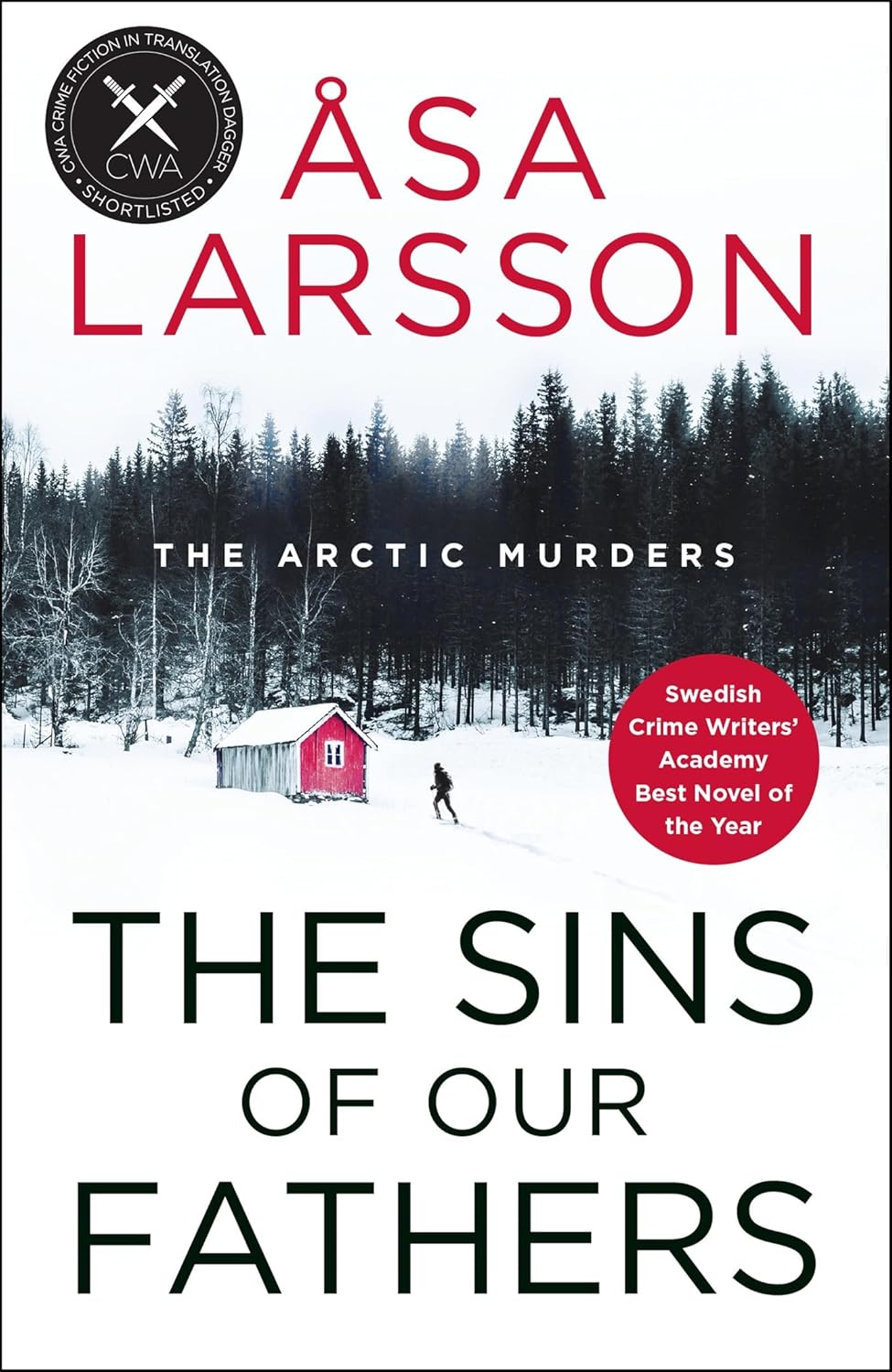
Forensic pathologist Lars Pohjanen has only a few weeks to live when he asks Rebecka Martinsson to investigate a murder that has long since passed the statute of limitations. A body found in a freezer at the home of the deceased alcoholic, Henry Pekkari, has been identified as a man who disappeared without a trace in 1962: the father of Swedish Olympic boxing champion Börje Ström. Rebecka wants nothing to do with a fifty-year-old case – she has enough to worry about. But how can she ignore a dying man’s wish?
When the post-mortem confirms that Pekkari, too, was murdered, Rebecka has a red-hot investigation on her hands. But what does it have to do with the body kept in his freezer for decades?
Meanwhile, the city of Kiruna is being torn down and moved a few kilometres east, to make way for the mine that has been devouring the city from below. With the city in flux, the tentacles of organized crime are slowly taking over . . .
IN A NUTSHELL
The Sins Of Our Fathers‘ was an excellent conclusion to the six-book Rebecka Martinsson series. It went well beyond the remit of a typical crime novel, tackling themes of the damage that anger, greed, and envy do, and the long shadows that they cast across generations. It was a solid mystery, told across two timelines. It also reached a milestone in Rebecka Martinsson. Rebecka was broken at the start of the series, and she remains broken at the end, but she is making the best life for herself that she can.
At 600 pages, ‘The Sins Of Our Fathers‘ was a lengthy crime novel, but I was grateful for that, as it gave Åsa Larsson the space to deliver a powerful, complex novel that brought the series to a satisfying conclusion.
The story was immersive, people-centric and trope-free. Emotions, fleeting and or irrepressible, were captured perfectly. The plot was powered as much by anger, envy, guilt and a struggle for hope and purpose, as it was by solving the murders. Telling the story in two timelines within one lifetime showed the long shadows trauma and regret cast over our lives.
I thought this was a wonderful read. It was so much more than a crime novel. It was a book that understood that we all make mistakes and that all of the mistakes have consequences, that life can be crap and people can be awful, that greed and the lust for power breeds predators who hunt us, but that kindness, forgiveness and the ability to find and hold onto the things that matter to us offers, if not salvation, then at least meaning.
One of the most distinctive things about the series was that Rebecka Martinsson, the central character, suffers traumas so severe that she loses her mental health and has to spend time in a psychiatric hospital to help her learn to cope. Despite, or perhaps because of, this, she continues to work hard on the cases that come her way, even when the emotional toll they take is high. She isn’t a superhero. She doesn’t solve cases single-handedly. She doesn’t always know what she wants or what she needs, but she always tries to do the right thing. I liked that, in this final book of the series, Rebecka wasn’t suddenly restored to robust mental health so that she could ride off into the sunset for her Happy Ever After ending. She remains broken and she knows that. Yet she has started to understand what she wants and needs and is doing the best she can to make a life for herself.
For me, this book, even more than the five that preceded it, sets the bar for what Nordic Noir can be.
 Mike Finn's Fiction
Excellent appraisal – thank you.
LikeLiked by 1 person