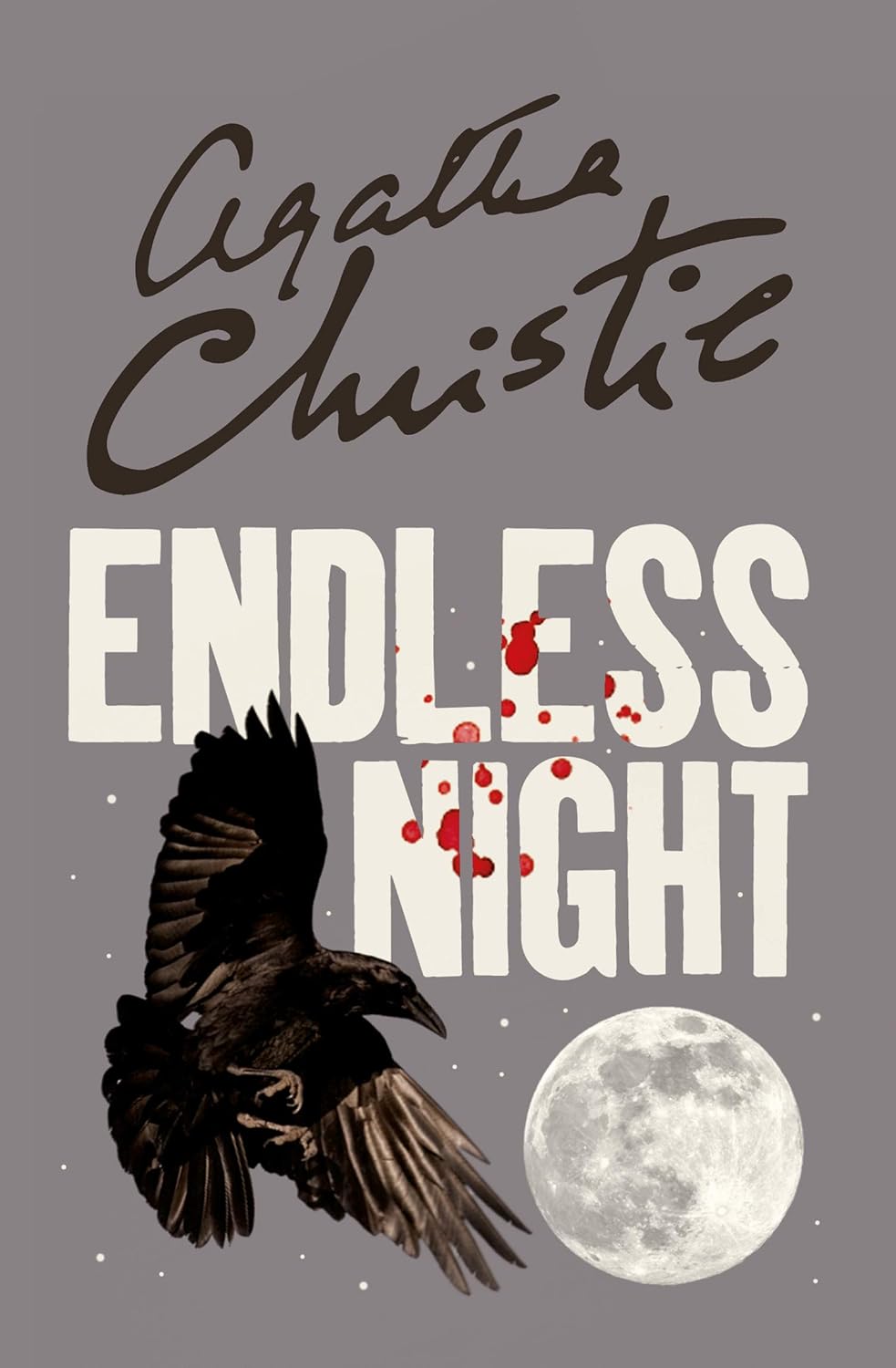
Gipsy’s Acre was a truly beautiful upland site with views out to sea – and in Michael Rogers it stirred a child-like fantasy. There, amongst the dark fir trees, he planned to build a house, find a girl and live happily ever after. Yet, as he left the village, a shadow of menace hung over the land. For this was the place where accidents happened. Perhaps Michael should have heeded the locals’ warnings: ‘There’s no luck for them as meddles with Gipsy’s Acre.’ Michael Rogers is a man who is about to learn the true meaning of the old saying ‘In my end is my beginning.’
GoodReads provided these snippets of information about ‘Endless Night‘
The title Endless Night was taken from William Blake’s Auguries of Innocence and describes Christie’s favourite theme in the novel: a “twisted” character, who always chooses evil over good.
Christie finished Endless Night in six weeks, as opposed to the three-four months that most of her other novels took. Despite being in her seventies while writing it, she told an interviewer that being Michael, the twenty-something narrator, “wasn’t difficult. After all, you hear people like him talking all the time.”
The book is dedicated to Christie’s relative “Nora Prichard from whom I first heard the legend of Gipsy’s Acre.” Gipsy’s Acre was a field on the Welsh moors.
‘Endless Night’ was a wonderful surprise. It was original, modern, and remarkably cinematic. It felt like watching the most recent film versions of ‘The Talented Mr Ripley‘ or ‘My Cousin Rachel‘. In a blind test, I wouldn’t have guessed this was Christie’s work, except for how twisty the plot is, and how blindsided I was by the ending.
This was a very contemporary novel for 1967, written about and from the point of view of Michael Rogers, a young man who is very much of his time. That Christie could, in her seventies, write such a compelling story entirely as a first-person account by a twenty-something Englishman is a mark of her skill.
There are no clever detectives in this book. No interviews with suspects to garner clues to who did what. For most of the book, it’s not even clear what there is for any detective to investigate. And yet, there is from the start a sense of doom, a feeling that a curse has been unleashed or a geas challenged, perhaps from the moment that Michael Rogers met Ellie Goodman in the woods at Gipsey’s Acre. The tone of Michael Rogers’ storytelling makes it sound as if he has an albatross around his neck, and all that remains is to discover how it came to be placed there.
Although this tale is told from Michael Roger’s point of view, there isn’t much introspection in his storytelling. From the start, he felt to me like a man who habitually puts on a show. He seemed callow, reflexively mendacious and quietly secretive. He’s a man who harbours deep longings for things he doesn’t have. He can be passionate about art and architecture. He woos the young Ellie Goodman gently but persistently, seeming to see in her something he would like to see in himself but is unable to find. He sees her as living in the light while he is doomed to the endless night.
The sense of a doom yet to be revealed is created partly by extensive foreshadowing, especially of the character of Greta, the capable young woman who manages Ellie’s life for her, winning her freedom from the constraints her family places on her. I found myself looking forward to the first meeting between Greta and Michael. I knew there would be fireworks. I’d hoped that the jealous, controlling side of his character that I thought he was trying to hide might show itself and give Ellie fair warning. Greta turned out to be everything that I expected and more.
I won’t go into the plot. It’s clever and stays the reader’s mind, but it’s hard to discuss without spoiling the impact of the story for the first-time reader.
I think the thing that most marks this as a Christie novel, despite the variation in style, is how she lays out the whole story on the first page, but does it in such a way that when you re-read the first page after finishing the book, your understanding of the text has completely changed. There’s no cheating involved. Just a subtle shift in perspective. Here’s the passage I’m thinking of:
“In my end is my beginning … That’s a quotation I’ve often heard people say. It sounds all right—but what does it really mean?
Is there ever any particular spot where one can put one’s finger and say: ‘It all began that day, at such a time and such a place, with such an incident?’
Did my story begin, perhaps, when I noticed the Sale Bill hanging on the wall of the George and Dragon, announcing Sale by Auction of that valuable property ‘The Towers’, and giving particulars of the acreage, the miles and furlongs, and the highly idealized portrait of ‘The Towers’ as it might have been perhaps in its prime, anything from eighty to a hundred years ago?
I was doing nothing particular, just strolling along the main street of Kingston Bishop, a place of no importance whatever, killing time. I noticed the Sale Bill. Why? Fate up to its dirty work? Or dealing out its golden handshake of good fortune? You can look at it either way.
Or you could say, perhaps, that it all had its beginnings when I met Santonix, during the talks I had with him; I can close my eyes and see: his flushed cheeks, the over-brilliant eyes, and the movement of the strong yet delicate hand that sketched and drew plans and elevations of houses. One house in particular, a beautiful house, a house that would be wonderful to own!
My longing for a house, a fine and beautiful house, such a house as I could never hope to have, flowered into life then. It was a happy fantasy shared between us, the house that Santonix would build for me—if he lasted long enough …
A house that in my dreams I would live in with the girl that I loved, a house in which just like a child’s silly fairy story we should live together ‘happy ever afterwards’. All pure fantasy, all nonsense, but it started that tide of longing in me. Longing for something I was never likely to have.
Or if this is a love story—and it is a love story, I swear—then why not begin where I first caught sight of Ellie standing in the dark fir trees of Gipsy’s Acre?”
I think this is one of Christie’s best novels. If you haven’t read anything else by her, I recommend you start here. If you think you know her writing well, read this and enjoy the differences.
 Mike Finn's Fiction
Brilliant review Mike!! I thoroughly enjoyed this read!
LikeLike
Thank you.
LikeLike