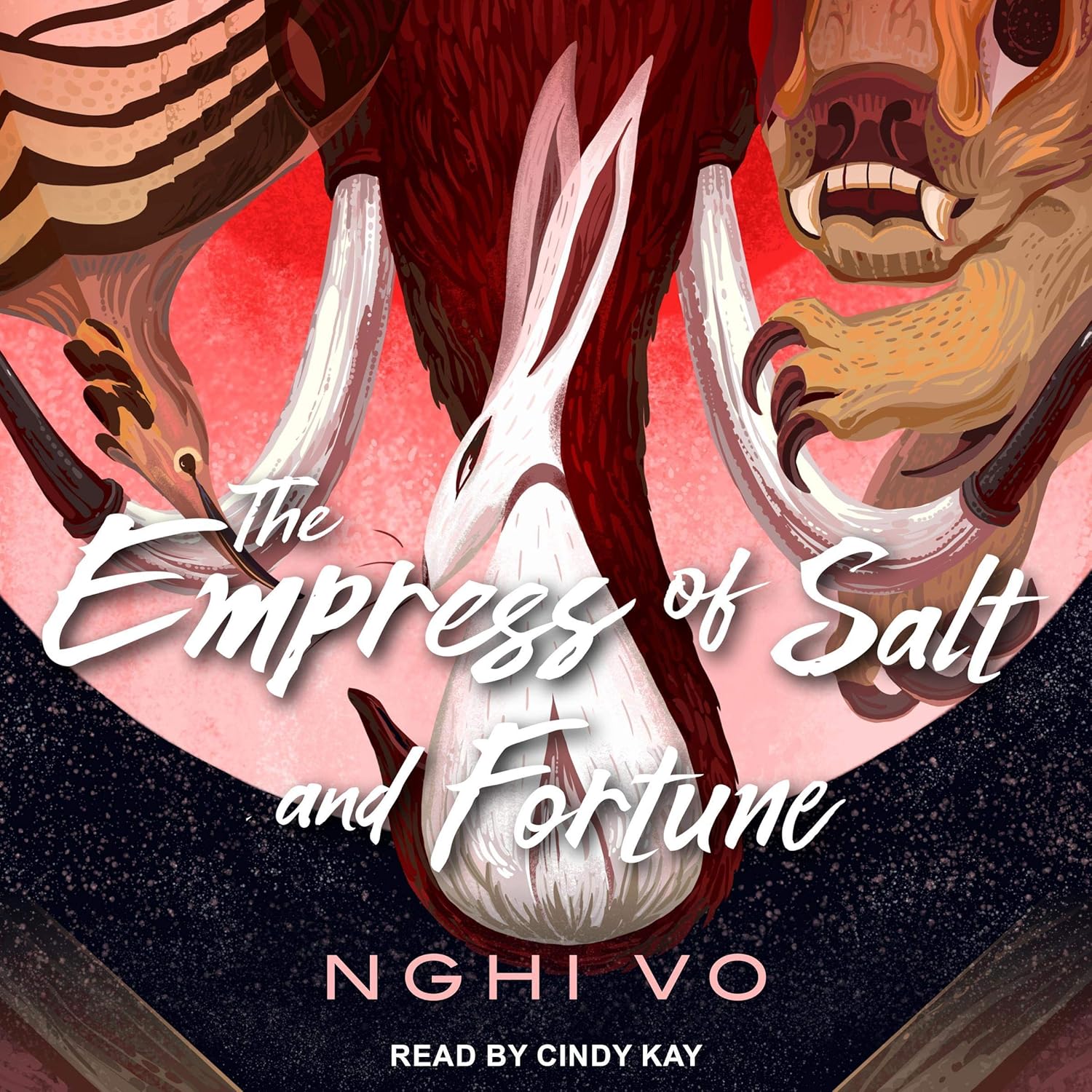
A young royal from the far north is sent south for a political marriage in an empire reminiscent of imperial China. Her brothers are dead, her armies and their war mammoths long defeated and caged behind their borders. Alone and sometimes reviled, she must choose her allies carefully.
Rabbit, a handmaiden, sold by her parents to the palace for the lack of five baskets of dye, befriends the emperor’s lonely new wife and gets more than she bargained for.
At once feminist high fantasy and an indictment of monarchy, this evocative debut follows the rise of the empress In-yo, who has few resources and fewer friends. She’s a northern daughter in a mage-made summer exile, but she will bend history to her will and bring down her enemies, piece by piece.
I read Nghi Vo’s short story, ‘Stitched To Skin Like Family Is‘ (2024) when I saw that it had won the 2025 Hugo Award for Best Short Story. It was a powerful story, told in an original way, so I went looking for more of her work.
I found an audiobook version of a novella called ‘The Empress of Salt and Fortune‘ (2020), which is listed as the first book in the Singing Hills Cycle. It had nothing in common with ‘Stitched To Skin Like Family Is‘ except that the storytelling was original and mesmerising, and the content was chilling.
The storytelling structure is distinctive and deceptively simple. It’s not a propulsive linear narrative that takes the reader’s imagination on a thrilling fairground ride of twists and shocks. It’s a quiet, mostly static story that tacitly promises the reader that there is treasure to be found if you have the patience to unwrap everything and the acuity to pull the piecestogether.
In the beginning, the story seems as innocuous as a gingerbread house in a forest. How exciting could it be to watch a young cleric and a talking memory bird called Almost Brilliant inventory the abandoned palace of a dead empress while listening to the reminisces of her now-elderly handmaiden, especially when the handmaiden is an approachable old woman called Rabbit?
But the objects being inventoried summon stories of a young woman who rose from being an exiled ancillary wife of the Emperor to being the revered ruler of the Empire. And Rabbit was her confidante through all of it.
In the space of 110 pages, Nghi Vo creates a whole world, tells the story of two young women brought to court against their will, one a princess and one a peasant who, in the course of their long lives, changed the world.
The story is set in a fictional empire that is reminiscent of Imperial China, except that magic is routinely used to control the weather and to fight wars (which sometimes are the same thing). The Emperor’s rule is absolute. His hunger for power is implacable. His use of violence and cruelty to maintain or extend that power is taken for granted.
So what could a young woman, a barbarian princess from a northern land, cut off from her people and exiled to a remote palace with a peasant girl as her only constant companion, do to change things?
I fell into this story easily and happily. The young cleric managed to be more than a plot device, although they were outshone in every scene by Rabbit and her reminiscences. I particularly liked that this turned out to be as much Rabbit’s story as the dead Empress’.
I recommend the audiobook. Cindy Kay’s narration perfectly captures the tone of the story. Click on the YouTube link below to hear a sample.
Nghi Vo became a writer because while there were alternatives, none of them suited her as well as a lifetime of endless research combined with simply making things up.
She is the author of Siren Queen, The Chosen and the Beautiful, and The Singing Hills Cycle, including The Empress of Salt and Fortune, When the Tiger Came Down the Mountain, and Into the Riverlands.

 Mike Finn's Fiction