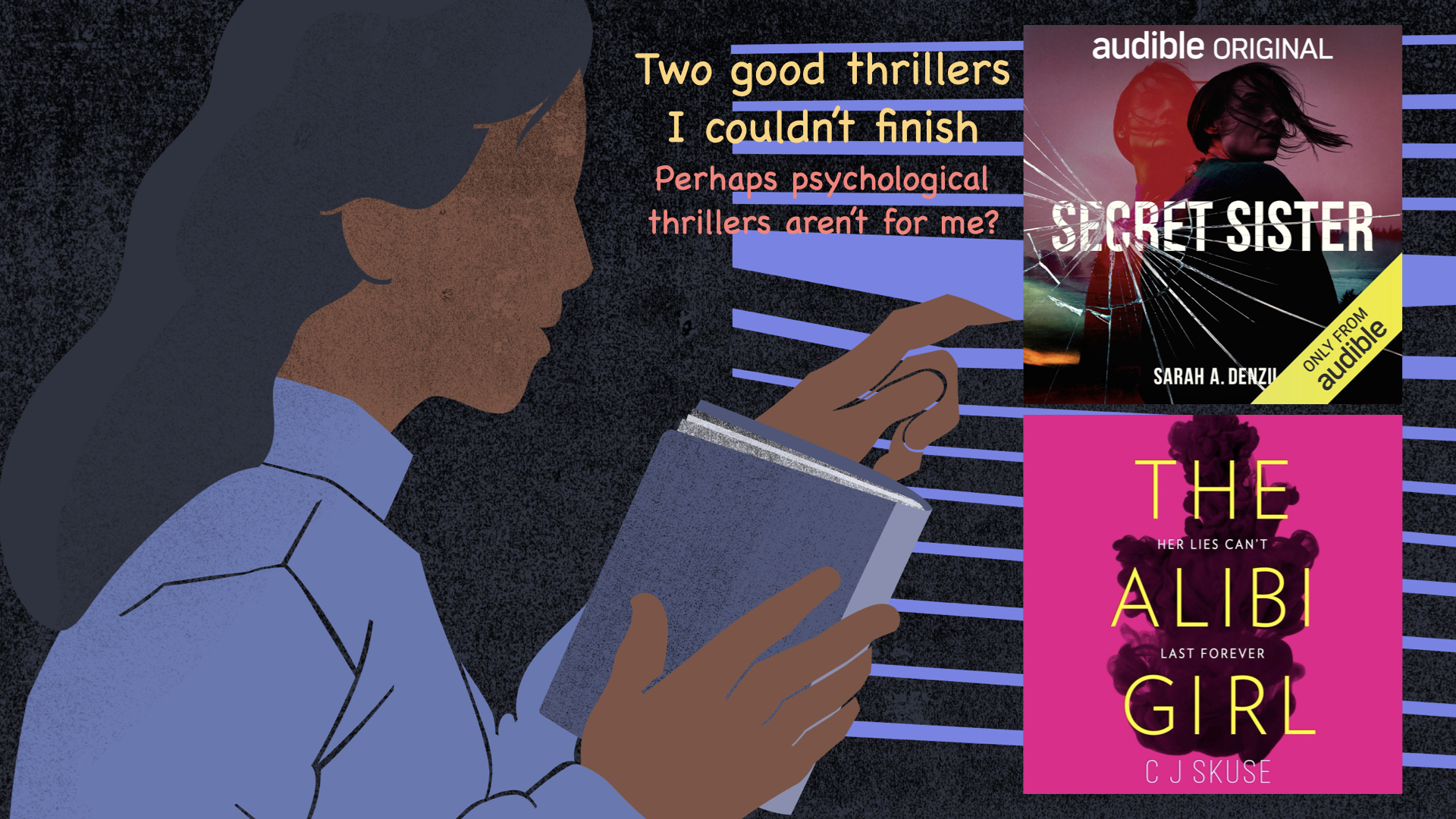
This week, I’ve had the unusual experience of setting two books aside, not because they weren’t good but because they were so well-written that I found them upsetting. Maybe this is a sign that psychological thrillers aren’t for me.
Here are the two books and how they affected me.

On the Yorkshire moors, celebrated author Faye Mathis is coming to terms with her early-onset dementia. She has begun writing her memoir, committing her past to paper before her memory betrays her. But her family history is full of gaps, bloodlines cut short, family ties all ending in knots…
When a picture of Faye – dirty and dishevelled, stumbling alone on the moors – goes viral, her life is thrown into chaos. Faye is convinced she is not that person in the photograph. But how can she be sure?
Faye sets out to find the true identity of the woman in the photograph. But the more questions she asks, the more confounding the truth becomes. As her darkest suspicions begin to bear true, Faye is forced to question all that she knows and everything she doesn’t.
Because every family has secrets, and there’s always someone who wants them to remain that way.
‘Secret Sister‘ (2025) is an Audible Original, written by Sarah A. Denzil (‘Silent Child‘, ‘The Housemaid‘, ‘The Woman In Coach D‘) and narrated by Jessica Gunning, Sacha Dhawan, Joanne Froggatt, Nathaniel Curtis, Hopi Grace.
This is a project Audible have put money into. The production standards are high. It’s a powerful audiobook.
It opens with a man digging a grave in the dark of the night on a Yorkshire moor for a woman who is not yet dead. Things do not go to plan. Then it shifts to our heroine, Faye Mathis, who is living alone in her house on the moors. Faye is a fifty-year-old, divorced, best-selling author of children’s books about a pair of sleuthing teenage twins. She’s recently been diagnosed with dementia and believes she will soon no longer be able to function.
It’s a great set-up that gets even more intense when it becomes clear that there are some secrets associated with Faye’s adoption that may now pose a threat to her.
The story is well-told and well-narrated. It gets more and more intense. There’s a rich suspect pool of people who may be ready to betray Faye, possibly even kill her. Faye is struggling to understand how much of what’s going on is real and how much is a side effect of her dementia-produced paranoia.
At the start of the book, I was pulled along by my curiosity about Faye and her situation. By the time I was halfway through the book, I’d grown to like Faye and to understand how vulnerable she was and how much malice was heading her way. I realised two things. Firstly, the rest of the book was likely to be about very unpleasant things happening to a vulnerable woman. She might survive it all, but she’d go through hell first. Secondly, I had no desire to wade through that, no matter how well done it was. It was too real and too upsetting.
I like my thrillers to be thrilling. The thrill should be believable enough to keep me engaged, but not so real that thrill turns to upset. This started to feel like I was inflicting trauma on myself in the name of entertainment.
Joanne Haynes has a secret: that is not her real name.
And there’s more. Her flat isn’t hers. Her cats aren’t hers. Even her hair isn’t really hers.
Nor is she any of the other women she pretends to be. Not the bestselling romance novelist who gets her morning snack from the doughnut van on the seafront. Nor the pregnant woman in the dental surgery. Nor the chemo patient in the supermarket for whom the cashier feels ever so sorry. They’re all just alibis.
In fact, the only thing that’s real about Joanne is that nobody can know who she really is.
But someone has got too close. It looks like her alibis have begun to run out…
I’ve read and enjoyed two of C. J. Skuse’s female serial killer books, ‘Sweetpea‘ (2017) and ‘In Bloom’ (2018), so I had high expectations of her standalone novel, ‘The Alibi Girl‘ (2020). I wasn’t disappointed. It was well-written and well-narrated.
I immediately felt like I was living in the head of Joanne Haynes, the main character. Joanne is an adult who still wants to be a child. She lies all the time, partly for survival, partly to cope with her isolation, and partly because the lies are as real to her as the truth of a life she doesn’t want to be living.
The story is told from Joanne’s point of view, so, given how often and how extravagantly she lies, it takes a while to figure out what’s really going on. It’s clear that Joanne is in hiding, but I didn’t know from whom or why. The exposition was beautifully done, vividly evoking the trauma, the anxiety, the compulsions and the threats that shape Joanne’s life.
Present-day Joanne is twenty-eight, but the key events of the story took place when she was ten years old. C J Skuse captured the ten-year-old girl’s view of the world perfectly and poignantly. Her life then was a mixture of innocence, trust, fantasy, and an all-absorbing friendship with her cousin. What the ten-year-old Joanne could not see, but the reader can, is that Joanne’s father’s behaviour is placing her at risk.
‘The Alibi Girl’ is an immersive story. The reader lives in Joanne’s head and that’s not at all a pleasant place to be, not because Joanne is unpleasant but because she’s unstable. It’s an instability caused by trauma. A trauma that smashed a little girl’s world and left her isolated, unable and unwilling to deal with being an adult but deeply afraid of being found by the people who are hunting her.
Joanne’s life, her history, her anxiety, her neuroses were too grim for me by the time I was halfway through the book, so I set it aside.
It may seem odd that I’ll happily read C J Skuse’s novels about a serial killer who always has a list of people she’d like to kill, but couldn’t face reading about a woman who was broken at ten years old and has never recovered. For me, the difference is that I could keep a mental and emotional distance between me and the serial killer, even while being deeply engaged in what was happening to her, but I couldn’t keep that distance from Joanne, especially Joanne at ten years old.
 Mike Finn's Fiction