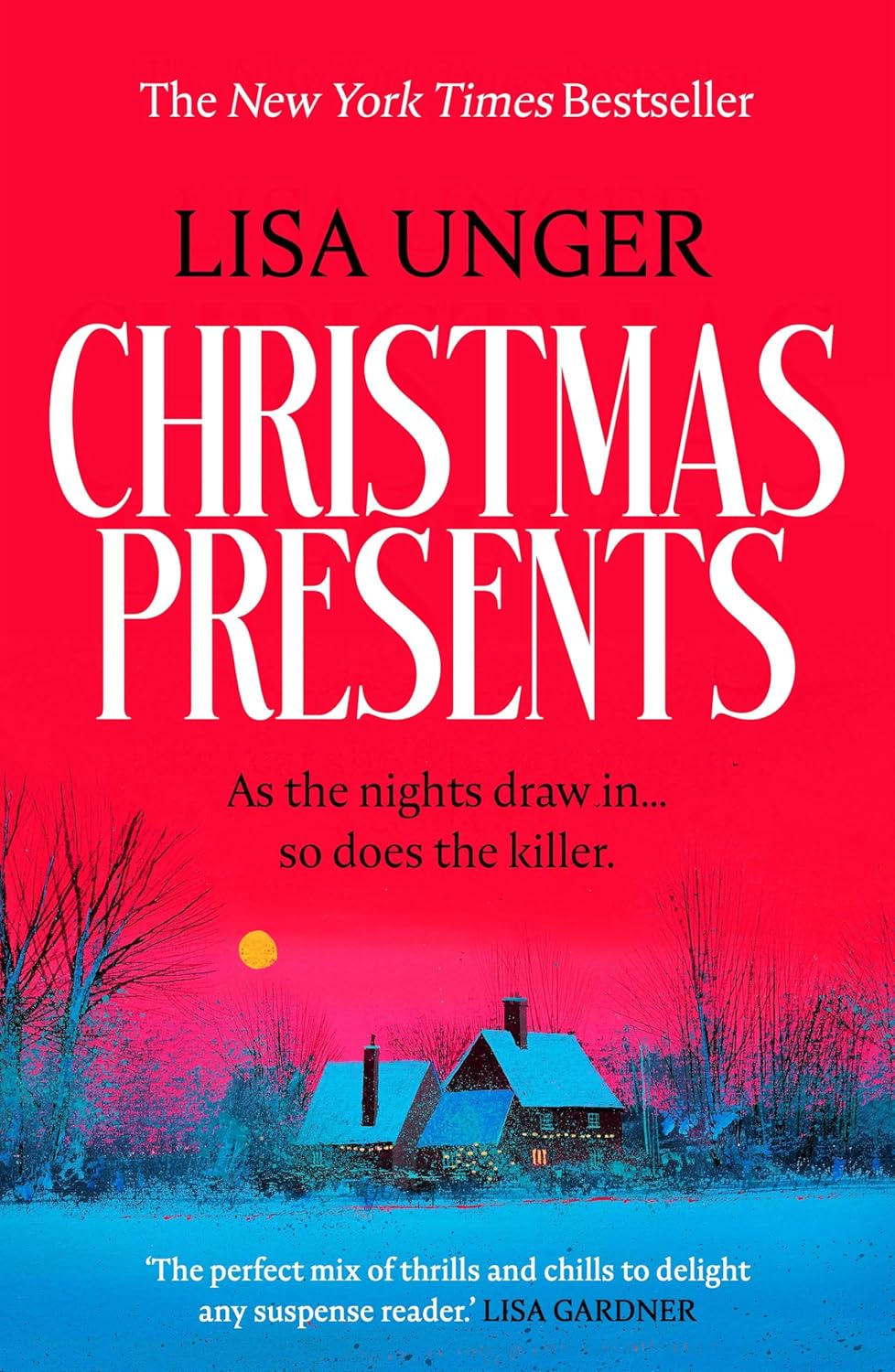
When true crime podcaster Harley Granger drifts into Madeline Martin’s bookshop days before Christmas, he seems intent on digging up a past that Madeline would much rather forget.
Granger’s work has earned him fame and wealth – and some serious criticism for his various unethical practices. Granger also has a lot of questions about the night Madeline was left for dead, the only surviving victim of killer Evan Handy.
Handy, who also murdered Madeline’s best friend and is suspected in the disappearance of two local sisters, has been in jail for a decade. Since then, though, three other young women have gone missing in similar circumstances. Is the true predator still out there somewhere?
As Christmas approaches and a blizzard bears down, Madeline must confront the past to answer questions that have haunted her since that day. Is the truth more terrible than she ever imagined?
IN A NUTSHELL
‘Christmas Presents’ is a powerful novella-length thriller about the damage a serial killer does to a small town. It’s clever, original, tautly-crafted, surprising, and propulsive. It uses dual timelines with great precision to maximise both the tension of the story and empathy with the victims and survivors.
I picked up ‘Christmas Presents‘ after enjoying Lisa Unger’s clever short story ‘The Kill Clause’ (2025), which was also set at Christmas. I enjoyed ‘Christmas Presents’ even more. It was a rich reading experience that had much more depth to it than I’d expected of what seemed to be a serial killer thriller.
What I liked most about it was that the focus was on the women, not on the killer. The story felt grounded in the community of the small town. The plot twists added to the tension, but didn’t feel like magic tricks. Family, friendship, and second chances were as central to the story as the darkness unleashed by the killer.
The prologue to ‘Christmas Presents‘ surprised me. I didn’t expect a Christmas thriller to start in a topless bar. In some ways, it sets the tone for the novel. It’s told from the point of view of the young woman dancing on the stage, looking out over the collection of men watching her gyrate around a pole. She comes across as intelligent and transactional. The men come across as ranging from sad to predatory.
Chapters 1 and 2 were closer to what I’d expected. The focus moved to a young woman running a bookshop in a small town and a true crime podcaster who wants to interview her about past trauma. There were lots of hints about dark things in the collective past of a small group of friends. The True Crime podcast guy was positioned as being almost as predatory as the serial killer whose case he wanted to return to.
Yet, after those two chapters, the prologue kept nagging at me. I wanted to know how it fit with the rest of the story. I didn’t know whether it was happening in the past, present, or future, or how or if the two young women were connected, but I really wanted to find out which, I guess, was the response the prologue was designed to trigger.
The story was told from three perspectives: the young dancer, the young bookstore owner, and the true crime podcaster. The podcaster’s sections were all in the present day. The bookstore owner’s sections were in the present day but were supplemented by her memories of the traumatic night on which she was nearly killed by a serial killer and the events leading up to that night. For much of the story, I wasn’t sure when the dancer’s sections were happening in relation to the timeline of the other two.
This may sound complicated, but it wasn’t confusing. It was engaging and skillfully done. The shifts in point of view seemed to me to be deliberately disruptive, forcing me to look at events from different perspectives. The backstory and the present day were woven together to strengthen characterisation and deepen my engagement with the fates of the young women.
I admired how Lisa Unger slowly raised my level of unease as I started to understand that the people in this pretty, snow-covered small town were living in the shadow of a violent past that had left unanswered questions haunting them like ghosts. The phrase ‘The past is alive’ was a theme that dominated the book.
The story uses familiar genre tropes as the dough and engaging, realistic, slightly broken characters as the yeast. The result was a story that pulled no punches in showing the damage done by the serial killer, but which focused on survival, forgiveness, second chances, and the bravery of the young women.
I’ll be back for more Lisa Unger. I have her 2006 novel ‘The Red Hunter‘ on my shelves, and I’ll be pulling it to the top of my TBR pile soon.

Lisa Unger is theg author of twenty-three novels, including her upcoming release SERVED HIM RIGHT (March, 2026).
She has been nominated for, or won, numerous awards including the Strand Critics, Audie, Hammett, Macavity, ITW Thriller, and Goodreads Choice. In 2019, she received two Edgar Award nominations in the same year, an honor held by only a few authors including Agatha Christie.
Her short fiction has been anthologized in The Best American Mystery and Suspense
Lisa is the current co-President of the International Thriller Writers organization. She lives on the west coast of Florida with her family.
 Mike Finn's Fiction