
Graham Richards, the sole survivor of a deadly shooting, has retreated to a remote cabin in the woods to escape the pain of his past. Living off the grid, he grows his own food and uses solar power for his energy needs, hoping to spend the rest of his life in obscurity.
However, Graham’s desire for solitude is shattered when a little girl goes missing in the nearby town, and the scarred man in the lonely cabin becomes the prime suspect. Graham finds himself pulled back into the world he wanted to leave behind, using his survival skills and instincts honed from years in the wilderness to clear his name and find the missing girl. But as he delves deeper into the case, he realizes that the threat is far greater than he ever imagined.
With gripping suspense and emotional intensity, this must-read thriller takes readers on a journey of heart-stopping danger and unexpected twists. Will Graham be able to confront his demons and save the missing girl before it’s too late? Fans of intense psychological thrillers won’t want to miss this haunting tale of one man’s fight for redemption.
IN A NUTSHELL
A compelling book. Very violent. Very vivid. Very tense. A thriller amplified by a touch of the supernatural. A story about darkness: those who create it, those who suffer under it, those who can see it, and those who will do what it takes to end it.
Don’t judge this one by its cover. ‘Off The Grid’ isn’t a cosy, or even an upbeat, book. It’s exciting and surprising, but it’s also filled with graphic descriptions of savage violence, sexual predation and gleefully vicious murders. Does it sound bad if I say that I enjoyed this book a lot?
The first few pages of the Prologue almost lost me. They felt like a TV movie collage of a happy family that you know is doomed. I didn’t believe it. Until the violence started. Then, I couldn’t look away from it.
Then, suddenly, I’m somewhere else. A little girl has gone missing. A detective is investigating it, and I’ve no idea how it all connects to the Prologue…. but I really want to know.
By the time I was a third of the way through the book, I was hooked. Here’s what I wrote:
“I’m enjoying this. I’m eager to read more. It feels quirky, not in a trying too hard to be zany way, but in an I see the world differently way. The story is engaging. Some of the writing shines. The pacing works, AND I have no idea where this is heading.”
The quirkiness didn’t let up. I’d thought the whole thing would be about our reclusive hero’s search for the missing girl and how he and the detective interacted. It wasn’t. There was a surprising resolution, and we moved on.
Suddenly, I was involved with a whole new set of people and an even deeper level of darkness. I was immersed in the action and engaged with the people. I worked out that I was reading something dark and dangerous, but I still had no idea where it was going. Here’s what I wrote two-thirds of the way through.
“This is vivid and surprising. Much of it is told from the point of view of people in serious trouble, and it’s told in a way that gets me deeply engaged with their fear and their hope. There is a lot of violence. It’s not gratuitous, but it pulls no punches. This is a world where bad things happen to people who don’t deserve it and where no one’s survival is guaranteed.”
I admired how John Hunt succeeded in telling the story from multiple points of view while keeping me engaged and often tense. I’d expected our off-the-grid protagonist to be a version of Evan Smoak, a quiet, uniquely skilled man at the centre of the action, protecting the weak and rescuing the vulnerable. Instead, I got a damaged man who wants to be left alone and only gets involved if he absolutely has to. He’s central to the plot but he’s not all that the plot is about.
The violence in the book was sometimes hard to take, but it was central to what the book was about. It was never exploitative. What made it hard to take was that both people being subjected to the violence and the people unleashing it felt real.
The ending surprised me but didn’t disappoint me. It was as unexpected as the rest of the book, but it felt right.
When I finished the book, I found myself reconsidering the title. It applies to a lot of the characters in the book. Our damaged hero is off the grid because it pains him to be around people. The bod guys go off the grid so that they can kill without being caught. Their victims are selected because they live at the margins of society; they are off the grid in the sense that no one will come looking for them. The violence in the book is emblematic of what can happen off the grid when we choose to leave society behind or are excluded from it, when there is nothing to hold back the darkness except our own will.
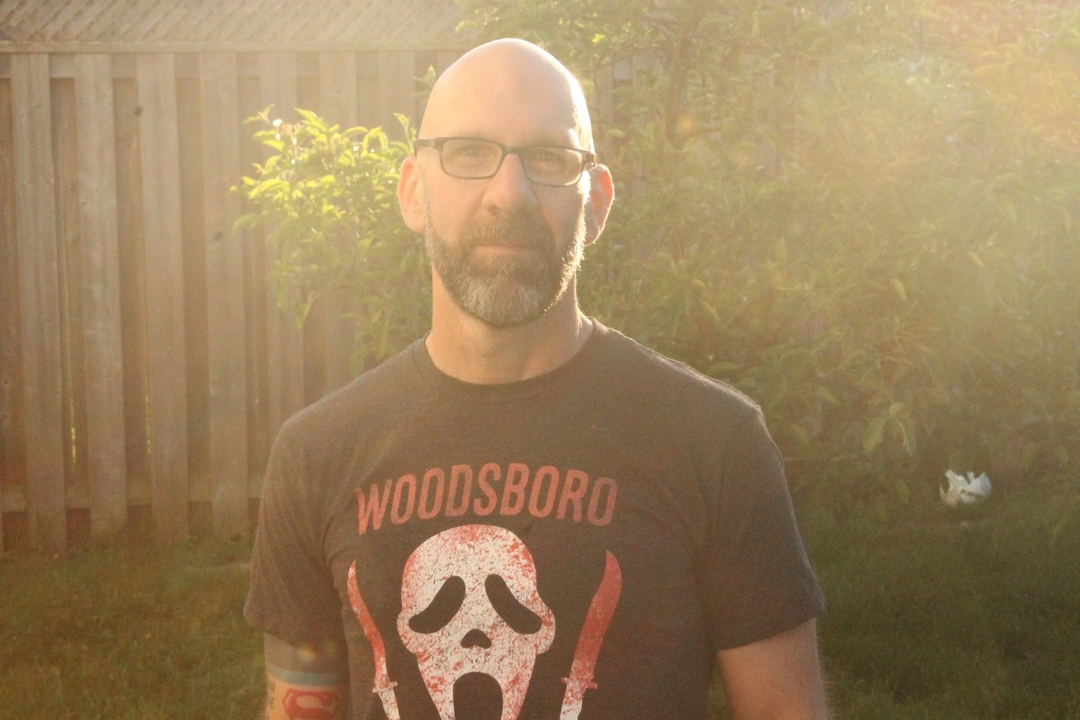
A busy father of four with a dog and cat, John Hunt lives and works in Guelph, Ontario, Canada.
He has had nine short stories published in various anthologies and is a member of the Horror Writers Association.
He is the author of Doll House, The Tracker, Off The Grid, Murder Run, Olivia, (the sequel to Doll House), Balance (a post-apocalyptic novella ,and Four Shots of Horror ( a short story anthology).
 Mike Finn's Fiction