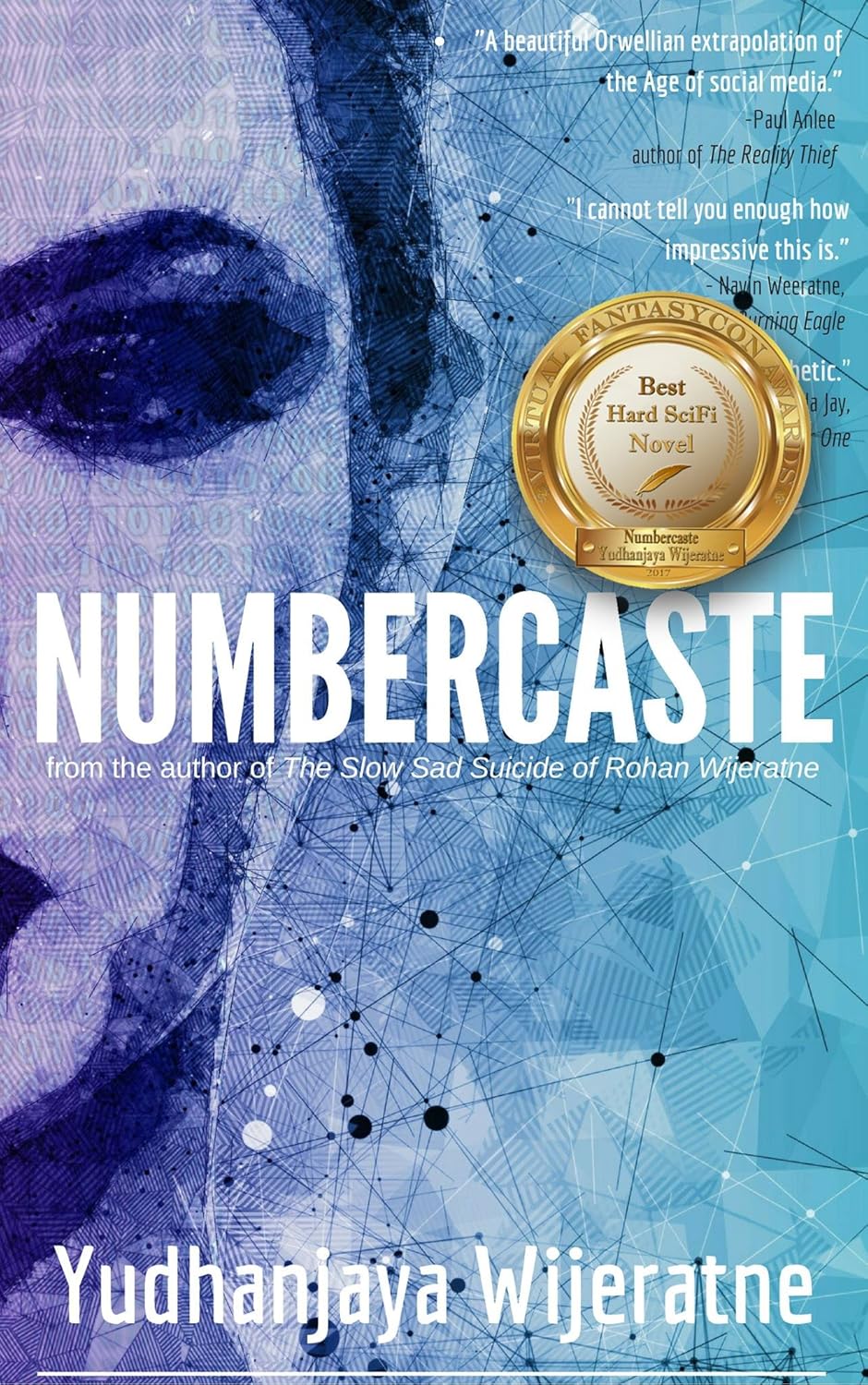
When Patrick Udo is offered a job at NumberCorp, he packs his bags and goes to the Valley. After all, the 2030s are a difficult time, and jobs are rare. Little does he know that he’s joining one of the most ambitious undertakings of his time or any other.
NumberCorp, crunching through vast amounts of social network data, is building a new society – one where everyone’s social circles are examined, their activities quantified, and their importance distilled into the all-powerful Number. A society where everything from your home to your education to entry at the local nightclub depends on an app that states exactly how important you are. As NumberCorp rises in power and in influence, the questions start coming in. What would you do to build the perfect state? And how far is too far?
I was impressed by Yudhanjaya Wijeratne’s mindbending novel ‘The Salvage Crew’ (2020), so I decided to try his debut novel ‘Numbercaste‘ (2017).
This was a very different read from the life-and-death struggles of ‘The Salvage Crew‘, but I enjoyed it just as much.
‘Numbercaste‘ was a quietly propulsive novel. Set in the 2030s, the story is told as Patric Udo’s unauthorised insider’s account of the growth of NumbeCorp, a Silicon Valley tech firm, from start-up to global domination. Initially, it reads like a typical tech start-up memoir but written with an air of foreboding and regret, which crankied up my curiosity. Patrick Udo’s reflections on his journey with NumberCorp are as much confession and apology as they are a chronicle of achievement. He describes how a charismatic leader can sweep people along a path that feels like victory as obstacle after obstacle is overcome, creating dizzying new possibilities, while never giving them time to pause and reflect on whether being able to do something means that it should be done.
I found the central idea behind NumberCorp, the calculation and distribution of a single number that expresses a person’s value to society, based on ubiquitous data gathering, to be quietly scary because it could so easily come true.
The tone of the story remains calm, almost resigned, as Patric Udo looks back on events, but the events themselves become darker and darker. It becomes clear that NumberCorp isn’t trading technology or even information; it’s centralising power by forcing the universal acceptance of its assessment of a person’s value. While it achieves much of this through the use of technology, its access to power is secured through the ruthless use of trolling, bribery, blackmail and physical attacks, to silence or discredit anyone who opposes NumberCorp’s worldview or who wars others that NumberCorp’s global ambitions are a threat
I found that the darker things got, the more the book felt like a prophecy. For me, the scariest thing about the book was the character of Julius Common, the visionary founder and leader of NumberCorp. He is a clever, sincere, charismatic man with monomaniacal focus on reshaping the world to reflect his version of value. He is a strategic long-term thinker, motivated neither by money nor status but by acquiring the power needed to change the way the world works. He is ruthless, but he’s not a psychopathic Bond villain. He’s capable of compassion, perhaps even of friendship, but he will not allow anyone to stand in his way.
Since Yudhanjaya Wijeratne published ‘Numbercaste‘ in 2017, the technology to assimilate, evaluate and disseminate data on individuals has grown dramatically.
The kind of capability that Cambridge Analytica used in 2016 to weaponise Social Media to manipulate the British people into voting for the massive self-harm that was Brexit has become more sophisticated and more wide-reaching over the past ten years.
In the same period, we’ve seen the real-life versions of Julius Common, the Dark Tech Lords of Silicon Valley, start to establish a Broligarchy that is attempting to undermine democracy in the USA and Europe.
Peter Thiel and Palantir have some remarkable similarities to Juliius Common and NumberCorp.
If you want to understand the current threat, I recommend visiting Carole Cadwalladr’s Substack How to Survive the Broligarchy’.
 Mike Finn's Fiction