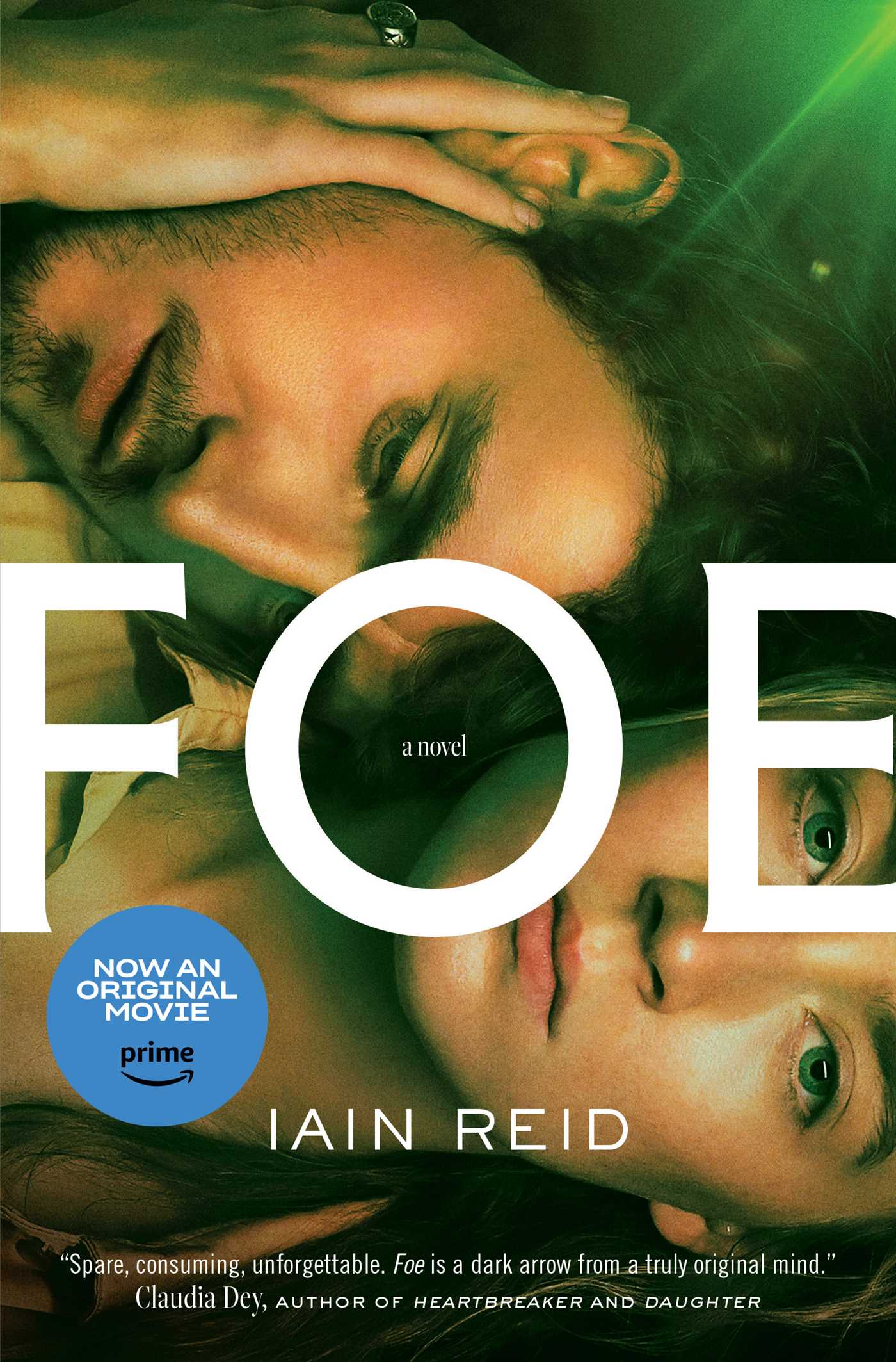
You think you know everything about your life.
Long-married couple Junior and Henrietta live a quiet, solitary life on their farm, where they work at the local feed mill and raise chickens. Their lives are simple, straightforward, uncomplicated.
Until everything you think you know collapses.
Until the day a stranger arrives at their door with alarming news: Junior has been chosen to take an extraordinary journey, a journey across both time and distance, while Hen remains at home. Junior will be gone for years. But Hen won’t be left alone.
Who can you trust if you can’t even trust yourself?
As the time for his departure draws nearer, Junior finds himself questioning everything about his life – even whether it’s really his life at all.
Foe’ was an astonishingly strong novel. It was so intense that I had to make myself take breaks from it. The sense of gathering darkness, deepening wrongness and oncoming but unknowable tragedy made that very hard to do.
From the beginning, the writing was focused, concise, quietly disturbing and completely engaging. There is a sense that something was off, that there was a gap between words and actions. That the most important things were being left unsaid and that there was a lie behind every smile. The more I searched for the truth in the novel, the more I realised how deeply it was hidden, which, of course, made me hungry to find out not just what was being hidden but why and by whom.
‘Foe’ is set in a near-future America where the technology has advanced, the gap between the rich and the rest has widened, and the best resources are being focused on colonising space. The novel is 275 pages long, structured into three acts, with most scenes featuring only three characters: Junior and Hen, a married couple who live on a remote farm, and Terrance, a stranger whose entry into their lives changes everything. Most of the ‘action’ of the novel takes place in the farmhouse in an atmosphere of forced, artificial intimacy with an undercurrent of menace and mistrust.
By the end of Act One, it was clear that none of the three characters was being honest, not even the apparently straightforward Junior, from whose point of view Act One was told. Junior comes across as odd, but in a way that’s hard to define, especially as he refuses to acknowledge anything unusual about himself,past or present. The mendacious atmosphere seemed to be masking malice, but I couldn’t even guess at anyone’s motives.
By the end of Act Two, the atmosphere between the three main characters was oppressive, disturbing, and emotionally claustrophobic. Like Junior, I can’t quite figure out what was going on except that it was wrong. Unlike Junior, I was filled with foreboding, knowing that things were going to get worse. I was fascinated by the threat emanating from the smiling, polite, physically non-threatening Terrance. His presence was not just disruptive; it was quietly, confidently, coercive. He had the slick assurance of someone shielded from consequences. It seemed to me that he was so focused on his mission that only it was real. Junior and Hen were just potentially volatile variables that he had to manage. Watching him manage was chilling.
I won’t spoil the novel by talking about the resolution in Act Three except to say that it was intense, surprising, complex and changed my understanding of everything that went before.
‘Foe’ was a deeply engaging, suspenseful read. I spent most of the novel in a state of conscious ignorance and anxious anticipation of that ignorance ending.
The uncertainty in the novel pushed me to think about bigger themes: the nature of identity, the reality of and restrictions on choice, the reciprocity needed to sustain a marriage and whether the interior world of an individual’s experiences is unique or fungible.
 Mike Finn's Fiction