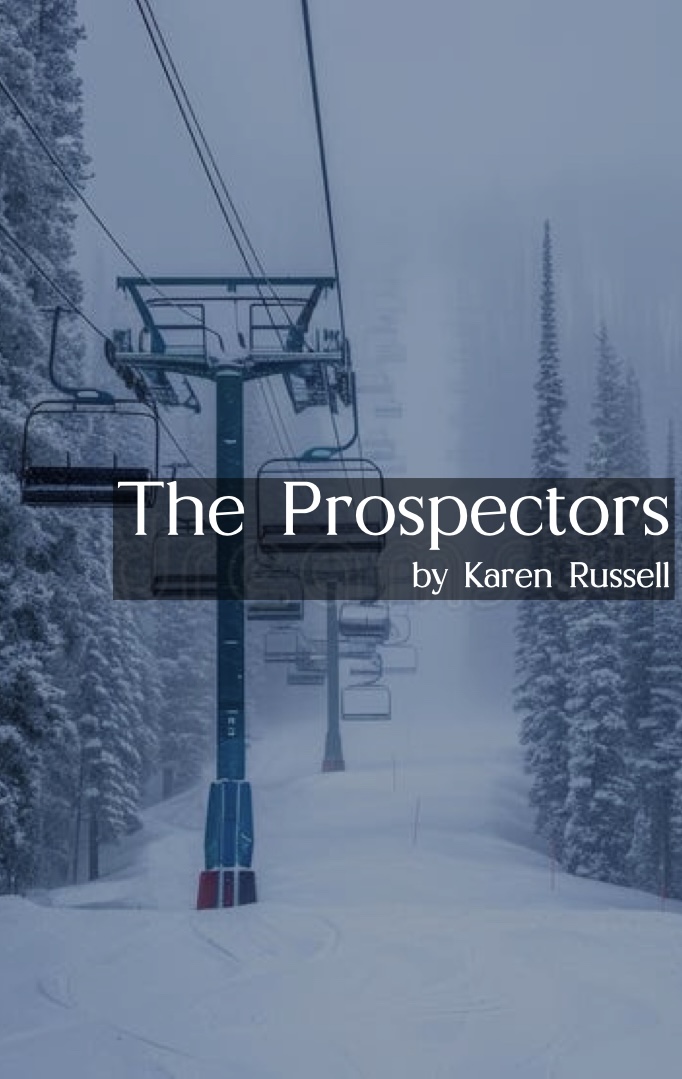
Two opportunistic young women fleeing the Depression jump a chairlift to a moutaintop party, expecting to scam the rich, but find themselves fighting for their lives.
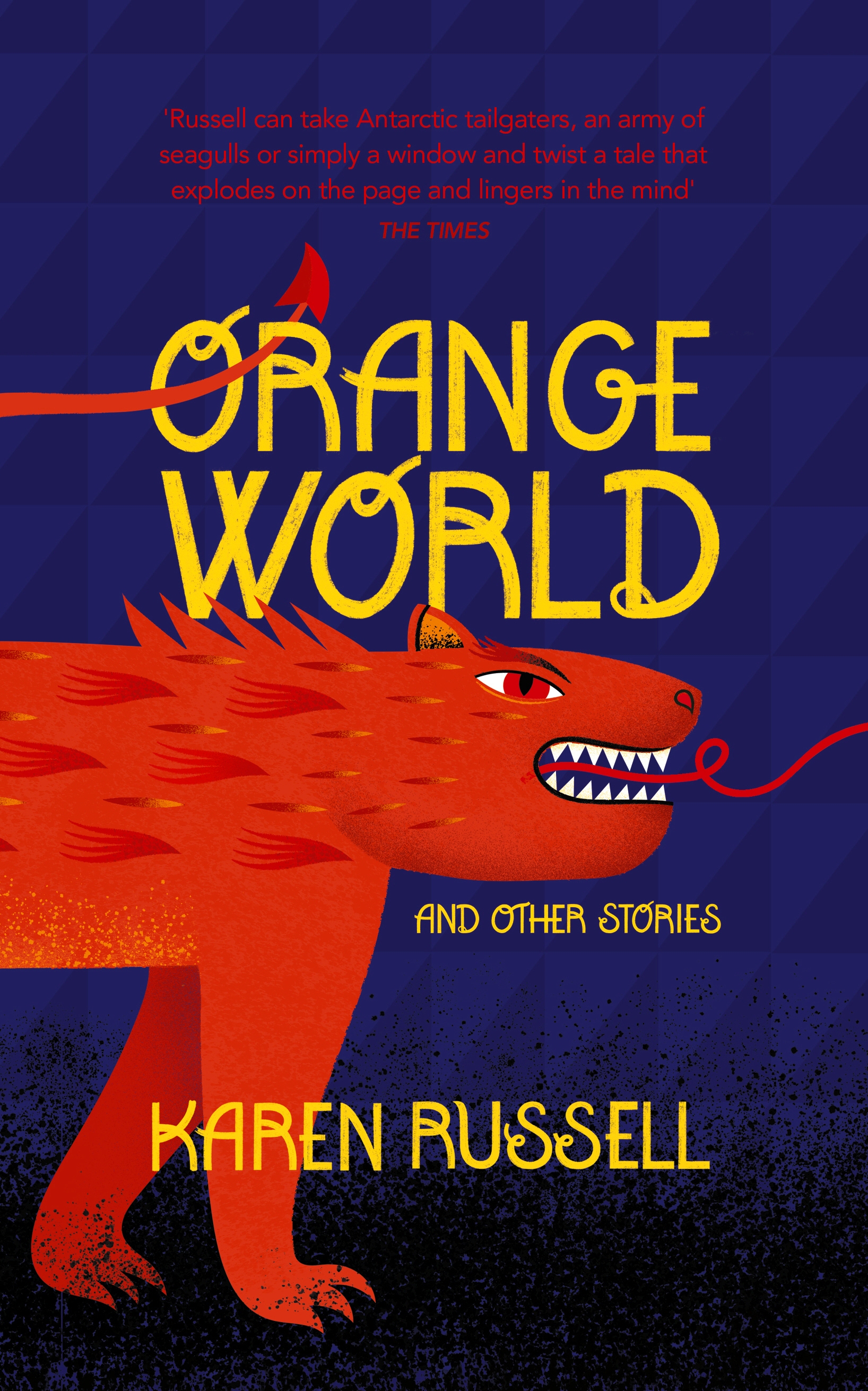
Karen Russell’s short stories have a way of getting under my skin. It’s been seven years since I read ‘Ava Wrestles The Alligator’, the first story in her debut short story collection, ‘St. Lucy’s Home For Girls Raised By Wolves’ (2005), and it still sits vividly in my memory.
This week, her short story ’The Prospectors’ from ‘Orange World and Other Stories’ (2019) hooked my imagination, pulling me into the world of two young women determined to choose their own path through life. The story took me to unexpected places. It was exciting and bold, but the talon that clawed its way into my imagination was the relationship between the two women, which was a remarkable mix of hope, pragmatism, trust and bravery. I’ve done my best to share my experience of reading the story below.
‘The Prospectors’ is a story of two spirited young women, Aubby and Clara, living through the Depression of 1930s America, who, brought together by chance, come to understand that, working as a team, they can write a different future for themselves than the ones they feel trapped by. It is a story about the power of will to change your identity and the power of friendship to achieve personal freedom. It’s also a fascinating ghost story.
The tale is told from Aubby’s point of view. I found myself being pulled into the story by awareness of herself and Clara as a duality. She reflected deeply on the of the bond between them: its strength, its life-shaping effect and its inestimable value.
At the point that we first meet them, Aubby and Clara have been living their chosen life in the West for four years, calling themselves Prospectors and living by relieving others of their valuables. Four years earlier, they’d both been working as maids in Clara’s parents’ hotel. Neither of them had been happy about it, but neither had seen an alternative until they met the other. I love this description of how a question Clara prompted Aubby to take control of her life. Clara asks:
“ “”What would you be, Aubby, if you lived somewhere else?”
“I’d be a prospector,” I told her, without batting an eye. *I’d be a prospector of the prospectors. I’d wait for luck to strike them, and then I’d take their gold.”
Clara’s delighted reaction amazes her. She recognises that:
“ …until this moment, I hadn’t considered that my days at the hotel might be eclipsing other sorts of lives…Things simply happened to me, and I didn’t matter enough to anyone or any scheme for them to build into a destiny. When I thought about the future, it felt almost claustrophobically near at hand, as if my nose were bumping up against a dirty window. Next Monday. Next Wednesday. But that night I saw Clara’s laughing face, and I realized with a shock that together we could lift the glass, and fly off.”
I kept thinking about how liberating that kind of ephinany would be, the bond it would create, the possibilities that could blossom from it.
But ‘The Prospectors’ is not a fairy tale. There’s no fairy godmother looking out for Aubby and Clara. They have to look out for each other. Prospecting is a risky business. To succeed at it, they need to use each other’s skills, trade on their attractiveness, live off their wits and learn to become, for one night, whoever the people they’re prospecting need them to be. It is a way of life where it would be easy to lose yourself in the lies you tell; they need each other to navigate it safely. Aubby describes the support they give one another like this:
“For the duration of our friendship, we’d trade off roles like this: anchor and boat, beholder and beheld.”
The story starts with Aubby and Clara at the base of a mountain at dusk, waiting to meet a rich young man who has promised to take them up the mountain by chairlift to the opening party of a prestigious new hotel. A rich young man who doesn’t show up. Clara wants to go home. Aubby suggests finding the chairlift themselves and going anyway. The line that followed began my understanding of Aubby’s awareness of the dynamics of her relationship with Clara. Aubby thinks to herself:
“I felt a pang: I could see both that she was afraid of my proposal and that she could be persuaded. This is a terrible knowledge to possess about a friend.”
I think that’s a wonderful line because it says so much about both women.
The women find a chairlift to take them up the mountain, but what they find on their arrival is not what they expected. They’ve crossed a border between two realities, and they may not be able to find their way back.
I hadn’t expected this story to become a supernatural one but the transition was smooth and convincing. Ir seemed to me that the supernatural element was an exterme variation on the prospecting expeditions that Aubby and Clara normally set out on. Their expeditions always take them into worlds that are not their own, that they cannot remain in, and where they must pretend to be other people but never lose sight of each other or their way out of the situation.
At one point, before they’ve fully understood the nature place that they’ve arrived at and the people that they’ve met, Aubby and Clara seperate, each going off with a prospect of their own. The way Aubby describes their reunion makes a bridge between the real and the supernatural world and also speaks to the prices they pay for their freedom.
“Clara and I found each other on the staircase. What had happened to her, in her room? That’s a lock I can’t pick. Even on ordinary nights, we often split up, and afterward in the boardinghouse we never discussed those unreal intervals. On our prospecting expeditions, whatever doors we closed stayed shut.”
By the time they find each other, they both know that they’re in trouble. I thought the way they acknowledged that between them was perfect:
Back in the powder room, Clara’s eyes looked shiny, raccoonbeady. She was exhausted, I realized. Some grins are only reflexes, but others are courageous acts—Clara’s was the latter. The clock had just chimed ten-thirty. The party showed no signs of slowing. At least the clock is moving, I pointed out. We tried to conjure a picture of the risen sun, piercing the thousand windows of the Emerald Lodge.
“You doing okay?”
“I have certainly been better.”
“We’re going to make it down the mountain.”
“Of course we are.”
The ending was tense, spooky and exciting. What I liked most was that the only booty the women took with them was bird they’d freed from a cage. I loved the symbolism of that. I wanted to applaud when I read the final two sentences:
“In all our years of prospecting in the West, this was our greatest heist. Clara opened her satchel and lifted the yellow bird onto her lap, and I heard it shrieking the whole way down the mountain.”

Karen Russell is the author of six books of fiction, including the NYT bestsellers Vampires in the Lemon Grove and Swamplandia!, one of the NYT’s ten best books of the year and a finalist for the Pulitzer Prize. Her latest novel, The Antidote, was the winner of the 2026 Pacific Northwest Book Awards and a finalist for the 2025 National Book Award and the 2026 National Book Critics Circle Award.
She is the grateful recipient of a MacArthur Fellowship, a Guggenheim Fellowship, the NYPL’s Young Lions Award, the Bard Fiction Prize, the National Book Foundation’s “5 under 35” award, and was selected for Granta’s Best Young American Novelists and The New Yorker’s “20 under 40” list (She is now decisively over 40).
With Ellis Ludwig-Leone and Troy Schumacher, she co-created The Night Falls, one of the NYT’s Best Dance Performances of 2023.
She serves on the board of Street Books. Born and raised in Miami, FL, she is a Professor of English and Creative Writing at Stanford University and lives in Berkeley, CA with her husband, son, and daughter.
 Mike Finn's Fiction