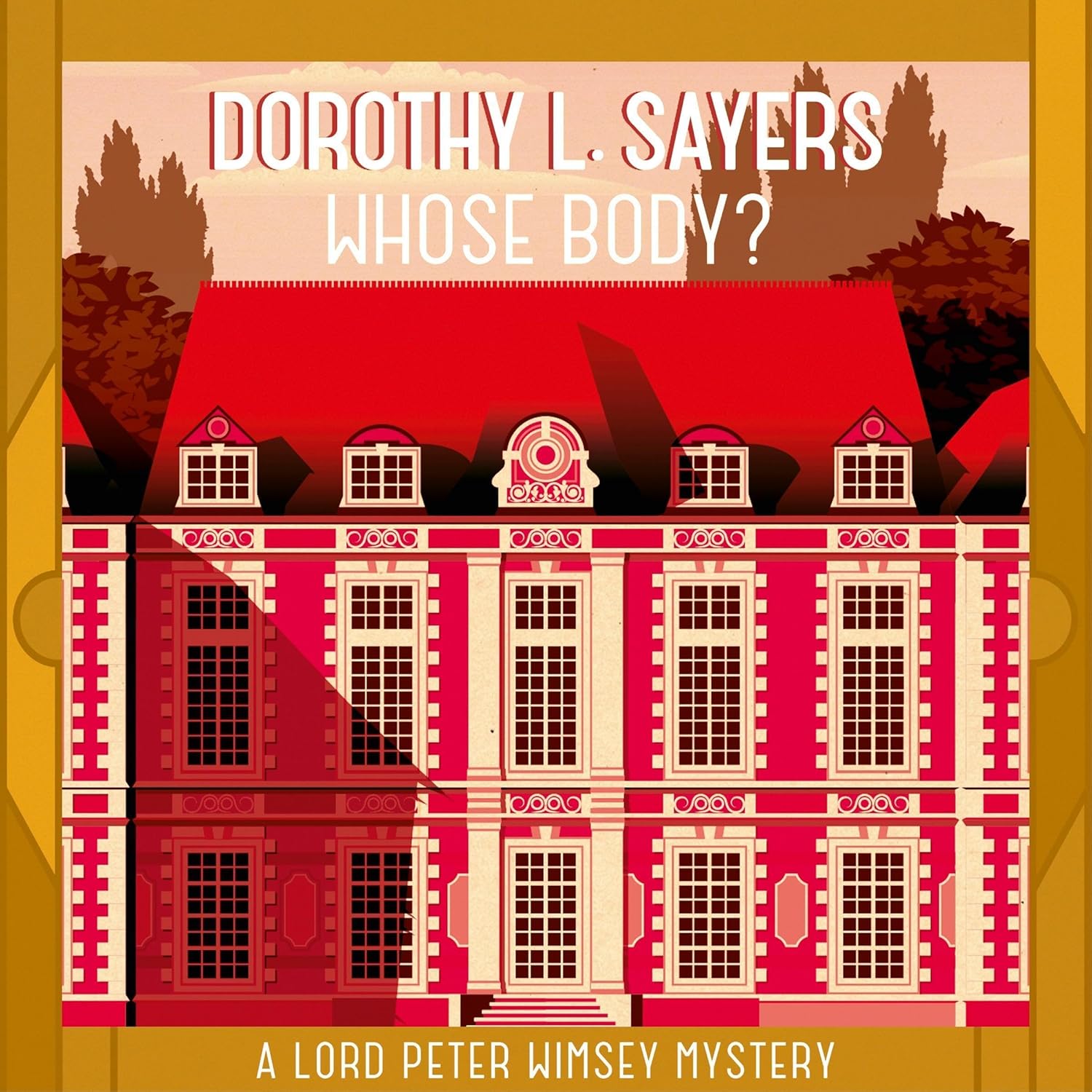
It was the body of a tall stout man. On his dead face, a handsome pair of gold pince-nez mocked death with grotesque elegance. The body wore nothing else.
Lord Peter Wimsey knew immediately what the corpse was supposed to be. His problem was to find out whose body had found its way into Mr Alfred Thipps’ Battersea bathroom.
What a difference a narrator makes. I first tried to read ‘Whose Body?’ back in 2017, but the audiobook was so chaotic that I abandoned it. This time, I was listening to the newest audiobook (recorded 100 years after the book was published) narrated by Robert Bathurst, who did a splendid job. He seems to be working his way through Sayers’ novels. I look forward to hearing more from him.
At the start, ‘Whose Body’ felt like Bertie Wooster and Jeeves Do Crime. Sayers was obviously having fun, and so was Wimsey, despite being confronted with a naked body of a stranger in a bath. The book and Wimsey became more serious as what at first seemed like a jolly interesting puzzle was overtaken by the realities of investigating a gruesome murder. I liked that Wimsey’s seriousness wasn’t triggered by gathering more pieces of the puzzle but by understanding that there were consequences for solving the puzzle on all of those touched by the deaths, including the killer.
The plot was a little elaborate, partly because of a last-minute improvisation by the murderer, although iz just about held together. What kept me engaged with the novel was getting to know Lord Peter Wimsey and the people whom he values.
I admired how Dorothy Sayers gradually made it clear that Wimsey wears his dizzy Wooster-like persona partly as a form of camouflage so that people underestimate him and partly to keep a self-protective emotional distance from the case. I think it said much about who Wimsey is that, having understood the reality of the evil he’s investigating and the consequences of solving the puzzle, he felt he could not walk away, even though continuing put his sometimes fragile mental health at risk.
I enjoyed the relationship between Wimsey and his valet, Bunter, who was also his batman during World War I. In some ways, Bunter is more competent and more worldly than Wimsey. He’s protective of Wimsey, but he also admires him. I thought the letter that Bunter sent to Wimsey, detailing the interview Bunter had with the valet of a suspect, was a splendid piece of writing. It managed what could have been a clunky piece of exposition with charm and humour. It displayed Bunter’s intellect, his ever-present awareness of class distinctions and appropriate behaviour, his ability subtly to make fun of Wimesy and his certainty that his humour will be noticed and well-recieved.
Wimsey’s friendship with Inspector Charles Parker also enhanced the novel. It was good to see an intelligent, thoughtful policeman in a book about an amateur sleuth. Parker is a cautious, serious-minded, well-educated man. He’s not Watson to Wimsey’s Holmes; he’s a partner whose opinion and expertise Wimsey values. I rather liked that Parker was a man who relaxes by reading discourses on Christian theology.
Wimsey’s mother made me smile. She’s a force of nature: indomitable but benign. She clearly has a soft spot for Wimsey and his enthusiasms. Having met Wimsey’s sober, serious, entitled older brother, a man untroubled by imagination and obsessed with reputation, I can see why.
The thing that most surprised me in the novel was that the murderer was such a chilling creation. The confession letter the murderer left for Wimsey was another piece of clever exposition that was also a character sketch. It gave an insight into the mind of a man who felt neither remorse nor shame and whose confession seems to have been written in the expectation of admiration of his cleverness rather than condemnation of his crimes. This must be one of the earliest depictions of a sociopath in crime fiction.
All in all, this was an impressive start to the series and a remarkable debut novel.
 Mike Finn's Fiction