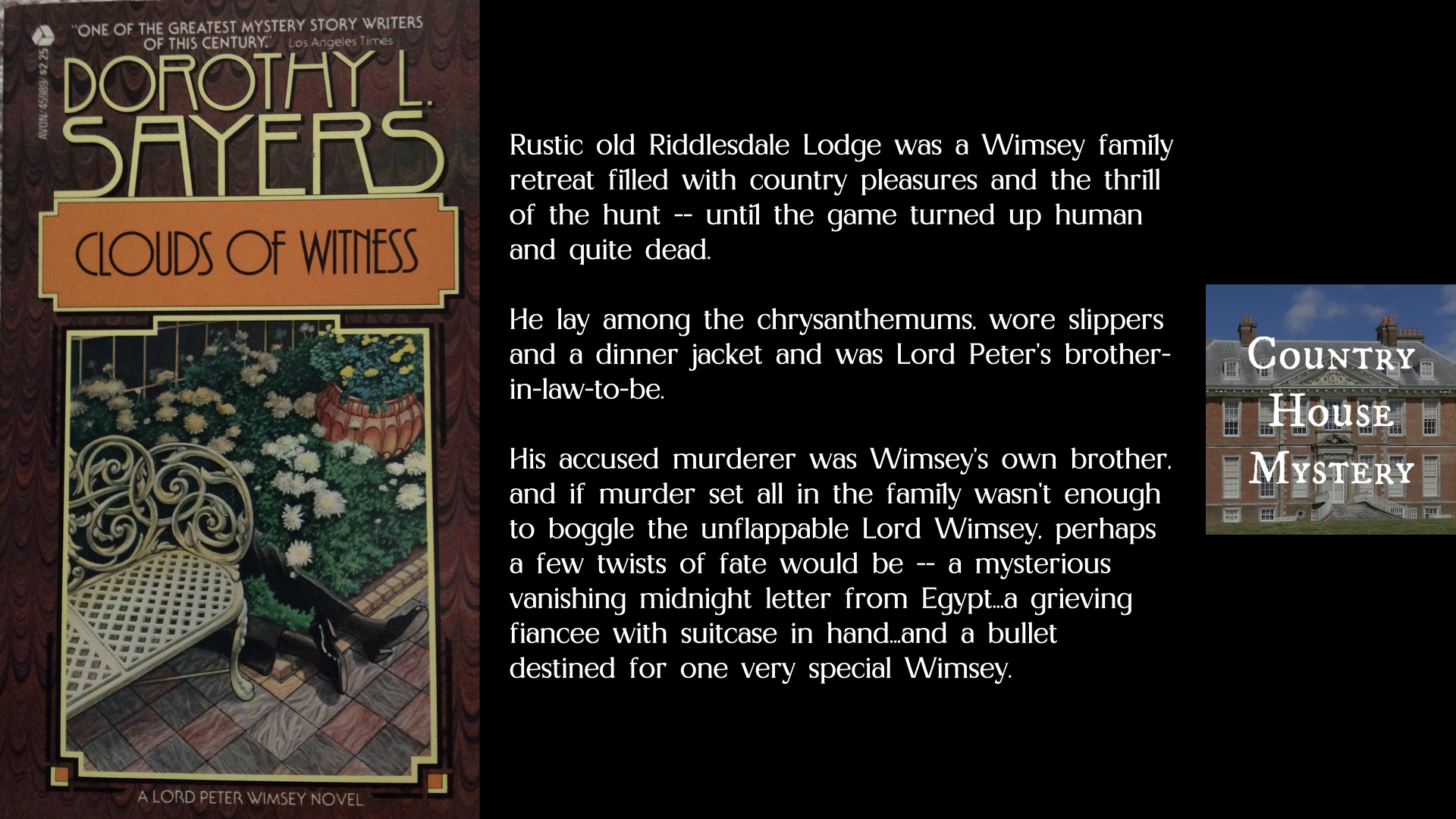
I found Clouds Of Witness to be a very mixed bag. It has a chaotic feel to it as if the energy of the eccentric and well-drawn characters keeps pressing against the confines of the exposition of the slightly over-complicated plot.
Some parts of it sparkle. I love the way Wimsey uses words as both a shield and a sword. When he first appears, he finds the shooting party at breakfast, knows that they’ve been speaking about him and unleashes a torrent of knowing commentary, an effortless domination of the room, all achieved with a breezy we’re all good chaps here tone that it’s hard to take offence at but which can’t be mistaken for affability.
I also love the way his mother talks when she’s sharing her thoughts. You can see her mind working as she pursues her thoughts in a rush of words that tumble like a pack of hounds chasing a fox and which she keeps trying to discipline through half-remembered quotations and verbal footnotes. It ought to sound as if she’s babbling but instead, it displays a sharp, well-educated mind forming patterns from the available data.
The characters, even those whose role in the plot is minor, thrum with life. Their voices sound true on the ear. Their foibles, habits and manners are captured with actuely observed without being commented on. I loved the adroit concise, incisive and amusing descriptions of the reasons why the members of the shooting party are angry and unhappy at breakfast on the Sunday morning after the inquest. It made me smile and it helped me see each of them more clearly.
The plot was fairly sound. Everything worked and it delivered a few surprises along the way but it lost a little credibility by depending on so many people deciding independently to do covert and uncharacteristic things in the early hours of a particular morning.
Some of the plot exposition was clumsy, by modern standards. The way the inquest was reported using transcripts enhanced with notes from the police rather than from the point of view of one of the people present shows how conventions in novels have changed over the past ninety-seven years. The KC’s closing argument in the trial in the House Of Lords went on so long that I suspect some of their Lordships may have dozed through parts of it.
The action scenes, which included shots fired, death-defying flights and perilous encounters on the moors felt a little frantic, like something from a comic book.
Another sign of how expectations around novels have changed since 1926 is the way French is used in the text. Most of the short sentences in French are not translated and a long letter, that is key to the plot, is included in its entirety before the translation is g8iven. It seems that Dorothy L Sayers assumed that her readers would be able to read French with ease.
Reading Clouds Of Witness after having read later novels like Strong Poison (1930), The Nine Tailors (1934) and Gaudy Night (1935), I was aware of how brightly Dorothy Sayers’ raw talent shone through and how much she had honed her skills over the next decade.


A book and author of their time perhaps and yet still compelling for the modern reader.
LikeLiked by 1 person
I came to Dorothy Sayers/Peter Wimsey via BBC/ Masterpiece Theatre here in the US in the 1970s, and Ian Carmichael’s brilliant portrayal of Lord Peter. Clouds of Witness was the first one I saw, and it has colored my perception of the novels to this day. I return to them from time to time; they feel less dated than Agatha Christie, especially the ones with Harriet Vane. Wimsey’s PTSD /shell-shock from the War also plays a rôle in how I feel about him as a character.
LikeLike
My first impressions were also formed by Ian Carmichael’s performance. I loved him in The Nine Tailors.
I really like the chemistry between Wimsey and Vane. My favourite TV version of them stars Edward Petherbridge and Harriet Walter. https://www.youtube.com/watch?v=zj0_B5vAFZY
LikeLike