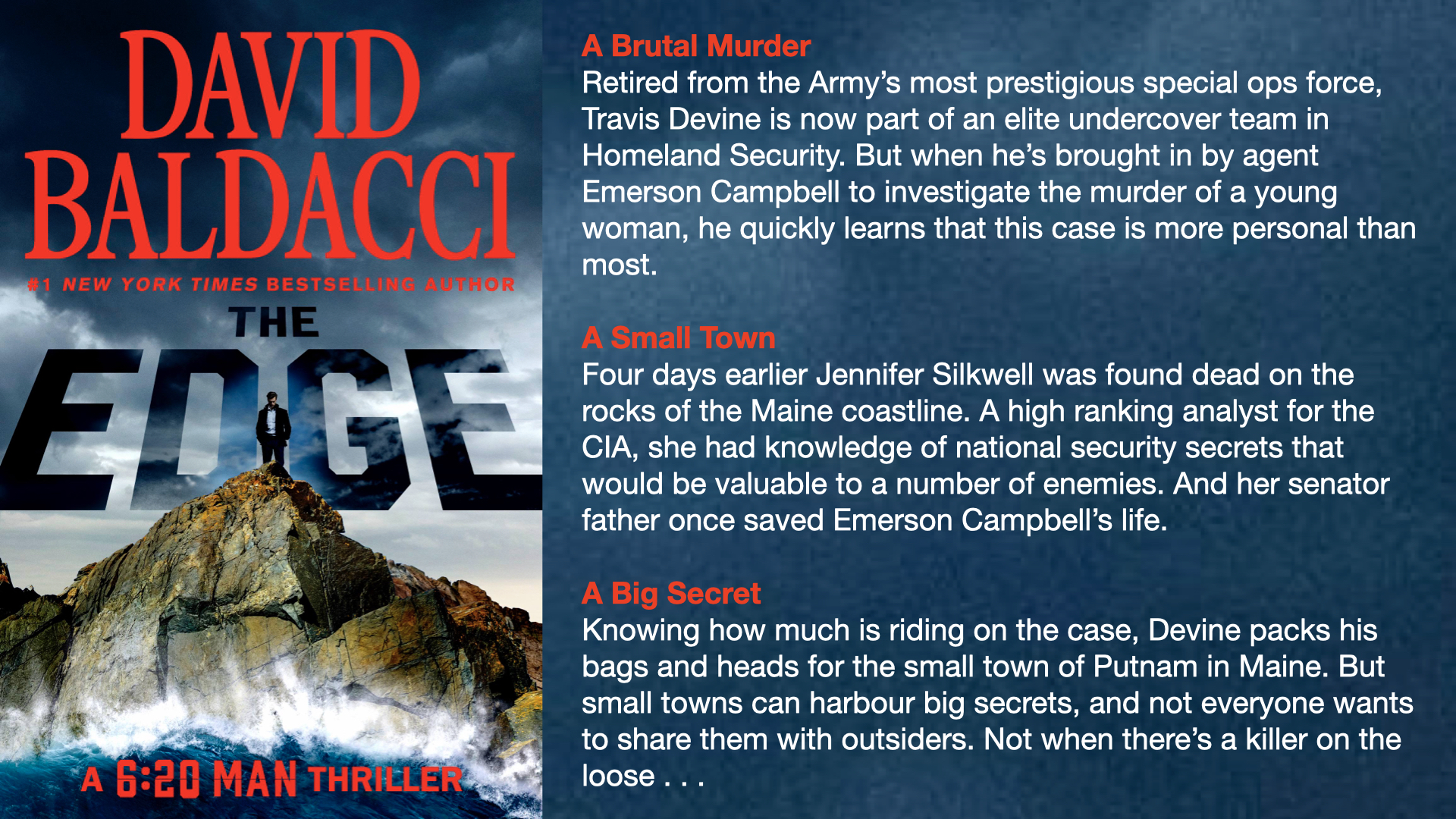
I ordered The Edge as soon as I’d finished the first book in the series, The 6:20 Man, last month. The first book kept me guessing and had a hero who wasn’t quite who I’d expected him to be. I couldn’t really see how the book would turn into a series, given the odd circumstances that had resulted in our hero, Travis Devine, stumbling into the centre of a complex and lethal plot, but I wanted to find out.
I dived into the audiobook of The Edge as soon as it arrived and had finished it by the following day. It was good solid entertainment. The plot had lots of twists. There was lethal violence at regular intervals from the opening scene onwards. The rural coastal Maine small-town setting felt authentic and seemed well-researched and Travis Devine continued to surprise me from time to time by demonstrating a level of empathy that somebody like Jack Reacher would never be capable of.
I think the strongest part of the book was the plot. The twists weren’t gratuitous. The situation really was complicated. There was a suspect pool of people it was easy to be suspicious of. There were lots of secrets to be uncovered and, at the centre of it all was a beautiful, talented-but-damaged young woman for our hero to protect. The plot’s pacing kept the tension high. The disclosures were subtle and partial enough to help me enjoy speculating about who the bad guys were without feeling either spoonfed or tricked.
As with The 6:20 Man, the audiobook version, of The Edge uses one main narrator with others being pulled in t to speak the dialogue of some of the main characters. This gives a lot of the benefits of a ‘full cast’ performance without either the annoying sound effects and music that are often added and without needing to cut away anything that isn’t dialogue.
Even so, I didn’t enjoy The Edge as much as The 6:20 Man. Some of that may be the typical second book in a series problem of having lost novelty but having not yet gained significant backstory. Some of it was that, in this book, Devine has gone from a man following a path or atonement that gets him involved in a plot for personal reasons to being yet another patriotic action hero who kills people in foreign countries on behalf of a shadowy quasi-legal government agency. This isn’t the kind of hero I normally end up with any sympathy with. To me, they usually come across as psychopathic, government-sponsored terrorists who have better weapons and more resources than most.
Devine managed to keep m interest because of his surprising mix of one-man killing machine and sensitive millenial investigator skills. When he’s in combat mode he becomes an efficient killer. When he leaves combat mode he feels no remorse. When he’s interviewing people he doesn’t bully, he de-escalates conflict, he listens carefully and he shows both insight and empathy. I guess this makes him a Millenial killing machine with Emotional Intelligence to match his combat readiness.
Devine’s status as an agent of the State means that, from the start of the book, people are out to kill him. Fortunately, Devine is better at killing than they are or the book would have been very short. I felt quite ambivalent about this aspect of the book. Some of it helped the plot but the plot would have been strong without it. Devine as a killing machine changed the tone of the book, making the violence feel gratuitous and making me feel like a voyeur.
This effect was amplified by the way David Baldacci writes his action scenes. The violence is described with clinical accuracy. The focus is on competence, not emotion. This is a killing-is-a-discipline-with-science-behind-it pitch. We focus on how Devine does what he does but not on the bloody mess he leaves behind.
This contrasts with the descriptions of how our hero interacts with the young woman he is attracted to He goes from competent and clinical to awkward and naive. Some of that is charming but not entirely credible. The biggest contrast for me was that the (many) scenes of violence in the book are shown in vivid detail, the one sex scene in the book is a straight fade to black.
One reason the Devine as Killing Machine didn’t capture my imagination was the clunky language that David Baldacci uses to describe it. For example, instead of “He shot the man in the head, killing him”, we get: “The shot struck him cleanly in the head and the round stayed there after destroying an irreparable amount of the brain’s soft brain tissue”. Did we need the ‘irreparable amount’? The man died. It doesn’t get more irreparable than that. Then there’s the ‘the brains’ soft brain tissue.” That’s one more brain than that sentence needed. This clunkiness woke up my inner-grumpy-old-critic, which always makes it more difficult for me to enjoy a book.
 Mike Finn's Fiction
This sounds like a good time. I love a solid airport thriller and not enough of them have rainy New England settings. Def will give this one a try sometime.
LikeLiked by 1 person