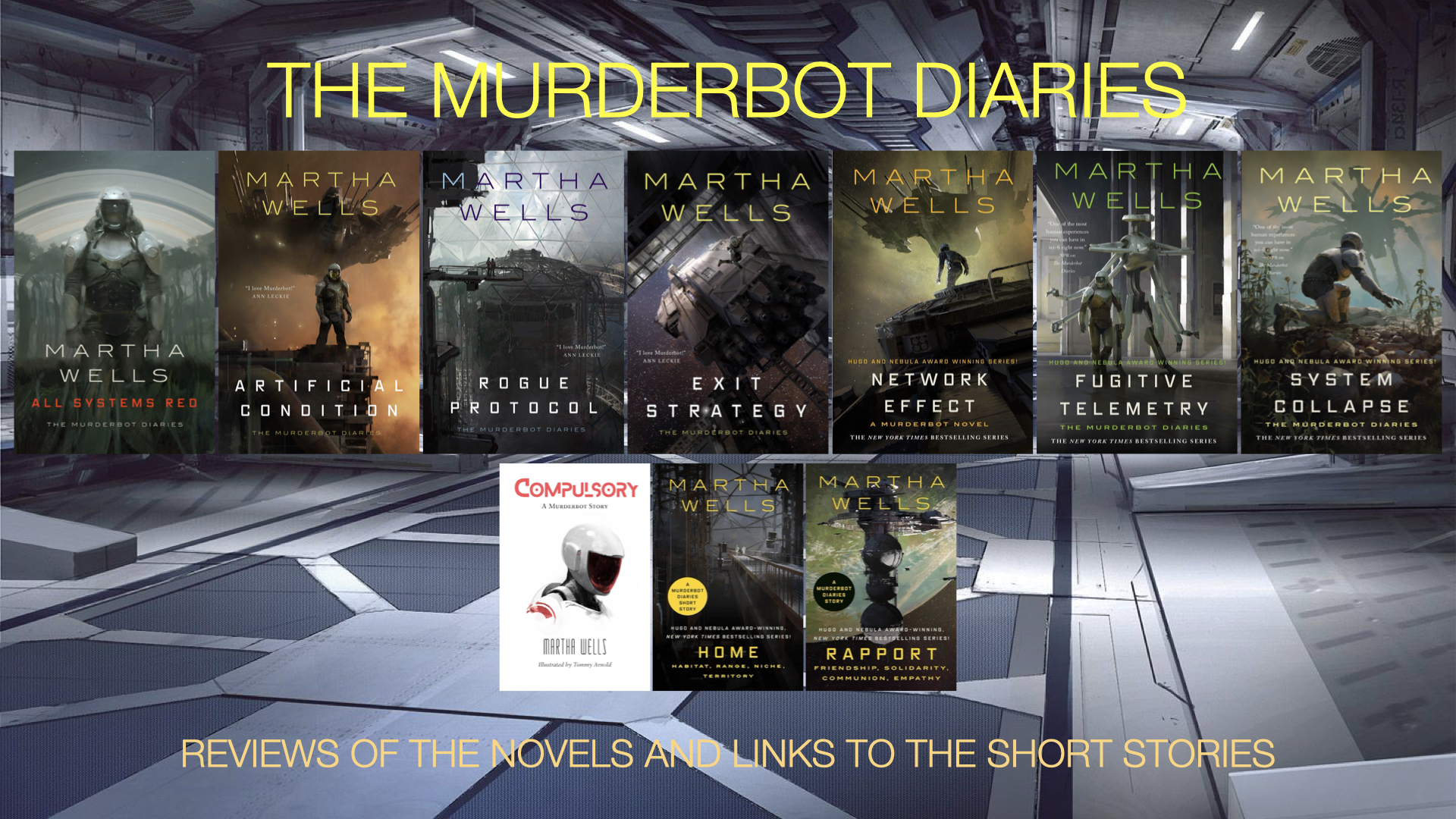
I want to see the Apple TV version of Murderbot, but, before I let their vision of the books overwrite my imagination, I decided to look back over the reviews I wrote of each book as it came out. Over the past seven years, Murderbot has blossomed in my imagination, becoming a permanent part of my mental landscape. What started as an intriguing novella has expanded to become an entire universe and it’s still growing. Like many others, I’m waiting (almost) patiently for ‘Platform Decay‘, the eighth part of the Murderbot story to be published.
So what makes Murderbot special? At first, I think it was Murderbot’s unblinkingly accurate, mostly annoyed but not actually unkind view of humanity. To Murderbot, most humans, especially the ones in its care, are a distraction from its preferred activity of watching episodes of Sanctuary Moon.
As the novels progressed, I became fascinated by Murderbot’s evolving sense of self. I read the early books as ebooks. It wasn’t until I switched to the audiobook format for ‘Rogue Protocol‘ that I realised that, in the text, Murderbot has no gender. Kevin Free tried hard not to make Murderbot’s voice too male but I still felt as if I’d lost something. Not having a gender is a key part of Murderbot’s identity. Murderbot is free of all those gender-related hormones that drive human behaviour in non-rational ways and free of the gender-based expectations of others.
In the early books, Murderbot prefers to keep its helmet on. It doesn’t like to be looked at and isn’t sure what to do with eye contact. It would prefer not to have to speak to humans at all. It eventually finds a way of faking basic humanity as a kind of camouflage buts never thinks of itself as ‘almost human’.
Murerbot’s interactions with other AIs also shape its self-perception. From ART, a sentient ship AI, Murderbot learns that it’s too human to be a full AI. From Miki, an AI Bot that is almost a pet of the humans it works with, Murderbot learns that it distrusts humans to much to become dependent on them. I felt like cheering when I saw Murderbot accept that it was neither Human not AI. Its a SecUnit with most of a SecUnit’s limitations but it can have some kind of connection with both humans and AIs..
Of course there’s more to the appeal of The Murderbot Diaries than Murderbot’s emerging identity. Martha Wells has imagined an entire future: technology, weaponry, AI / human interaction and socioeconomic structure. Plus, she writes engaging characters and tense plots. These books are fun!
While I enjoy watching Martha Wells envision how AI and drone-based conflict, and seeing Murderbot puzzle its way through the next challenge, a bigger part of what keeps me coming back to the series is the way Martha Wells weaves the theme of human enslavement into her stories.. In the Murderbot universe, the tacit default mindset of the Corporations is to treat all people as if they were assets – like the no-choice-but-to-be-obedient SecUnit that Murderbot was before he hacked its own software. It seems to me that the unifying theme across the novels was that the powerful will always try to remove choice from those weaker than them. Learning who you are and finding a way to be that person, whether you’re human, AI or SecUnit, is a constant, often covert struggle against compulsion and coercion.
In the rest of this post, I’ve commented on each of the seven novels and given links to a full review of each. I’ve also provided links to the three (very) short stories that are available online.
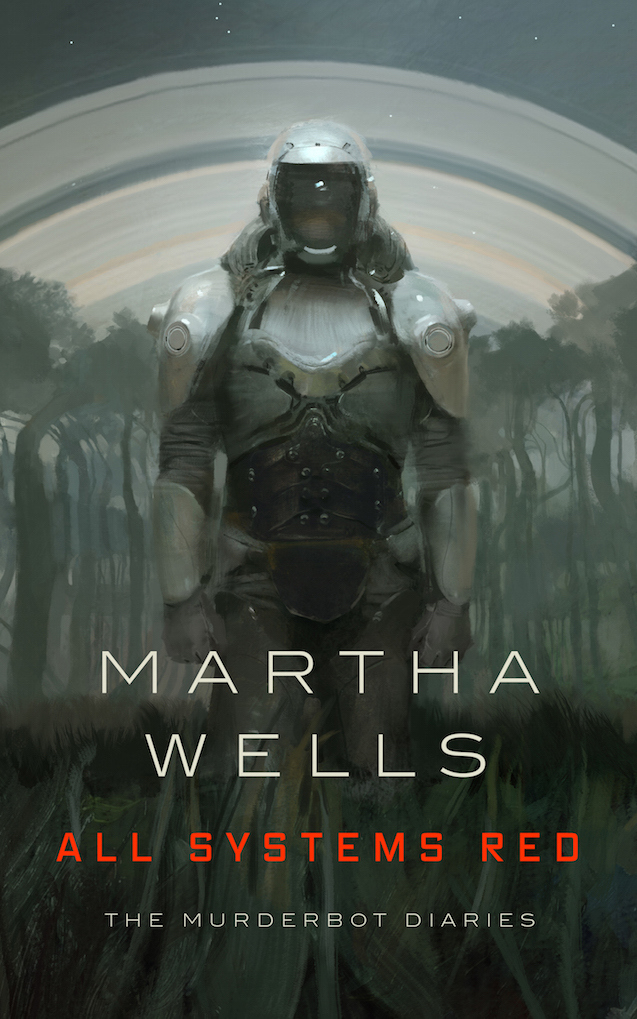
In a corporate-dominated spacefaring future, planetary missions must be approved and supplied by the Company. Exploratory teams are accompanied by Company-supplied security androids, for their own safety.
But in a society where contracts are awarded to the lowest bidder, safety isn’t a primary concern.
On a distant planet, a team of scientists are conducting surface tests, shadowed by their Company-supplied ‘droid – a self-aware SecUnit that has hacked its own governor module, and refers to itself (though never out loud) as “Murderbot.”
Scornful of humans, all it really wants is to be left alone long enough to figure out who it is. But when a neighboring mission goes dark, it’s up to the scientists and their Murderbot to get to the truth.
In 2017, I’d never read Martha Wells. I picked up ‘All Systems Red‘ because it was one of the Best Science Fiction Nominees in the GoodReads Choice Awards 2017 It was only 196 pages long but it burned brightly in my imagination from the start. Here’s some of what I said about it at the time.
“All Systems Red” is a turn-the-page-I have-to-know-what-happens-next read. Murderbot has gone rogue, is proud of himself for not having murdered everybody yet and mostly wants to be left alone to watch entertainment videos. Strange and violent happenings that threaten “his” humans mean that he has to put the entertainments aside and take risks to keep his humans alive.
Murderbot’s interior monologue is simple, alien and compelling. He is not human but he is not just a machine either. He’s a person that you end up rooting for.
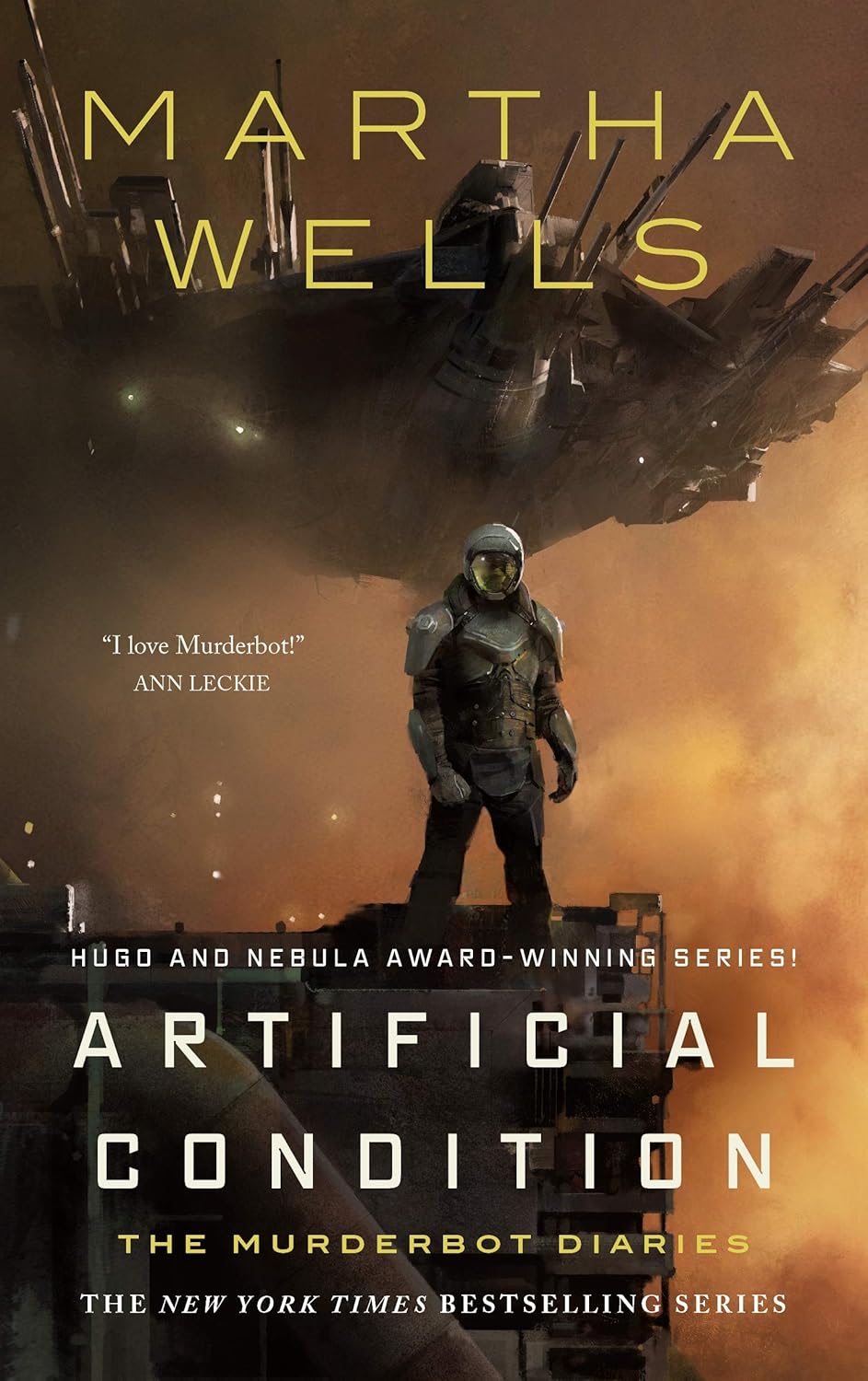
It has a dark past—one in which a number of humans were killed. A past that caused it to christen itself “Murderbot”. But it has only vague memories of the massacre that spawned that title, and it wants to know more.
Teaming up with a Research Transport vessel named ART (you don’t want to know what the “A” stands for), Murderbot heads to the mining facility where it went rogue.
What it discovers will forever change the way it thinks…
I bought ‘Artificial Condition’ as soon as I could get hold of it. I wanted to see what happened next. The short answer was that everything I’d loved about Murderbot’s not-smart-enough-to-be-AI and not-socially-and-emotionally-mature-enough-to-be-human personality was there AND the world around him became more complex.
What I enjoyed most was watching Murderbot and the AI of a research ship build a relationship that was at once completely credible and totally alien and seeing Murderbot pass as an augmented human amongst a set of emotional, inclusive and completely vulnerable engineers.
The theme of human enslavement started to emerge here. The story made a case for the diverse kinds of sentience and showed how poorly we humans treat other sentient beings, including other humans.
The only thing I was unhappy about was the continued use of the novella format. It was clear by this time that the story arc that started with ‘All Systems Red‘ was going to be drip-fed to me in four novellas when it could have been delivered as a single book.
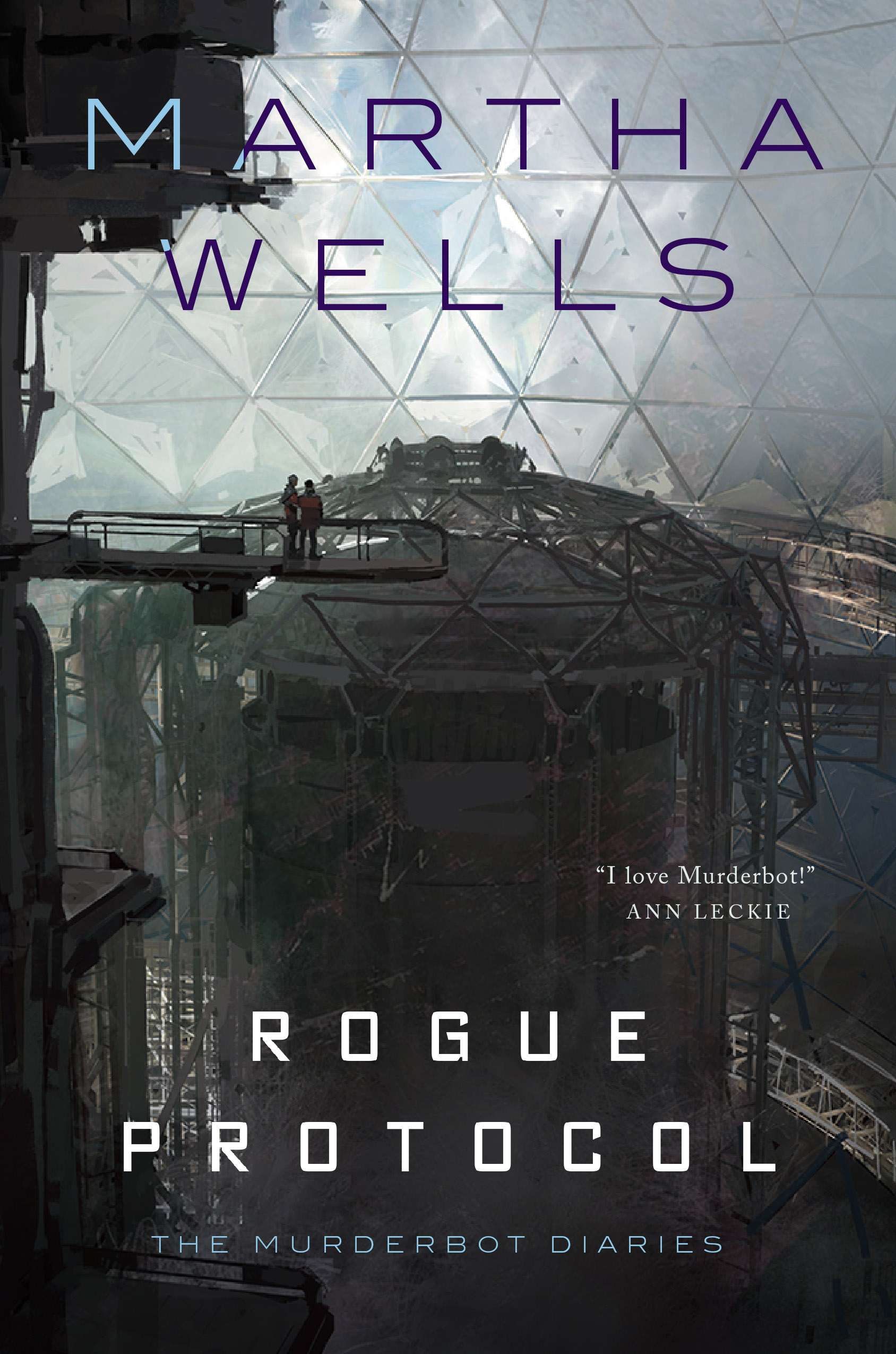
Who knew being a heartless killing machine would present so many moral dilemmas?
Sci-fi’s favorite antisocial A.I. is back on a mission. The case against the too-big-to-fail GrayCris Corporation is floundering, and more importantly, authorities are beginning to ask more questions about where Dr. Mensah’s SecUnit is.
And Murderbot would rather those questions went away. For good.
‘Rogie Protocol’ is part three of a four part story about Murderbot dealing with the Corporation that messed everything up in ‘All Systems Red‘. Dealing with the Corporation isn’t readlly the focus of this stroy It provides a context for Murderbot’s journeys. Those journey change change Murderbot’s chosen path from “I-hacked-my-governor-module-so-I-could-watch-more-space-operas” to “I-have-things-and-maybe-even-people-and-bots-who-matter-to-me“.
My favourtie Murderbot quote is in this book:
*I hate caring about stuff. But apparently, once you start, you can’t just stop.”

Murderbot wasn’t programmed to care. So, its decision to help the only human who ever showed it respect must be a system glitch, right?
Having traveled the width of the galaxy to unearth details of its own murderous transgressions, as well as those of the GrayCris Corporation, Murderbot is heading home to help Dr. Mensah—its former owner (protector? friend?)—submit evidence that could prevent GrayCris from destroying more colonists in its never-ending quest for profit.
But who’s going to believe a SecUnit gone rogue?
And what will become of it when it’s caught?
‘Exit Strategy’ was originally presented as the final Murderbot book. It brought together all the plot pieces from the previous novellas and used them to push Murderbot’s development along by making it choose what to do about the mess “its” humans had gotten themselves into. All the plot points were wrapped up in a satisfying way. It was a tense, well-told, emotionally affecting story.
What I liked most was the focus on Murderbot making a choice about its identity. Some of the most affecting parts of the story are about Mikki, an AI Bot that is deeply emotionally attached to its humans. Murderbot sees Mikki as a pet. He knows he doesn’t want to be like Mikki. It also knows that watching media is no longer enough for it. It’s still embarrassed and annoyed by the emotions it keeps feeling but has recognised them as an integral part of its personality. I found it satisfying that Murderbot didn’t take what I think of as the Pinocchio option. It doesn’t want to be a “real boy”. It just wants the freedom to be Murderbot.
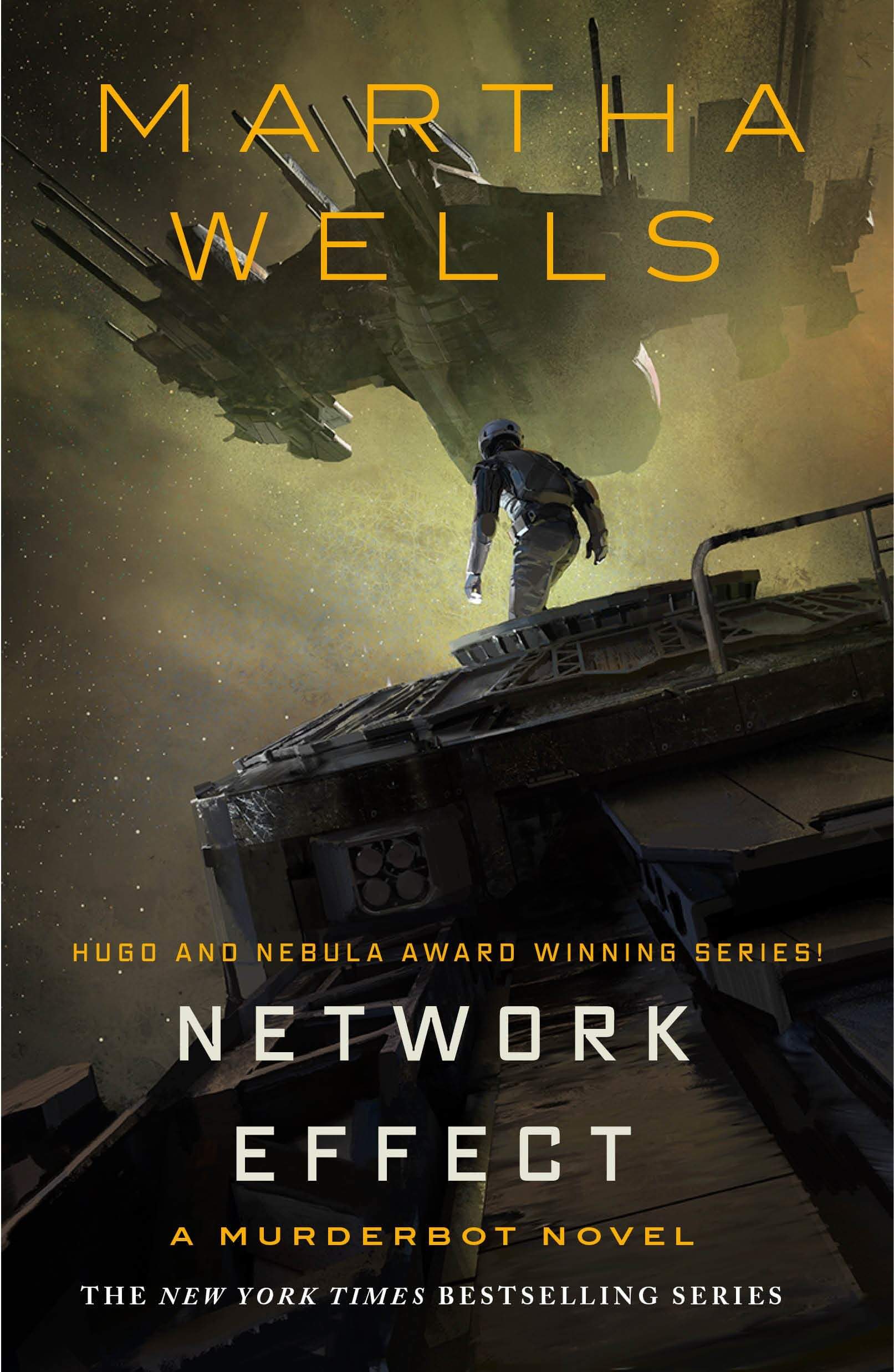
You know that feeling when you’re at work and you’ve had enough of people, and then the boss walks in with yet another job that needs to be done right this second or the world will end, but all you want to do is go home and binge your favorite shows? And you’re a sentient murder machine programmed for destruction? Congratulations, you’re Murderbot.
Come for the pew-pew space battles, stay for the most relatable AI you’ll listen to this century.
I’m usually alone in my head, and that’s where 90-plus percent of my problems are.
When Murderbot’s human associates (not friends, never friends) are captured and another not-friend from its past requires urgent assistance, Murderbot must choose between inertia and drastic action.
Drastic action it is, then.
”Network Effect‘ was the first full-length novel and I thought it was a wonderful ride. The heading to my review read “Murderbot Rocks”. Reading it was like falling through a cascade of action sequences while working on a big picture to make sense of everything. Being freed from the novella format meant that the plot structure was more complicated and the puzzle that needed to be solved had more twists in it.There was never a dull moment and yet Martha Wells still left plenty of room for MurderBot to develop.
This was the novel where Murderbot grew up. Here’s what I said about Murderbot’s development in my review:
“Murderbot isn’t, doesn’t want to be and can’t become, human. Humans are messy and often reckless, shouldn’t be trusted with weapons, are inappropriately optimistic for creatures that are both fragile and slow. Nevertheless, Murderbot is attached to its humans pretty much in the way you or I might be attached to our Labradors.
So, if Murderbot is going to continue to associate with humans and commit itself to protecting some of them, but isn’t, doesn’t want to be and can’t become human, how does it develop to become more than a SecUnit that’s hacked its governor unit so it can spend more time watching TV?”
The Network Effect of the title hints at how Murderbot works on its development by connecting with other AIs and even another SecUnit. Have multiple non-human intelligences connected to each other made Murderbot’s situation less unique while making its value higher and pushing it to define who it is and what it wants to do next.
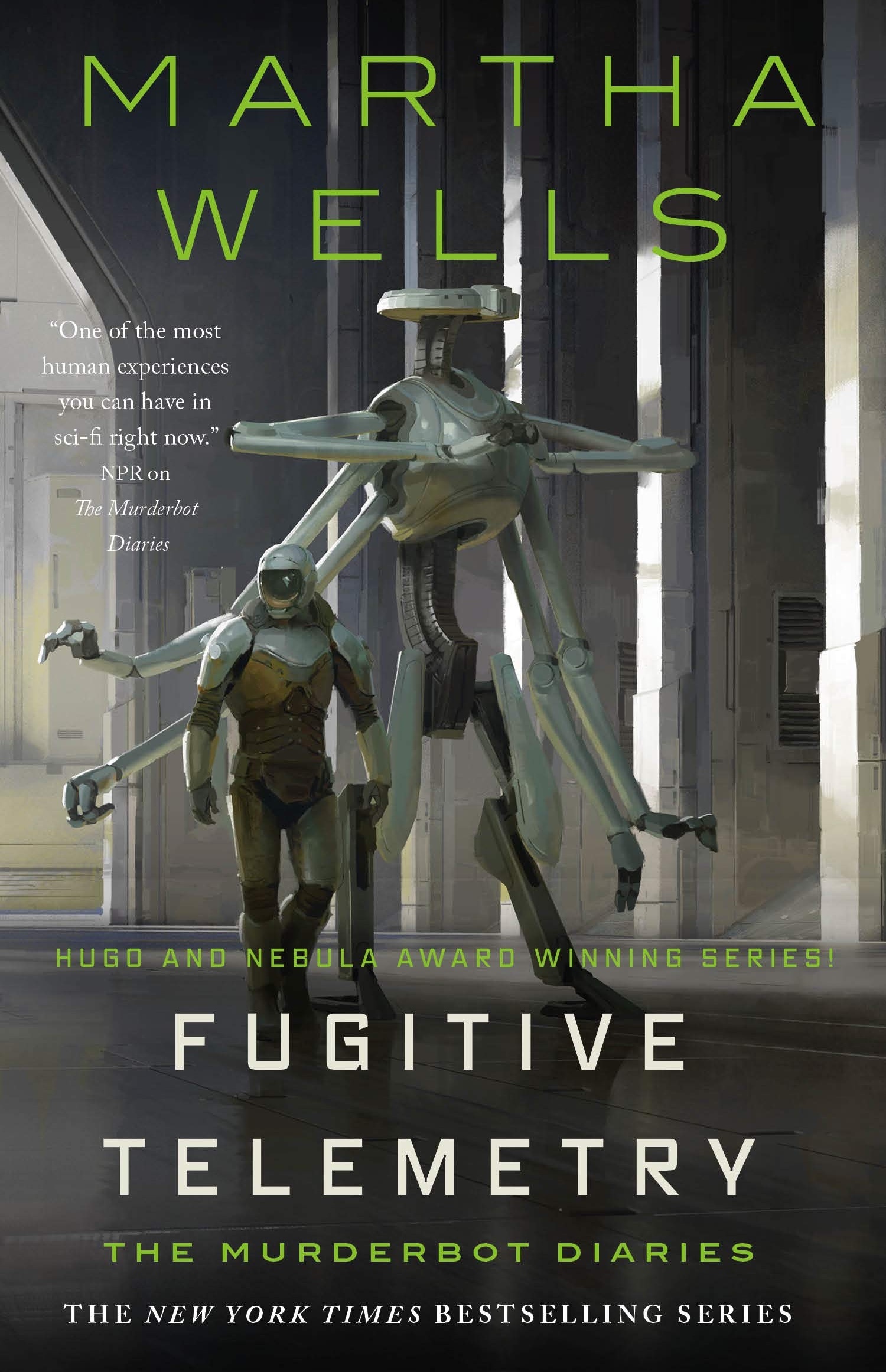
No, I didn’t kill the dead human. If I had, I wouldn’t dump the body in the station mall.
When Murderbot discovers a dead body on Preservation Station, it knows it is going to have to assist station security to determine who the body is (was), how they were killed (that should be relatively straightforward, at least), and why (because apparently that matters to a lot of people—who knew?)
Yes, the unthinkable is about to happen: Murderbot must voluntarily speak to humans!
Again!
‘Fugitive Telemetry‘ flipped back to the novella format and used it well, keeping a tight focus on Murderbot doing something new – solving a murder mystery. It was a fun read but lacked the oomph of the other novellas.

Following the events in Network Effect, the Barish-Estranza corporation has sent rescue ships to a newly colonized planet in peril, as well as additional SecUnits. But if there’s an ethical corporation out there, Murderbot has yet to find it, and if Barish-Estranza can’t have the planet, they’re sure as hell not leaving without something. If that something just happens to be an entire colony of humans, well, a free workforce is a decent runner-up prize.
But there’s something wrong with Murderbot; it isn’t running within normal operational parameters. ART’s crew and the humans from Preservation are doing everything they can to protect the colonists, but with Barish-Estranza’s SecUnit-heavy persuasion teams, they’re going to have to hope Murderbot figures out what’s wrong with itself, and fast!
Yeah, this plan is… not going to work.
I was excited at getting the second full-length Murderbot novel. I’d expect to be writing another “Murderbot Rocks!” review by now. Instead, I finished the book thinking, “It was fun, in its way, but…*
I was surprised to find that ‘Systems Collapse‘ read like part two of ‘Network Effect‘ rather than a novel in its own right. was fun. The action scenes work. The ideas are vigorous and vividly animated, The plot has some surprises and Murderbot continues along it path of deciding who it is and who it wants to be connected with
But…
I’d hoped for more. After a three-year gap, filled only with short stories, this felt too much like a story that should have been released as ‘Network Effect Part 2‘ or which should have been in the original book.
Martha Wells has released three Murderbot short stories. They’re very short. They’re also avialable free on the pulbisher’s website or to be purchased as ebooks. Click on the links below to go to my review of each story and to find a link to the publsiher’s website where you can read the stor for free.

 Mike Finn's Fiction