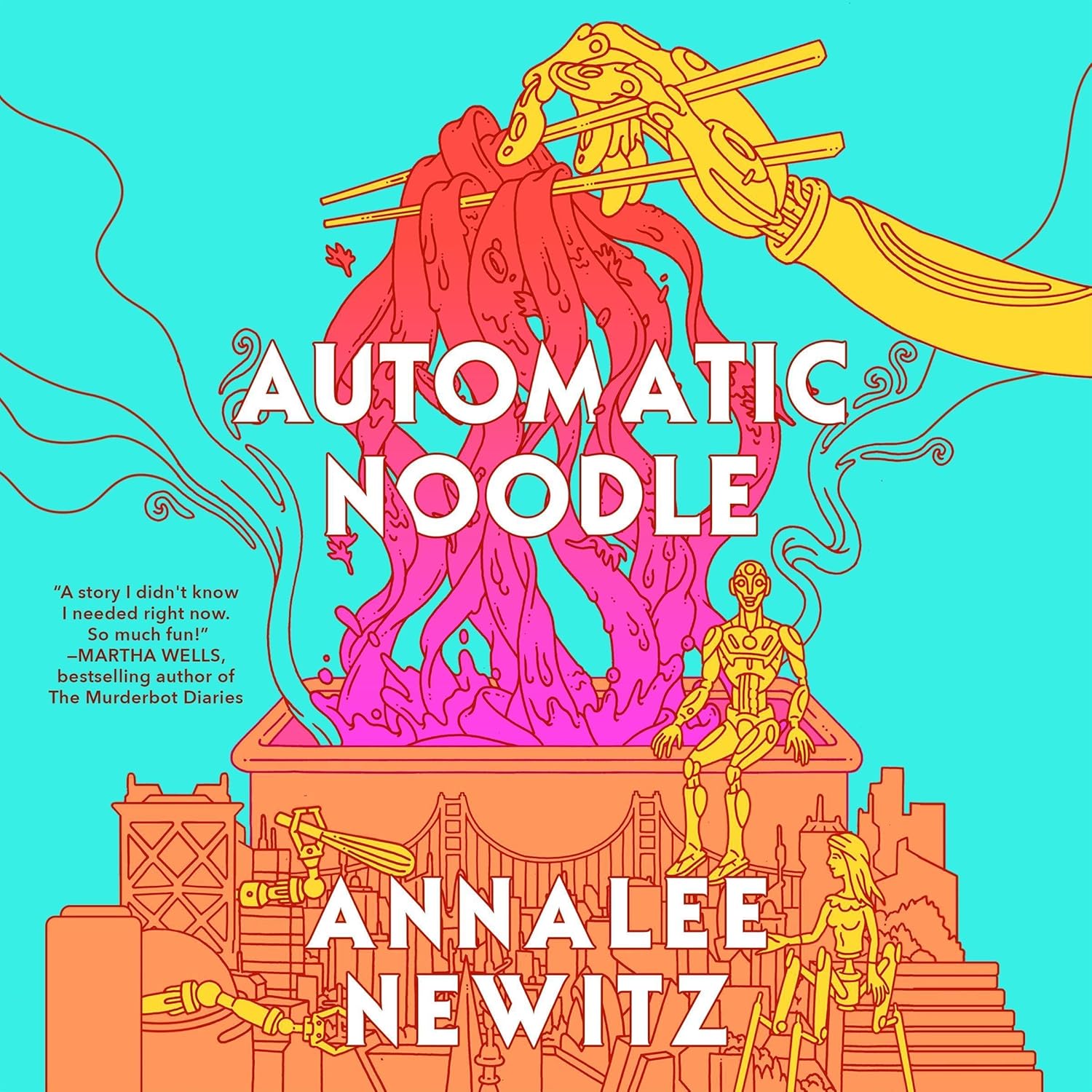
You don’t have to eat food to know the way to a city’s heart is through its stomach. So when a group of deactivated robots come back online in an abandoned ghost kitchen, they decide to make their own way doing what they know: making food—the tastiest hand-pulled noodles around—for the humans of San Francisco, who are recovering from a devastating war.
But when their robot-run business starts causing a stir, a targeted wave of one-star reviews threatens to boil over into a crisis. To keep their doors open, they’ll have to call on their customers, their community, and each other—and find a way to survive and thrive in a world that wasn’t built for them.
IN A NUTSHELL
Automatic Noodle’ is a remarkable speculative fiction novella. It’s original, engaging, thought-provoking and hopeful. I think it makes a particularly poignant read given the current attempt by Project 2025 to dismantle democracy in America. I read it in a single sitting, not just because it’s short but because it’s compelling, relevant and well-written. I recommend the audiobook. Em Grosland’s narration made the novella even more engaging.
The audiobook version of ‘Automatic Noodle‘ is only a little over four hours long, but it delivers a whole novel’s worth of ideas and emotions. I found myself completely engaged in the hopes, loves, fears and regrets of the main characters, which is remarkable given that the plot is linear, simple and focused on the establishment of a noodle restaurant, and the main characters are sentient bots. What makes it work is the depth and power of Annalee Newitz’s imagination and the originality of their perspective.
The novella combines strong world-building, a bot-centric narrative and plot about succeeding against the odds by claiming your own identity and building Found Family, to produce an uplifting and stimulating story.
‘Automatic Noodle’ is set in a plausible, perhaps even probable, near-future San Francisco recovering from the devastating effects of a war in which California won its independence from the United States of America.
It’s the story of four sentient bots, three of whom lived through the trauma of the war, who reboot after months of anenforced shutdown, to discover that they’ve been abandoned by the company that ran the fast food franchise they worked in.
I liked that the bots felt like people but didn’t feel like mechanical humans. These bots don’t want to be human. They justwant to be themselves. Their abilities and needs, even their relationship with their own bodies are fundamentally different from those of humans, except that, like humans, they have the capacity for love, joy, friendship, fear, grief and guilt. I loved getting to be inside the heads of each of the bots and coming to understand how they saw the world.
In Newitz’s near-future United States, sentient bots are owned. The newly independent California has determined that sentient bots have the right to be free. That sounds wonderful until you unpack the details. I won’t share those details here as discovering the limits on bot freedom was a fun part of reading the novella, but I was aware that many of the restrictions mirrored how ‘freed’ slaves were treated in various States under the Jim Crow laws.
I’ve seen ‘Automatic Noodle‘ described as Cozy Science Fiction. That wasn’t my experience of it. To me, Cozy implies the acceptance by writer and reader that the story takes place in an infeasibly nice world offering a sort of bubble-wrapped experience where nothing really bad will be allowed to happen. ‘Automatic Noodle‘ is born out of trauma, takes place in a devastated environment and requires the main characters to deal with hate-driven aggression. It’s a story about the resilience of hope in the face of hate and the universality of the need for love and friendship.
 Mike Finn's Fiction