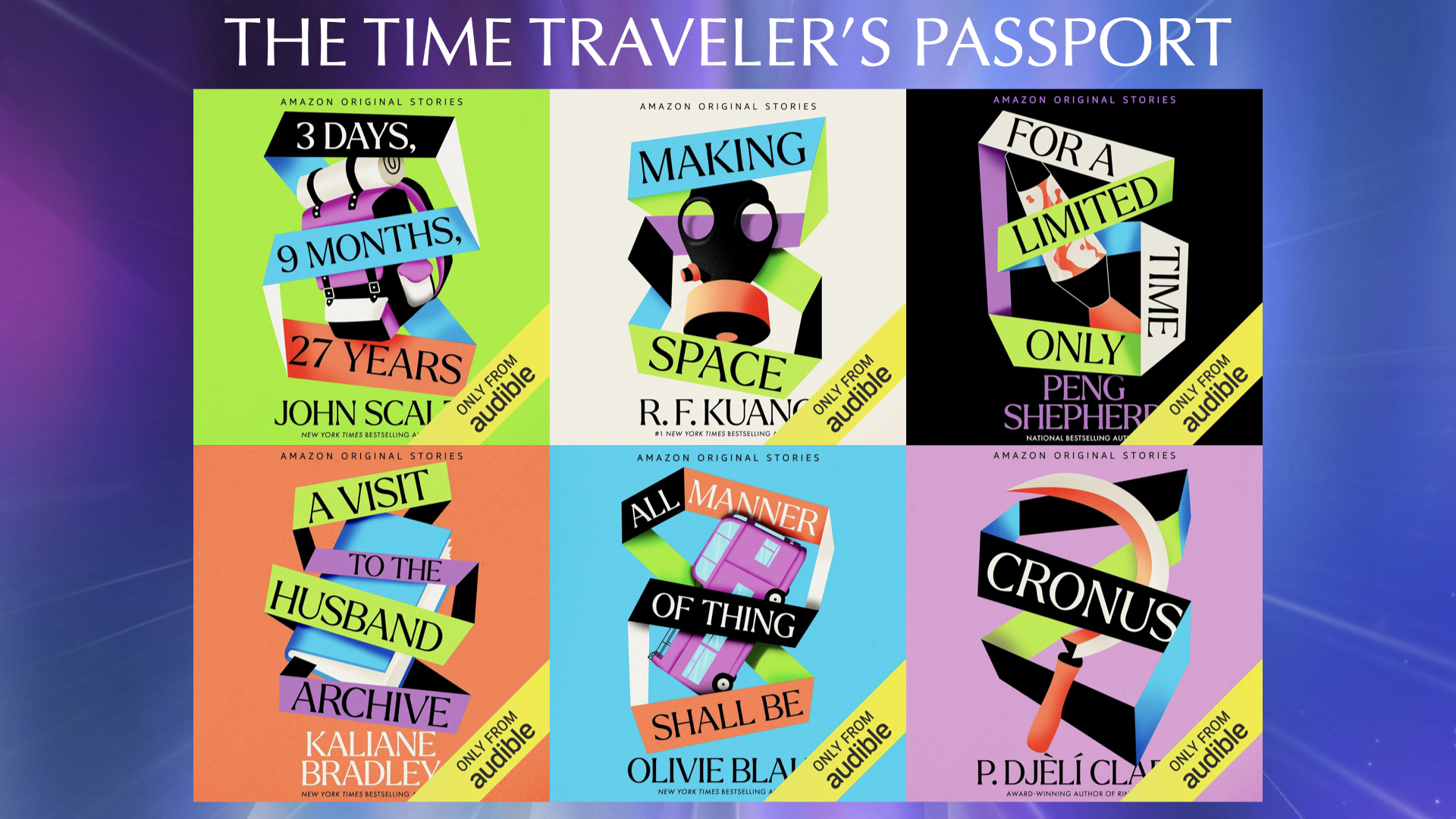
‘The Time Traveler’s Passport’, is an Amazon Original Stories collection of six new short stories from best-selling authors, curated by John Joseph Adams, that use the concept of time travel to explore themes of memory, identity and choice.
The stories are available individually in ebook and audiobook formats. I chose an audiobook version containing all six stories. Each story has its own narrator.
Each story takes about an hour to listen to, which, for me, made them the perfect way to start my day.
I reviewed and rated each short story below.
3 DAYS, 9 MONTHS, 27 YEARS by John Scalzi, narrated by Malcolm Hillgartner ★★★★
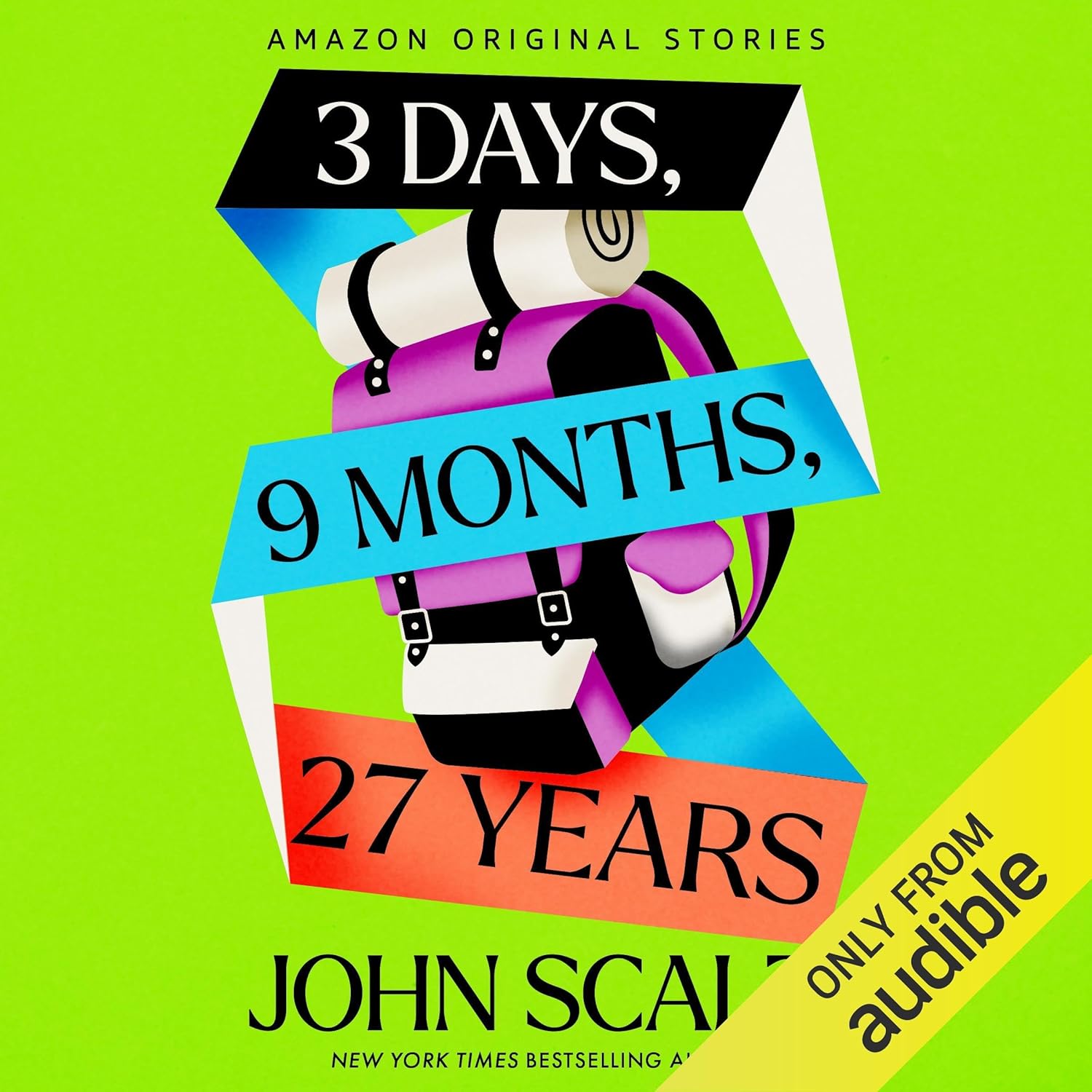
Time travel is real—and used for high-end tourism.
Every moment of the past is open to visitors, and no matter what they do then, everything now waits for them, thanks to the sure hand of an experienced time travel technician.
Come spend a day behind the controls of the time machine, and discover why, this day of all days, it’s time for this technician to make a change.
Because sometimes, time travel is more than just an adventure. Sometimes, it’s a moral imperative.
This is a clever story, told in a tone not of apathy but of informed, dispassionate resignation, by a man employed by a time travel tourism company as an operator who presses the buttons that send people back into the past and receives them, a second later for him, and either three days, or nine months, or twenty-seven years later for them.
At first, the operator seemed to be a device for explaining the limits, possibilities, risks and rewards of time travel tourism. If that was all there was to this story, it would still have been a stimulating, quirky and original model of time travel, but, as the story progresses, it becomes clear that the operator is educated well-above the role that he plays, that he has spent many years reflecting on time travel and that he has some, as yet undisclosed, connection to it.
I thought the final section of the story, when the operator’s history and motivation is revealed, lifted the story up another level, giving it an emotional context that explained the operator’s tone and made the story memorable.
MAKING SPACE by R. F. Kuang, narrated by Kristie Lee Walsh ★★★
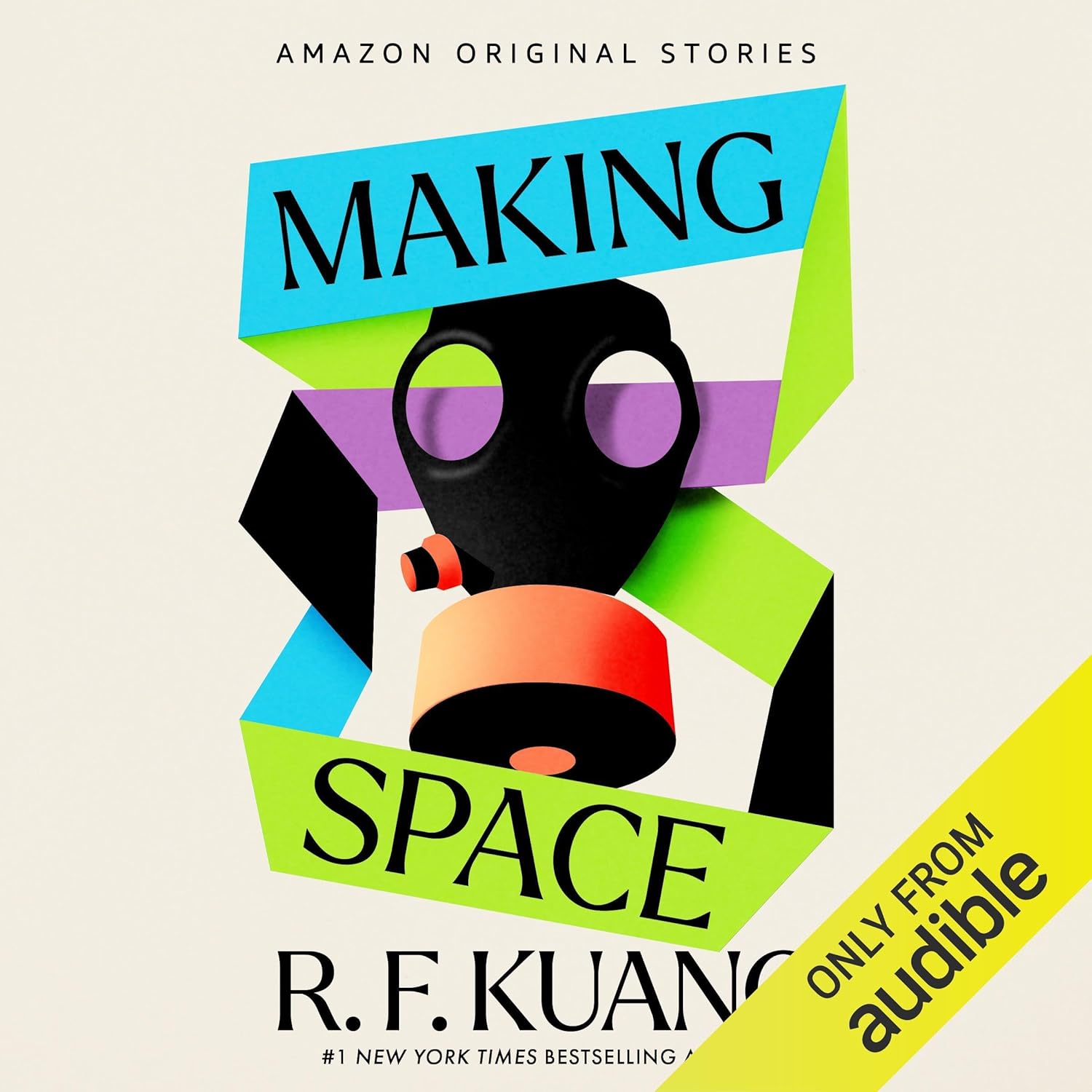
Jess desperately wants to be a mother, so when she discovers a young boy lost in the woods near her home, her heart goes out to him.
The boy, who Jess and her husband call “Buddy,” can’t tell them his name or anything about his family, but he’s clearly been through a lot.
When her husband cautions her not to get too involved, Jess brushes him off.
She would do anything for this child—and soon, she’ll have to prove it.
This was a dark tale, full of slowly expanding foreboding. It was a satisfying blend of domestic thriller, climate fiction and the kind of scary fairytale told to children as a warning. It seemed to me that there were three main themes to the story. The first was the effort we invest in not looking the truth in the eye: the truth of who we are, of what we want, of who we love and what our wants and loves drive us to do. The second theme was jealousy of those who have what we want and who take their privilege for granted. The third was the limitless, ruthless drive of a mother to give her child what she thinks they deserve. It was a dark mixture, made darker by being set amongst ordinary, ‘nice’ people in a newly gentrified neighbourhood.
FOR A LIMITED TIME ONLY by Peng Shepherd, narrated by Jonathan Davis ★★★★★

Russ commutes to work—not across town but through time.
An ambitious employee stuck in Oracle Marketing Solutions’ mundane “near past” division, he longs for the excitement of ancient eras and distant futures.
But Oracle’s secretive management has refused every one of his transfer requests, and Russ can’t understand why…until he makes a devastating discovery about his own timeline.
‘This was a story soaked in sadness. It felt human and real. I liked the way the meaning of the title kept changing throughout the story. I also liked that, while the mechanics of time travel are made to seem mundane and its motivation purely financial, the value of time and how we choose to use is shown as central to our happiness.
The scenes that showed Russ with his wife and his young daughter contrasted starkly with the scenes of Russ selling things he doesn’t care about to clients he was meeting for the first time. I admired the way, in the first half of the story, as well as establishing the situation and introducing the characters, I was given small indications that Russ was missing something important that people around him already understood. When Russ finally understands his own blind spot and its implications, his whole world collapses into an overwhelming sadness.
I thought that what Russ ended up using time travel for, while it came from a place of sorrow, offered a solace that all of us would find irresistible.
Jonathan Davis’ narration was pitch-perfect, massively increasing the already significant emotional impact of this story.
A VISIT TO THE HUSBAND ARCHIVE by Kaliane Bradley, narrated by Mirai ★★★★
Nobody likes being on agricultural rotation, and with this heat wave, it’s almost more than Ester can take.
She’s itching for something she can’t put words to—something she has no memory of wanting.
But then, she can’t remember much beyond the past couple of years.
She’s sent to the husband archive for a cure, but the man she checks out comes with baggage: stacks and stacks of paper he calls “books.”
What they teach each other may prove hard to forget.
The first thing that stood out for me about this story was Ester’s voice, skillfully narrated by Mirai. At the start, it’s clear that she’s a very literal-minded woman who has significant gaps in her memory and a pragmatic approach to recognising and satisfying her needs. She visits the Husband Archive because she has an itch to scratch. The husband the archivist allocates to her does more than share her bed. He uses language she doesn’t understand, shares the history of things that have vanished from her memory and, bit by bit, starts to awaken in Ester the beginnings of the ability and the desire to imagine things beyond the here and now, the practical and the mundane, and to form, for the first time, a plan. I enjoyed the challenge of trying to understand Ester’s world when I could see it only through her blinkered eyes, and I loved seeing Ester start to grow.
The second thing that stood out for me was the innovative concept of time in the story. This wasn’t the kind of time travel story I’d ever have thought of. The story showed how our ability to remember and to anticipate give time meaning in our lives. It also showed an entirely alien, non-human understanding of the value of time. I admired how these different ways of valuing time translated into a catastrophically destructive form of colonialism,
There was a lot in this story. It was intriguing, exciting, original, more than a little depressing, but, in the end, hopeful.
ALL MANNER OF THING SHALL BE by Olivie Blake, narrated by David Monteith DNF
What do you get when you throw together a PTA president, a dissipated rake, a poor little match-girl, a colonial nun, and an elderly revolutionary?
No, it’s not the start of a joke; it’s the cast of undead characters sharing a Victorian mansion in Santa Monica, California.
The motley housemates can usually keep the bickering to a minimum—but when their clashing personalities get stuck in a rut, they suffer what could be a terminal case of déjà vu.
This one wasn’t for me. I can see that it was meant to be humorous but it didn’t make me smile. It was trying too hard. It seemed to be going for look-how-packed-this-story-is-with-zany-ideas-and-larger-than-life-characters, but, to me, it was just noisy and a little frantic. I set it aside after only a few pages.
CRONUS by P. Djèlí Clark narrated by A’rese Emokpae ★★★★★
The year is 2030.
Annabeth works a stable job at CRONUS, a time travel company that caters to wealthy clients.
Life is harsh, but she’s willing to keep her head down—until a vision of a past that never happened leads her to question everything she knows.
They call it madness, but she’ll learn to call it memory.
Wow! This was intense, and dark, and very, very timely. I’m a fan of P. Djèlí Clark’s work, and I think this is his best story yet. The dialogue is spot on. The ideas demand attention, feeling more like prophecy than speculation. I loved how what starts off as a ‘Did he really just say that?’ disbelief grows into horror, then rage and finally an appetite for vengeance.
I’d like to be able to say that the racial hatred in this story was shocking, but unfortunately, it just felt familiar and believable. The story is an extrapolation of the direction of travel of the Broligarchy in the US. I’m convinced that if the anti-democracy Tech Bros had the time travel technology available to them, this story would quickly become our reality. Even without the technology, they’re doing everything they can to control how we remember and talk about the past.

