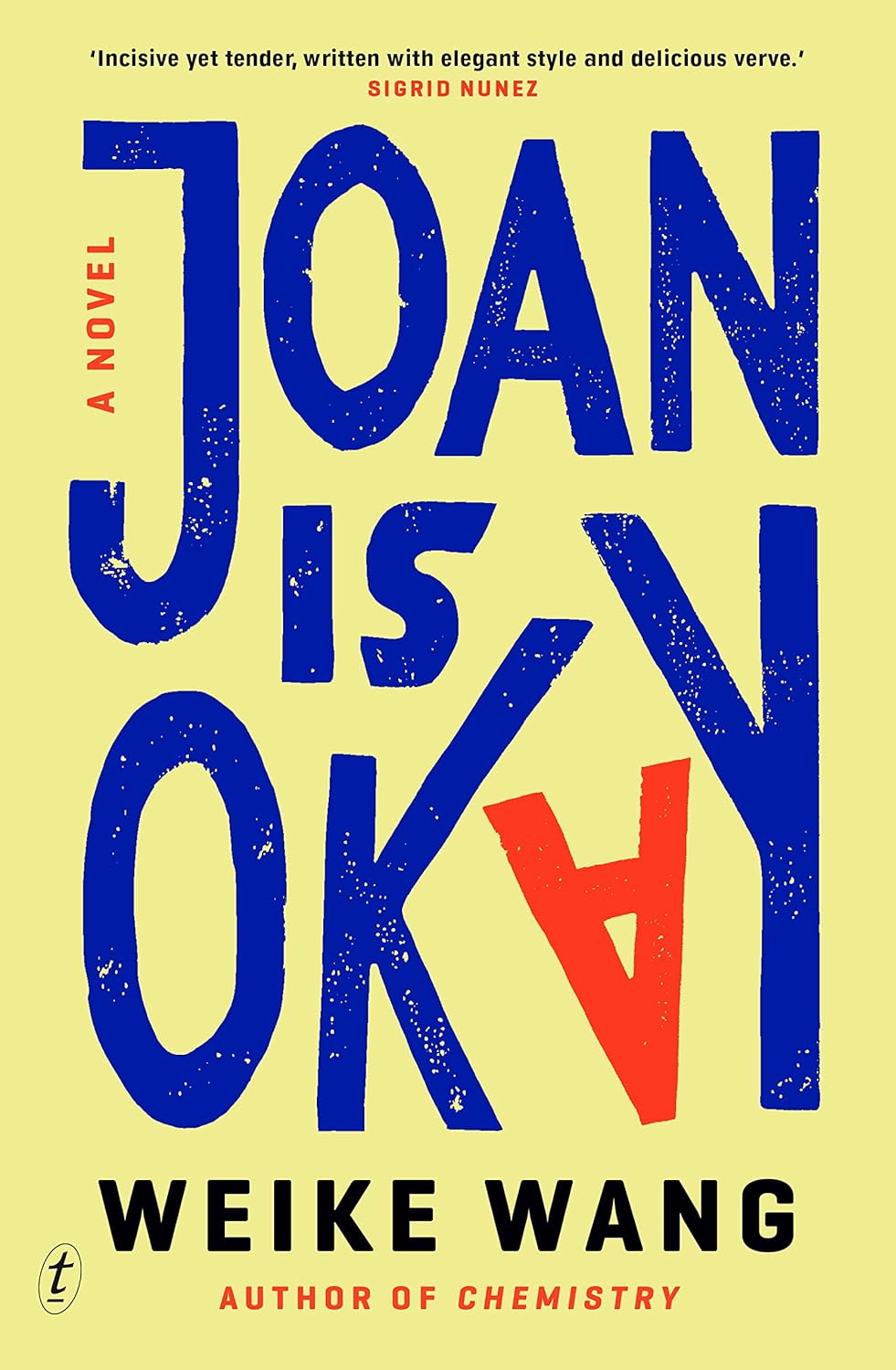
Joan is a thirty-something ICU doctor at a busy New York City hospital. She is intensely devoted to her work and happily solitary, but she sometimes wonders where her true roots lie: at the hospital, where her white coat makes her feel needed, or with her family, who try to shape her life according to their cultural and social expectations.
After moving to the United States to secure the American dream for their children, Joan’s parents have returned to China, hoping to spend the rest of their lives in their homeland now that Joan and her brother are well established in their careers.
But when her father suddenly dies, a series of events sends Joan spiralling out of her comfort zone, forcing her to consider her life anew.
I read ‘Joan Is Okay’ in April. I loved it, but, in the immediate afterglow of reading it, I didn’t know how to review it. Here’s what I wrote then:
“I find it much harder to say why an exceptionally good book is exceptionally good than I do to say why an unsatisfying book is unsatisfying, but I know an exceptional book when I read one; my whole body reacts to it, my emotions flare, ideas spark, the need to read more wars with a reluctance to finish. ‘Joan Is Okay‘ is an exceptional book. Read it and you’ll quickly see why. Joan isn’t just Okay, she’s remarkable. I loved spending time in her head.”
So, here I am, months later, still thinking about ‘Joan Is Okay’, knowing it’s one of the best books that I’ve read this year and feeling that I ought to be able to say more about why I feel that way.
Here goes.
Firstly, there’s the writing style. It’s a first-person narrative, which can be hard to sustain for a whole novel but which here feels as effortless and natural as breathing. The reader is immediately in Joan’s head. No barriers. No filters. Just Joan as she is. Here are the opening paragraphs. They’ll show you what I mean:
“WHEN I THINK ABOUT PEOPLE, I think about space, how much space a person takes up and how much use that person provides. I am just under five feet tall and just under a hundred pounds. Briefly I thought I would exceed five feet, and while that would’ve been fine, I also didn’t need the extra height. To stay just under something gives me a sense of comfort, as when it rains and I can open an umbrella over my head.
Today someone said that I looked like a mouse. Five six and 290 pounds, he, in a backless gown with nonslip tube socks, said that my looking like a mouse made him wary. He asked how old I was. What schools had I gone to, and were they prestigious? Then where were my degrees from these prestigious schools?
My degrees are large and framed, I said. I don’t carry them around.
While not a mouse, I do have prosaic features. My eyes, hooded and lashless. I have very thin eyebrows.
I told the man that he could try another hospital or come back at another time. But high chance that I would still be here and he would still think that I looked like a mouse.
I read somewhere that empathy is repeating the last three words of a sentence and nodding your head.”
Once I was in Joan’s head, I found I was very happy to be there. It felt familiar and a little like coming home.
Joan knows that she isn’t what people expect her to be.
What Joan confirms as she moves through the various stresses of the book, is that she knows who she is and she doesn’t want or need to be anyone else.
Even though those who love her, like her, or just work with her are constantly urging her to be more like them, to be as successful, or as social, or just as normal as they are, Joan does not accept the need to change. She really is okay. She just needs to navigate the demands of others and find a space where she can be herself. For Joan, that space is the ICU. Here’s Joan’s explanation of ICU and why she likes working there:
“A COMMON CONFUSION IS between intensive and emergency care. The latter is chaotic, usually on the first floor near the ambulance drop-off, in a room without dividers or enough beds. Someone might scream, Doctor! and because no one answers, that person screams on. Intensive care is just the opposite. It’s the best care that a hospital can give, and the room is quiet except for machine sounds, alarms that go on and off.
Just as radiologists know their imaging, ICU doctors know machines, ones that push oxygen into you, the all-mighty vent; ones that clean your blood, dialysis; the pumps, aka drips, that deliver medication and sedation through a central line directly to the heart. With many machines come many tubes. The endotracheal tube down the throat and to the vent for air, the nasogastric tube to the stomach for food, rectal tubes for stool, a foley for the bladder, etc. Fluid control was imperative. Too much fluid in and the body would swell. Too much fluid out and it would desiccate.
At my interview three years ago, the director asked why I chose intensive care, and I said I liked the purity of it, the total sense of control. Machines can tell you things that the people attached to them can’t, I said. I liked that the sick didn’t stay with us long, but for the stint that they do, we give it our all.”
The book takes place after the unexpected death of Joan’s father. It covers a period when Joan is reflecting on the life she’s made for herself and the ways in which her brother, her sister-in-law and even her extrovert, gregarious neighbour are urging her to change it so that she can be more… well… more like them and less like an oddity who makes them uncomfortable.
What I liked most about the book was that Joan listens to the people around her and then makes up her own mind. She lives in her rich, successful brother’s house for a while and sees his life with his wife and his children up close. She talks with her neighbour. She’s not dismissive of either of them. She just knows that what makes them happy and what makes her happy are not the same things. She leaves the surprise housewarming party her neighbour throws for her in Joan’s own flat. She leaves her brother’s house with a sense of relief. It’s not that she’s walking away from the world or choosing isolation; she’s walking into the place where she belongs and can be useful, while sustaining the solitude she needs without letting go of human connection. That felt like a happy ending to me.

Weike Wang is the author of 4 novels, the most forthcoming IRIS (Riverhead 2027).
She is the recipient of a Pen Hemingway, a Whiting award and a National Book Foundation 5 under 35.
Her work has appeared in The New Yorker, The Atlantic, Harper’s Magazine, Best American Short Stories and has won two O. Henry Prizes.
She earned her MFA from Boston University and her other degrees from Harvard.
She currently lives in New York City and has taught at the University of Pennsylvania, Columbia University, Barnard College and Boston University.
Bio taken from: https://www.weikewangwrites.com/


I’ll take that recommendation and add to my tbr pile. Sounds intriguing! Many thanks!
LikeLike
Thank you. I hope you enjoy the novel.
LikeLike