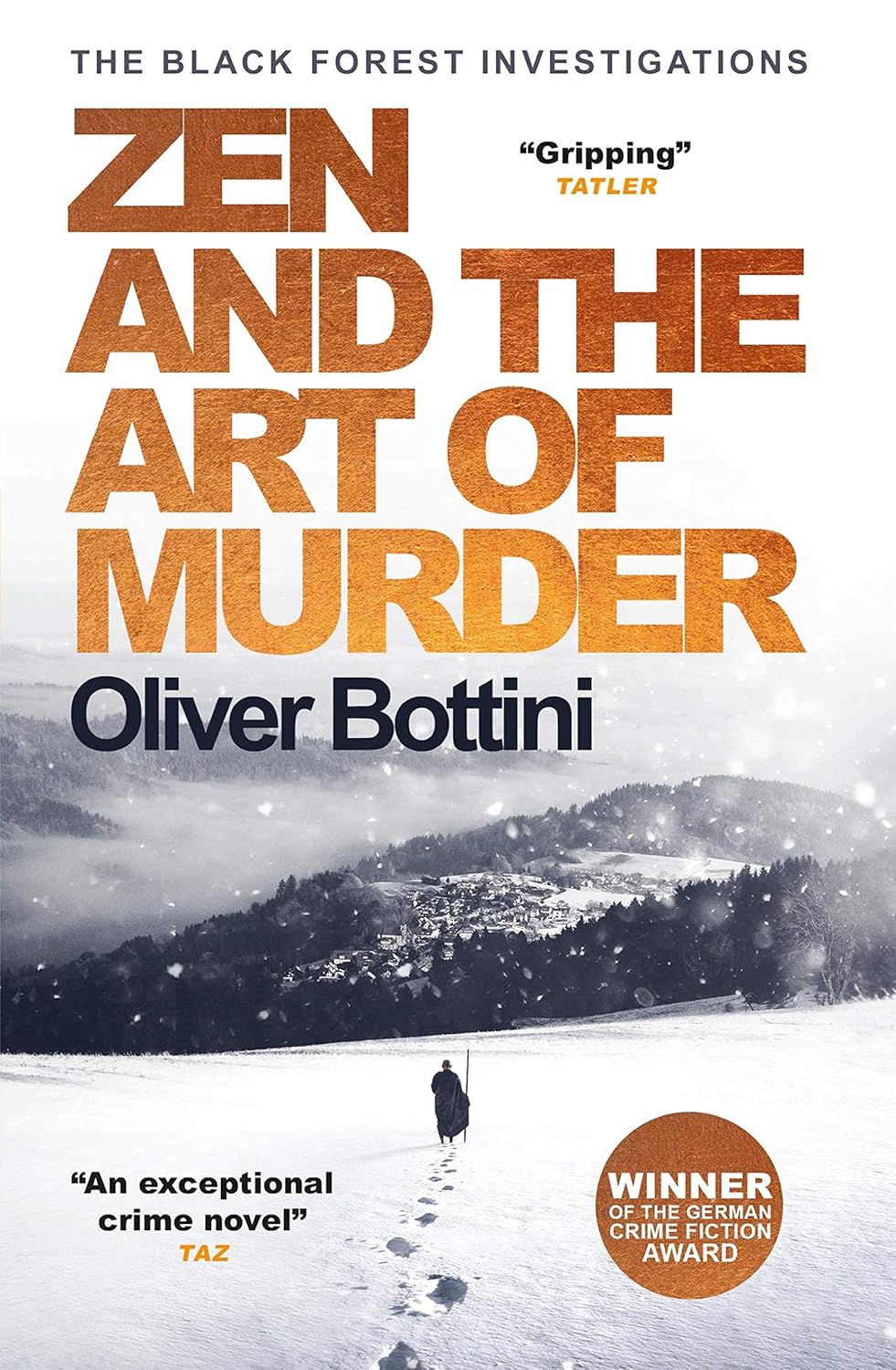
Louise Boni, maverick chief inspector with the Black Forest crime squad, is struggling with her demons. Divorced at forty-two, she is haunted by the shadows of the past.
Dreading yet another a dreary winter weekend alone, she receives a call from the departmental chief which signals the strangest assignment of her career – to trail a Japanese monk wandering through the snowy wasteland to the east of Freiburg, dressed only in sandals and a cowl. She sets off reluctantly, and by the time she catches up with him, she discovers that he is injured, and fearfully fleeing some unknown evil.
When her own team comes under fire, the investigation takes on a terrifying dimension, uncovering a hideous ring of child traffickers. The repercussions of their crimes will change the course of her own life.
IN A NUTSHELL
A strange book. The greatest mystery isn’t the one to do with the monk walking through the snow but with the mental and emotional condition of the lead detective. There were points when this novel almost lost me, but I’m glad I stuck with it. I think it will stick with me.
I bought ‘Zen and the Art of Murder’, having originally been written in German, being set well away from the big cities in the Black Forest in Germany’s southern borderlands, and telling the story of a silent, injured Japanese monk walking through the snow, it was bound to have a different perspective that the crime novels written by English speaking authors and set in Englisish speaking cultures. What I hadn’t expected was to get something so different that I mentally reclassified it as strange.
I don’t think this strangeness arose from the setting or the local cultures. I’ve spent quite a lot of time in the regions of Germany and France where the book is set, so it held no surprises. I think the strangeness was an artefact of the author’s intent.
It seems to me that storytelling style and the plot structure of ‘Zen and the Art of Murder’ were purposely designed to be disquieting; to disrupt the reader’s habitual ways of seeing and thinking about things and to open the reader up to the idea that the desires, motivations and values of others, all others, are unknowable. It seemed to me that, like the monk in the story, the novel travelled a path parallel to that of a conventional police procedural.
The first third of the novel was rich in weirdness but free of crime. The first police officer to see the monk moving through the driving snow mistakes him for a vision sent by his dead wife – a message in the form of a riddle to be solved rather than an anomaly disrupting the peace of a small village. Here’s how it starts:
“It was a snowy Saturday morning in Liebau. When Johann Georg Hollerer took his first glimpse out of the kitchen window at the high street, he was confronted by a vision. Dressed only in a dark robe and sandals, an oriental monk had emerged from the driving snow. His virtually bald, wet head glistened in the gloomy morning light as he walked slowly past Hollerer’s window towards the church. In his left hand he gripped a head-high staff for support, in his right he held a small bowl. Amelie has sent him to me, Hollerer thought, as the vision dissipated back into the snow. Hollerer returned to his breakfast table where he sat for several minutes, pondering the message Amelie had been trying to send. It confused him that she, a life-long God-fearing Catholic, should have chosen an oriental Buddhist to deliver it. Eventually he stood up, irritated. Even in death Amelie spoke to him in riddles and put him in a bad mood.
It was another half hour before Hollerer realised he hadn’t been duped by a vision. As he buttoned his uniform jacket over his protruding belly, he remembered noticing a large dark mark above the monk’s right ear. In the initial shock he hadn’t paid it much attention, but on second thoughts it was strange – a rectangular, dark-blue discoloration of the skin. Hollerer knew marks like that only too well, in all their stages of bruising, in every size, on all parts of the body. The monk had an injury to his head. As if he’d knocked it against something – or had been hit. Unsettled, he went to his bedside table. In the drawer beneath a dusty copy of the Old Testament lay his service pistol. He had not carried it once in thirty years, let alone used it. But now he picked up the gun with his thumb and forefinger.”
That feeling of not being sure that what you’ve seen is real but being disturbed by it nonetheless is almost constantly present in the novel.
The effect is amplified by the arrival of Chief Inspector Louise Boni, who has been assigned to support the local police officer in assuring the villagers and the village mayor that the monk is not a threat. She is so lost in her own remembered trauma that is more real to her than current events. Her wide-open emotions, her desire for meaning and perhaps for redemption, and her intermittent ability to share the reality everyone else takes for granted make her both the best and the worst person to be assigned to surveil the monk. For her, the monk becomes both a source of both solace and anxiety. She craves his apparent serenity and fears for his safety. Boni, the unsettled local police officer Hollerer, and the monk all seem to be at the fraying edge of reality. Part of what makes this unsettling is that the people, including the police officers, and the places feel grounded in the solidly familiar.
About a quarter of the way through the novel, this sentence gave me pause:
The detective, in the snow laden woods.as darkess falls on a strange, frustrating day: “when, she thought, was something finally going to happen?”
I’d been thinking that for pages before I reached this sentence, but when Boni thought it, I realised that it had been almost soothing to have so little happening. It had me listen harder to the detective as she struggled to push back despair. Even so, my expectations of the genre – that there should be a more or less linear progression from establishing the setting and the cast, finding the body, setting the parameters of the puzzle, identifying suspects and gathering data, to reaching a data-based conclusion – were hard to let go of; all of those expectations were being frustrated.
By the halfway mark, I was almost ready to set the book aside. Seeing events through the eyes of a woman so wrapped in guilt she could barely move and so often drunk and so plagued by dreams even when awake that her grasp on reality was unreliable made for a disjointed narrative. Boni’s emotions and urges constantly splashed over her thoughts, washing some of them away and blurring others. I could see that she was a woman who neither knew what she wanted nor how to stop wanting. I was finding it hard and upsetting to stay engaged with her.
I decided that, if I was to continue with the book, I had to change my expectation of it. ‘Zen and the Art of Murder’ wasn’t a novel about solving a crime; it was a novel about a woman on the edge of losing herself to guilt and grief and alcoholism who was desperately trying to find her way back. I kept reading because, even though I didn’t like Boni very much, she felt real and I wanted to see if she would find a way to reclaim her life.
The second half of the book surprised me. Suddenly, there was violence and death. There was wrongdoing to be uncovered, criminals to be caught, people to be saved, and colleagues to be avenged. I liked that Boni didn’t suddenly regain her grip on the world. She remained a liability to herself and others. She worked off instinct and alcohol. She took unacceptable risks, placing herself and others in danger. Her main strength was that she didn’t give up because she couldn’t give up. The only way forward was through.
It turned out that the plot was solid, the action scenes were well done, and the outcomes were credible. Oddly, that wasn’t what I valued most about the book. What stuck with me, what is still with me, is that Boni didn’t find redemption. Instead, she found a kind of acceptance: of who she is, of the faults and weaknesses she has,of the strange things she sometimes wants and of how little of that she can change.

Oliver Bottini was born in 1965.
Five of his novels, including ZEN AND THE ART OF MURDER and A SUMMER OF MURDER of the Black Forest Investigations have been awarded the Deutscher Krimipreis, Germany’s most prestigious award for crime writing.
ZEN AND THE ART OF MURDER was shortlisted for the 2018 CWA International Dagger.
He lives in Frankfurt. http://www.bottini.de.
Source: https://www.hachette.co.uk/contributor/oliver-bottini/
Jamie Bulloch (born 6 September 1969) is a British historian and translator of German literature, with over sixty published titles to his name. He is also twice winner of the Schlegel-Tieck prize.
Source:https://www.wikiwand.com/en/Jamie_Bulloch



We’re about to fly to Germany to visit our daughter in Freiburg. I might try to find the original version there. It looks very intriguing!
LikeLike
I hope you enjoy your trip and the book.
LikeLike