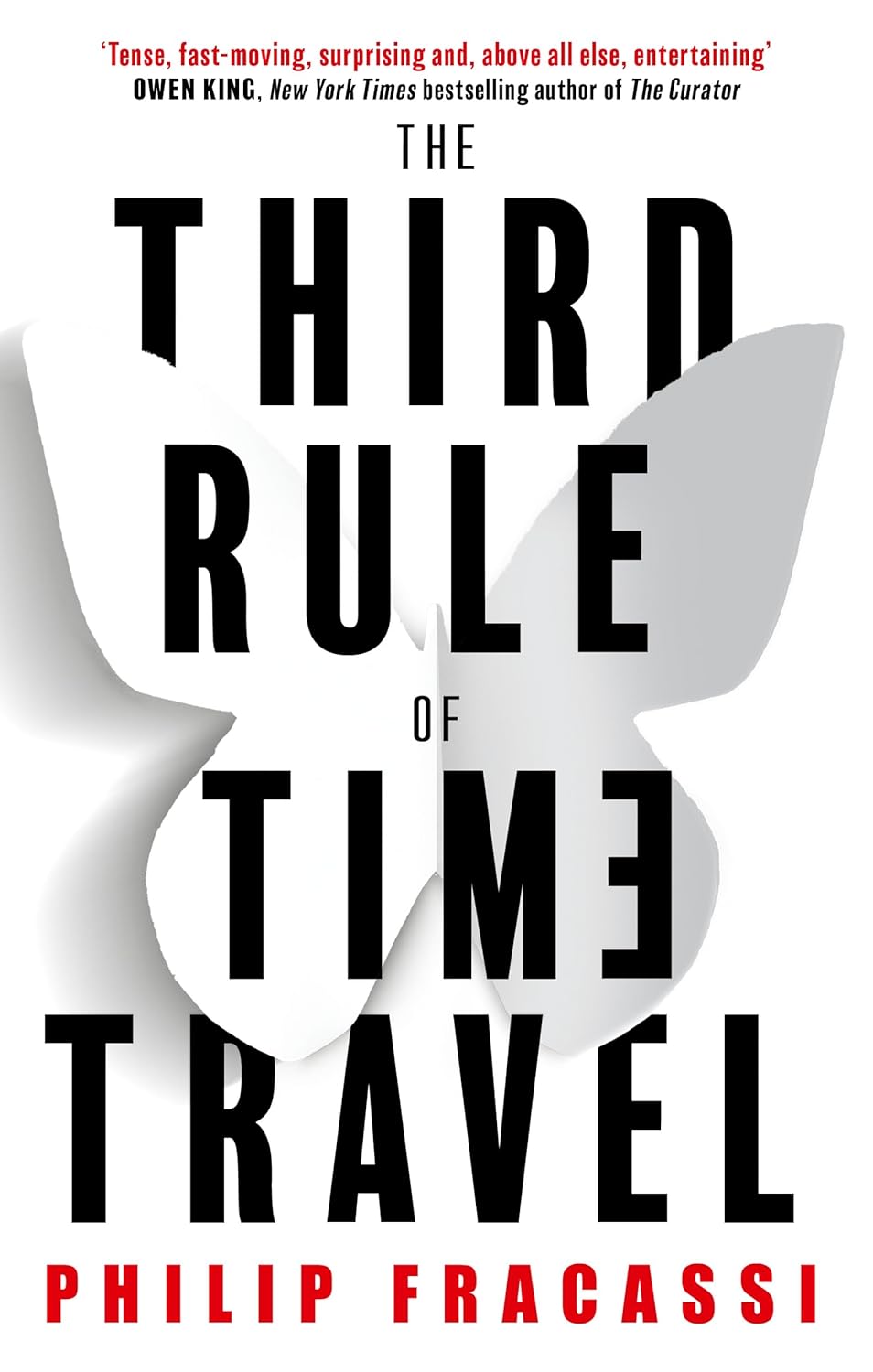
Rule One: Travel can only occur to a point within your lifetime.
Rule Two: You can only travel for ninety seconds.
Rule Three: You can only observe.
The rules cannot be broken.
This is not the story you think you know. And the rules are only the beginning.
IN A NUTSHELL
I think I picked this book up at the wrong time for me to enjoy it. I was in the mood for a clever, exciting, time-travel-as-a-puzzle novel. I was assuming that this would be a riff on Asimov’s three rules of robotics, with a mystery built around manipulating those rules in surprising ways. It turned out that the book is part techno-thriller and part psychological thriller, with a big dose of trauma and grief thrown in. Which wasn’t what I was expecting and which didn’t end up holding my attention. When, at the end of two months, I’d only read a third of a 336-page book, I decided it was time to set it aside. In doing so, I feel like I should be saying, “It’s not you, it’s me. OK, it’s a little you, but it’s mostly me. Either way, this wasn’t the outcome I wanted.”
The start of ‘The Third Rule of Time Travel’ was remarkable: dramatic, intense, intriguing and original. I bought the book after reading the first few pages.
It wasn’t the kind of intensity that can be sustained throughout a novel. What impressed me in the next few chapters was how the relatively undramatic events engendered such a strong sense of threat. It was like the itch I get between my shoulder blades when I know I’m being watched or the scent at the edge of a storm. I was engaged. Unfortunately, it didn’t last. By the 32% mark, I was saying:
“I’m not sure this is for me. The idea is novel. The writing is focused. The shift to an interview format worked well to carry the tech briefing while building the scientist’s character, worked well. What’s not working for me is the bereaved scientist being manipulated by a charismatic, probably sociopathic Tech Bro. If that’s the main story, then this isn’t going to hold me because I think it’s too simplistic.”
I stuck with the book for a little longer, but it was slow going because it was seldom the first book that I reached for. Part of my hesitation was that, from my point of view, after a strong start, the book had gone in an unexpected direction, becoming a thriller about a pioneering scientist versus an evil predatory billionaire CEO. I had difficulty getting behind that having because it was less interesting to me than the time travel proposition that the book started with, and because this scientist was so naive that, even allowing for her grief and her past trauma, I found it difficult to believe in her.
I like the way Philip Fracassi writes, but this time, what he was writing about didn’t call to me, so I set the book aside at 36%.

