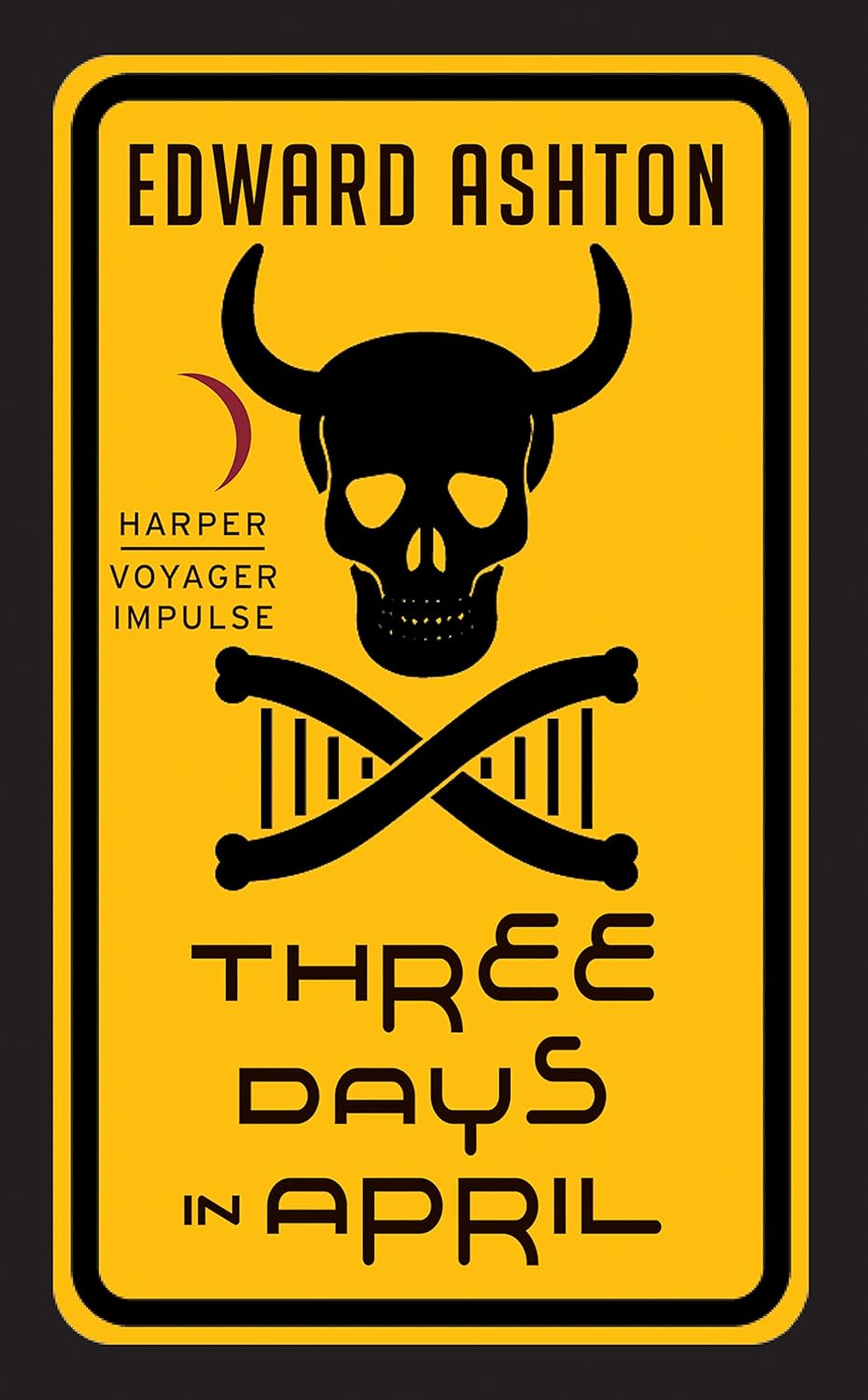
Anders Jensen is having a bad month. His roommate is a data thief, his girlfriend picks fights in bars, and his best friend is a cyborg…and a lousy tipper. When everything is spiraling out of control, though, maybe those are exactly the kind of friends you need.
In a world divided between the genetically engineered elite and the unmodified masses, Anders is an engineered, but still broke and living next to a crack house. All he wants is to land a tenure-track faculty position, and maybe meet someone who’s not technically a criminal-but when a nightmare plague rips through Hagerstown, Anders finds himself dodging kinetic energy weapons and government assassins as Baltimore slips into chaos.
His friends aren’t as helpless as they seem, though, and his girlfriend’s street-magician brother-in-law might be a pretentious hipster – or might hold the secret to saving them all.
IN A NUTSHELL
‘Three Days in April’ was a fun read. An original story full of surprises, told in a unique voice that I want to hear more of.
Edward Ashton is probably best known for his Mickey7 novels, the first of which was made into the movie ‘Mickey 17’. ‘Three Days in April’ (2015) was his debut novel, and it was a doozy. It was fast, fun, original and plausible. Labelling it ‘darkly comic’ underestimates how weaponised the humour is.
I loved that this wasn’t just a ‘look how bizarre we are’ satire. It tackled some big issues with a remarkable clarity of vision and the ruthless use of violence. The story explores the nature of personhood and what it means to be human. The characters represent a spectrum from a genetically unaltered (but still smart and attractive) human, through genetically modified but not visibly so, to instantly recognisable as genetically modified, to cyborg humans, and people who live their entire lives online. The politics of fear plays out both in acts of terrorism and in the acceptance of a surveillance state supported by kill squads to “keep normal people safe”. There’s a mixture of science, mysticism and ingrained, bloodyminded, cynical disbelief.
What I most admired about the novel was Edward Ashton’s skill at letting the story get complex and twisty without losing its lightness of touch. He used multiple points of view to enhance the story, not just by broadening the scope of the narrative, but by building characters who see the world differently, and without letting one view become the dominant one. He pulled no punches with the violence meted out by all sides, delivered an ingenious, tightly woven story that kept me guessing and yet still made me laugh and gave me hope.
 Mike Finn's Fiction