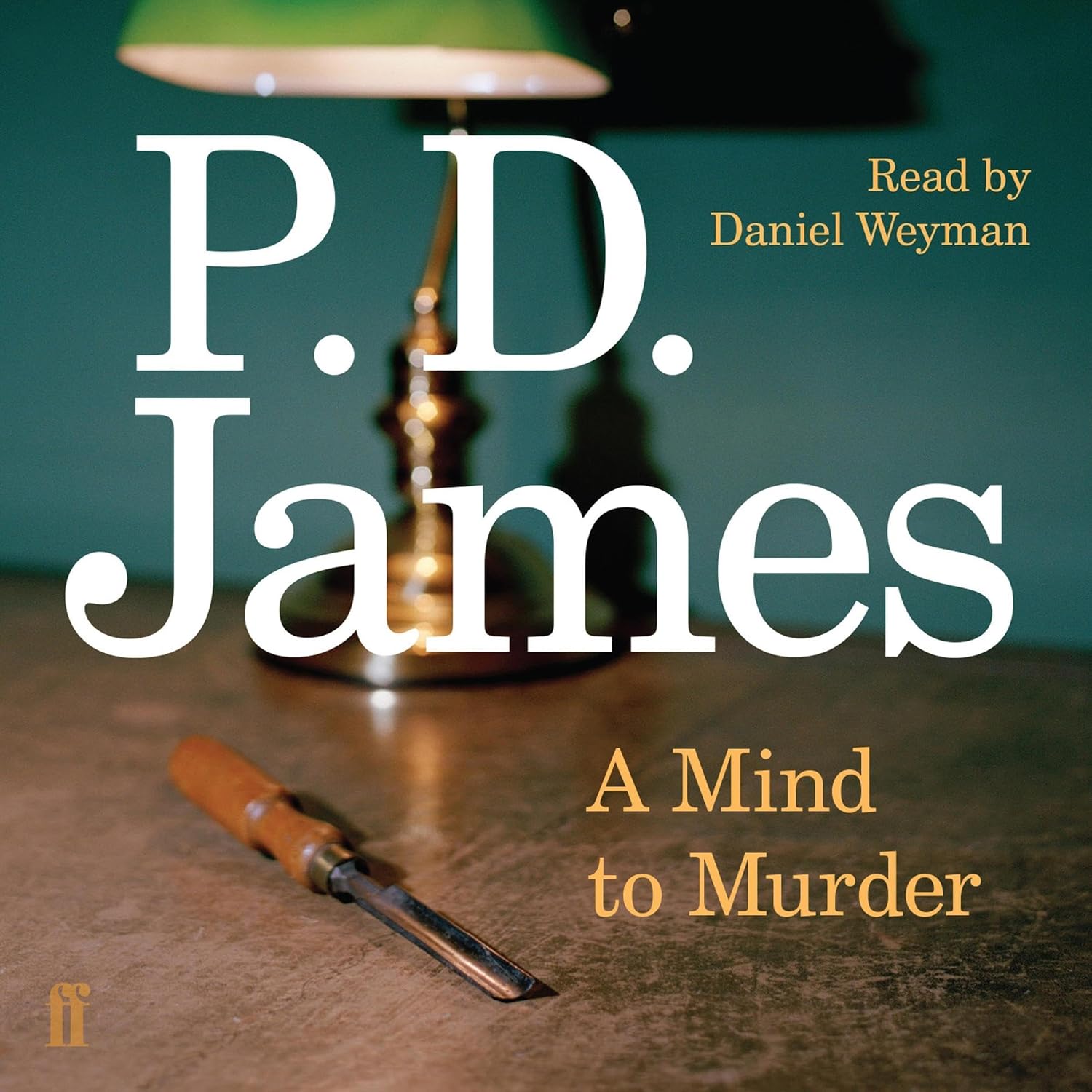
When the body of a woman is discovered at the Steen Psychiatric Clinic with a chisel through her heart, it seems to Dalgliesh a straightforward enough case: the building was locked, and no-one has been able to enter or leave since the murder. Logically, the killer must be one of the shocked group waiting to meet him.
But Dalgliesh quickly discovers an intricate web of lies and grudges among both patients and staff which threatens to derail the investigation. And as he works to uncover the truth, the murderer is preparing to strike again . . .
IN A NUTSHELL
A satisfying mystery, with engaging characters described in pleasing-to-the-ear prose but with problematic pacing. The start was so slow, so static, and so linear that by 40% I was considering setting it aside. The second half was better. The ending was exciting and surprising.
P.D. James set her second Adam Dalgliesh mystery in a small, used-to-be-posh-but-is-now-part-of-the-NHS central London psychiatric clinic, where the unpopular, rules-following, not-good-with-people Administration Officer has been murdered in a basement records room. The murder is brutal. The suspect pool is limited. Dalgliesh is on the scene before anyone who might be a suspect has had a chance to leave.
I loved the carefully crafted portraits of the suspects being interviewed and Dalgliesh’s quiet, polite, and scalpel-sharp questions… BUT… the interviewing and information gathering took up the first forty per cent of the book. Keeping the focus on Dalgliesh’s questioning of staff and patients temporarily detained in the clinic meant the story was static, linear and absent of all action. By the time Dalgliesh was finished for the day, my interest was starting to flag. I needed something, anything, to happen soon or I’d set the book aside.
The second half of the book was much better. I liked that P.D. James told the next part of the story as a sequence of internal monologues from the main suspects. The monologues enriched the character of the suspects, brought the internal politics of the clinic to life and made many of the suspects seem like strong candidates for the role of murderer.
When this was published in 1964, the ‘swinging sixties’ were more of a media concept than a daily reality for most people. I think a plot lubricated by references to premarital sex, illegitimate children, extra-marital affairs and psychosexual problems had a shock value that is hard for a modern reader to imagine. Whereas the most shocking thing for me was that the psychiatrists were routinely administering LSD to help their patients become more receptive to therapy.
Even when the pacing wasn’t working for me, I was carried along by P.D. James’ writing. Her summaries of people were concise, precise and beautifully phrased without ever dropping into purple prose.
Dalgliesh is a wonderful creation. His ability to weaponise patience, politeness, and personal distance to manipulate the people he’s interviewing is a joy to watch. His occasional bouts of self-critical introspection make him more interesting, mostly because knowing what he’s doing and why he’s doing it doesn’t help him to change what he’s doing. I think that’s what makes him feel human.
The last twenty per cent of the book was very tense. It was packed with dramatic action and plot twists that I didn’t see coming.
As with the first book, ‘Cover Her Face‘, Daniel Weyman’s narration was an excellent fit for P.D. James’ prose. Click on the YouTube link below to hear a sample.

