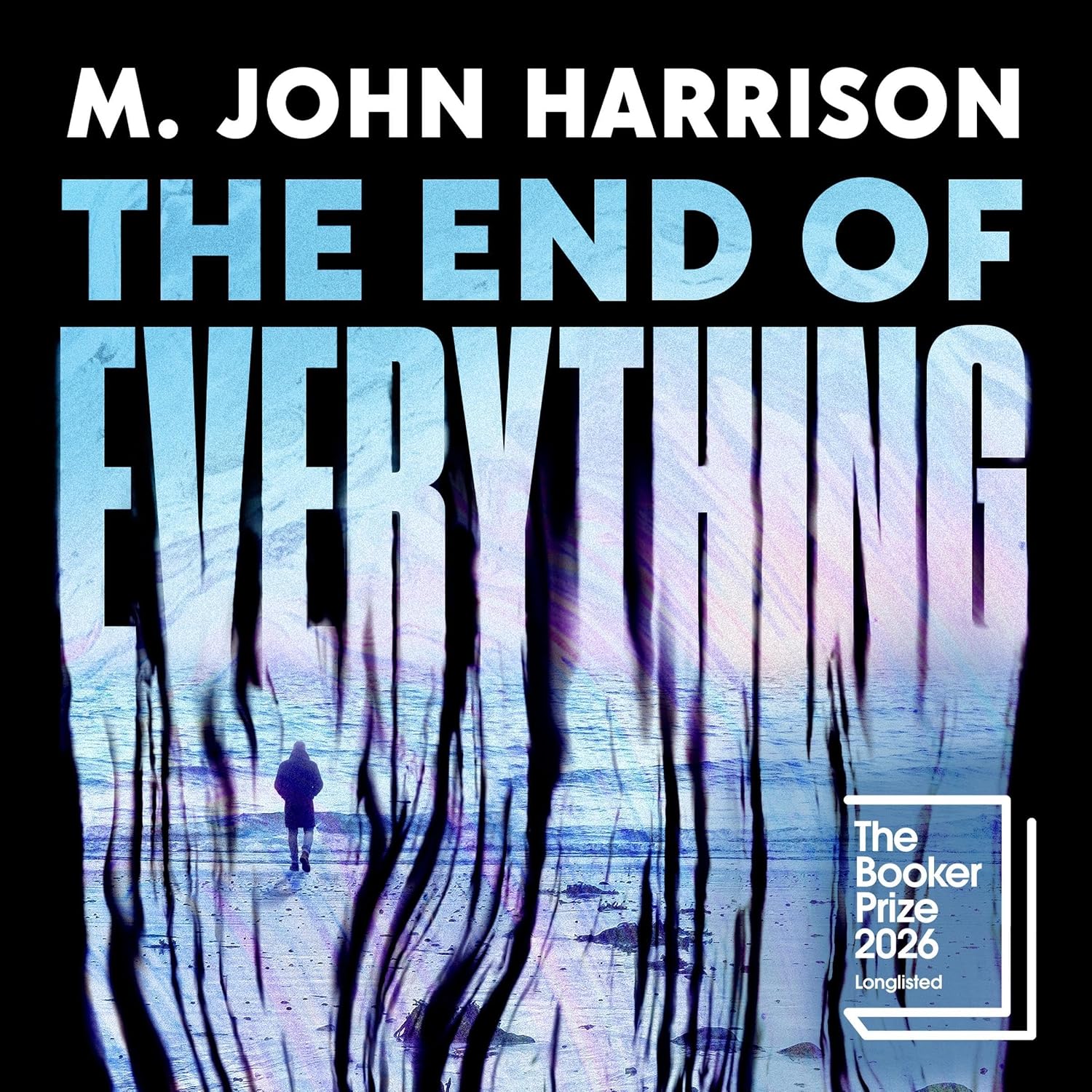
Phillip Tennent makes his living at the tideline, collecting artefacts that wash up from the Channel. It’s been years since the crisis changed everything, but its exact nature remains obscure. Government barely functions, the seas are full of new creatures, Europe has been mislaid. It feels like the end.
Now Phillip has fished out of the water an object he can’t keep. A creature that keeps changing. An artefact he must take inland, before it destroys everything he thinks he knows.
IN A NUTSHELL
I made it a third of the way through this short novella before abandoning it because I couldn’t listen to any more of the over-worked, trying-too-hard prose.
Listening to ‘The End of Everything‘ was like going through what the novella describes as a ‘Bad Patch’; an induced fugue state where a person is forced into the role of observer and where what is observed has neither meaning nor context. An experience which, instead of establishing a connection to a shared reality, erodes agency by unravelling reality: memory, identity and the experience of sequential time, like wool slipping from a knitting needle.
This novella is the textual equivalent of a psychotropic drug, stimulating a hunger for meaning and connection that it has neither the means nor the intent of sating.
I abandoned ‘The End of Everything’ not because of the kind of book it seemed to be trying to be; I’m okay with the concept of a novel immersing me in an environment where mankind has been forced into a sort of terminal dissociative state, bending reality into patterns that they’re not equipped to cope with or even fully to perceive. It’s an intriguing premise. I set ‘The End of Everything‘ aside because the writing was so determinedly literary that it was unbearable. The prose was unrelenting, overworked and trying too hard. Dense with imagery but lacking rhythm, it felt like a continuous stream of self-consciousness.
Here’s an example of the kind of writing that made reading this novella tiresome:
“By midday, the sky was open, blue and urgent, calling forth the retirees from their second-floor mansion flats. For them, nothing had changed. The women smiled into the sun in a kind of secretive delight. This morning they had found themselves, after all, still alive. The beloved grandfathers, queueing formally and amicably at the abandoned public toilet, rehearsed for each other their personal historical understandings of the coast. Amiable arguments about the exact nature of Henry VIII’s fortifications, which everyone could admit were never much use, pivoted, with barely a pause for breath, to the image of bright white contrails, those dog fights across the beautiful cold azure 1940s sky, when England’s day was saved, at its last moment, by doomed young men and a twenty-seven litre, liquid-cooled, V12 aircraft engine. There was little sense that any of them acknowledged how disconnected from itself, let alone from its crafted headlong self-myth, their world had become, or even if they had noticed at all.”
If that quote made you tap your feet and go, “Now THAT’S what I call literature”, then, like the Booker Prize judges. you’ll love this novella.

