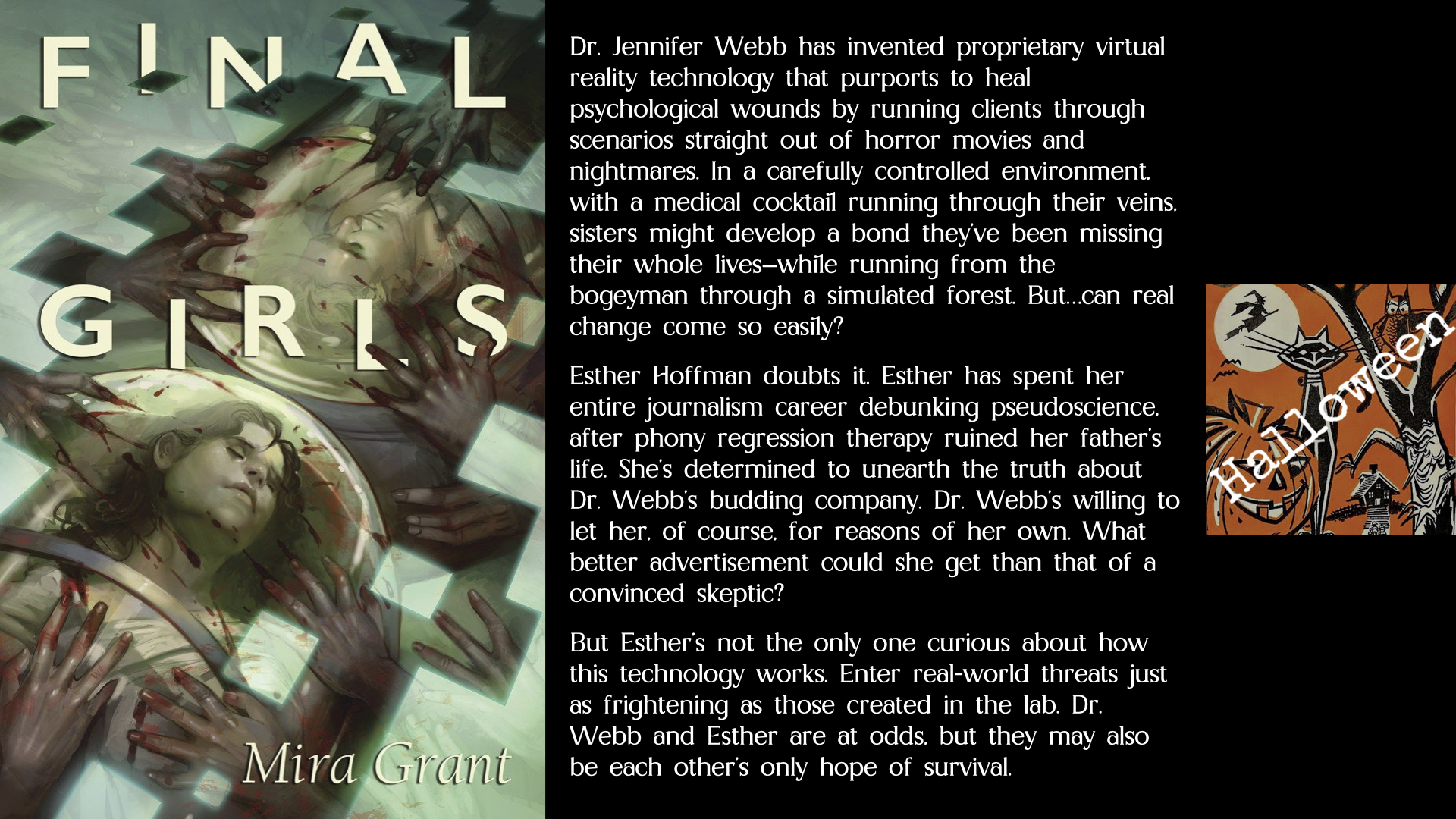
In ‘Final Girls‘ Mira Grant has interwoven tropes from Mad Scientist Science Fiction thrillers and Halloween / Evil Dead horror movies to deliver a story that is original, exciting and often surprising.
The opening chapter is called Running and it dropped me straight into a classic horror movie scene: two young sisters being chased by a monster through dark woods lit only by a sickly moon. Here are the first two paragraphs:
THE WOOD is dark and the wood is deep and the trees claw at the sky with branches like bones, ripping holes in the canopy of clouds, revealing glimpses of a distant, rotting moon the color of dead flesh. The light it casts turns everything cold and cruel, like something better buried and forgotten. It would almost be better without the moon. They would be running blind without the moon, yes, but at least if they were running blind, they wouldn’t have to see.
They run through the skeleton trees hand-in-hand, two girls separated by a handful of years that seemed like an eternity only a few short hours ago (a few short hours ago, before they were alone in the world; before they were orphans, before they knew the taste of their mother’s blood, the glittering trails of their father’s tears; before they were everything either of them has left). Those years don’t seem to matter anymore. They hold each other tight. They keep running. They keep running.
Grant, Mira, Final Girls. Subterranean Press, Kindle Edition.
The whole story is told with that same mix of immediacy and distance that I associate with fairy tales and horror stories told to a group around a campfire. You see what the protagonists are doing and their reactions, emotions and some of their thoughts are shared with you but you never really get inside the protagonists’ heads. I liked this approach. It kept me firmly in the realm of storytelling and reminded me of the power stories have over how we see the world and each other.
The three main characters, the sceptical report, the fringe scientist and the saboteur are all women and they’re all very good at what they do. That they sound like they come straight from Central Casting makes them instantly accessible in the way that the wolf and the little girl in the red hood are instantly accessible but it’s the details of their history and their motivations that make them engaging.
The Science Fiction part of the story is fascinating: using drugs to make people susceptible to dreams and to experience those dreams as reality and using computers to program the dreams, allowing the dreams to be experienced by two people who can interact with one another spontaneously and enable the dreams to be visualised real-time on a monitor – great stuff. Add in the idea of using fear as therapy to modify behaviour and create emotional bonds and your set up for something interesting.
The horror movie part is spectacular. It’s built into the dream scenario, which regresses the subjects to their thirteen-year-old selves and then takes them through a bullies-in-Halloween-costumes sequence. At least, that’s what is supposed to happen until the saboteur gets involved and real blood begins to flow.
One of the things i admired most about the novella was how effortlessly and skillfully Mira Grant uses different tenses to let me know which part of the story, dream or reality, I’m in. It’s so smooth I almost didn’t notice it but, like great camera work in a horror movie, it’s part of what gives the novella such momentum.
I didn’t see the ending coming but I loved it when I got there.

Mira Grant is an American Horror writer. Born and raised in Northern California, she claims to have made a lifelong study of horror movies, horrible viruses, and the inevitable threat of the living dead.
She has published eighteen novels, numerous short stories, Star Wars stories and collaborations with other authors. Mira Grant also publishes as Seanan McGuire.
 Mike Finn's Fiction
*adds to cart* Great review! Instantly made me want to pick up a copy 🙂
LikeLike
I hope you enjoy it.
LikeLiked by 1 person
Great review, but oh I wanted to edit that sample text
LikeLiked by 1 person
Thank you.
Actually, even Grammerly wanted to make a couple of changes when I pasted the text.
LikeLike