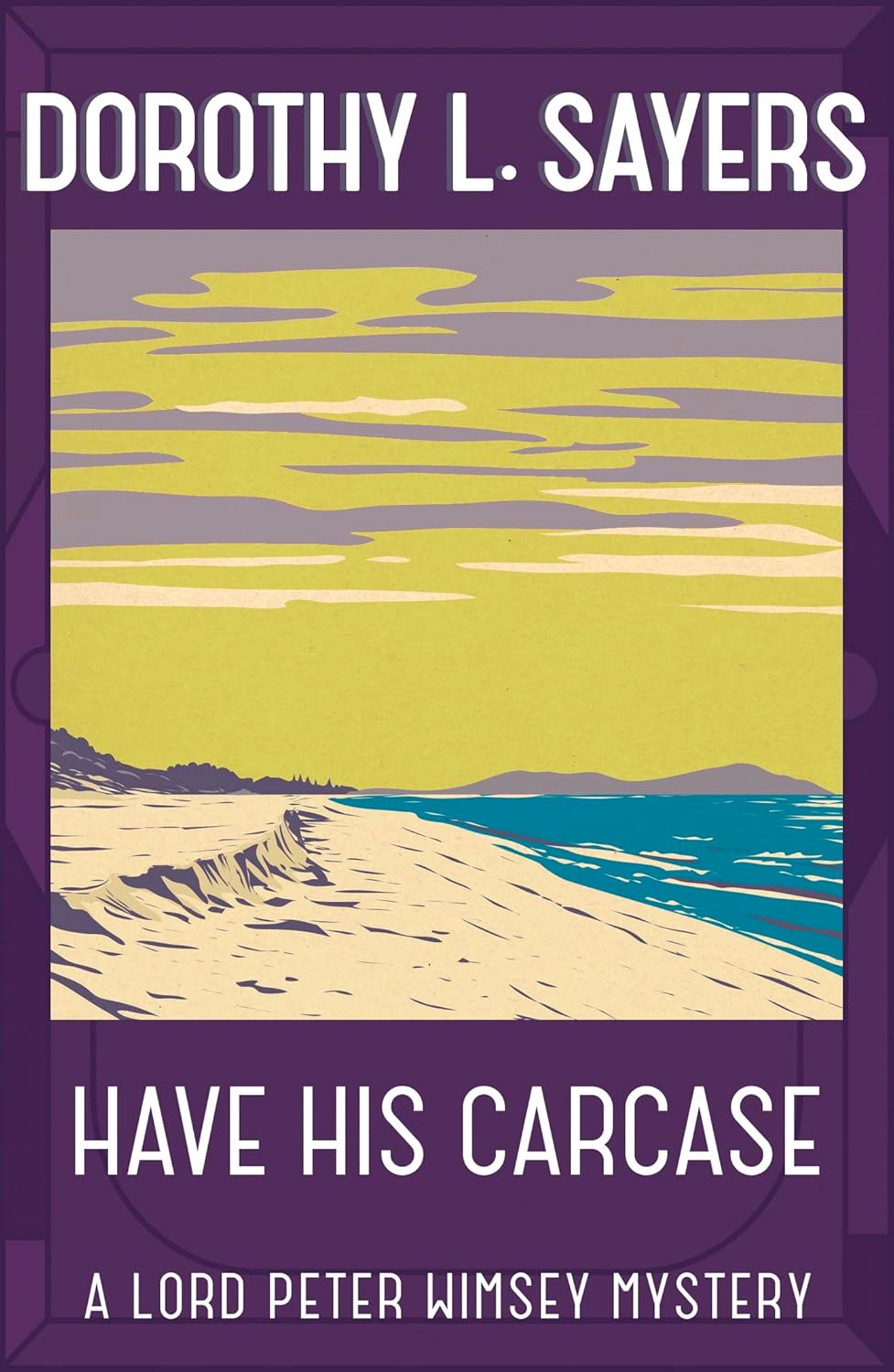
A young woman falls asleep on a deserted beach and wakes to discover the body of a man whose throat has been slashed from ear to ear . . .The young woman is the celebrated detective novelist Harriet Vane, once again drawn against her will into a murder investigation in which she herself could be a suspect.
Lord Peter Wimsey is only too eager to help her clear her name.
‘Have His Carcase’ disappointed me. I never expected to set a Lord Peter Wimsey book aside, especially one with Harriet Vane in it, but after struggling through the book for almost four months and only reaching 38%, I had to admit to myself that finishing it had become a chore rather than a pleasure.
The reality was that, most of the time, this book bored me.
I bought ‘Have His Carcase’ because I liked Harriet Vane when I met her in ’Strong Poison’ and in ‘Gaudy Night’ (my favourite Sayers novel so far), so I was initially pleased that the book started with Harriet Vane, finding the body of a murdered man while she was holidaying alone at the seaside. I wanted to see what she, a crime writer recently accused and acquitted of murder, would make of a real crime scene. At first, she lived up to my expectations. She kept her head, gathered evidence and tried to work out what had happened to the man. Knowing that the crime scene and the body would soon be swept away by the tide, she set off to get help. That was when things started to go wrong for me.
I think that her long and fruitless wanderings in the country lanes and her difficulties in getting the authorities to take her seriously were meant to be amusing, but I found them overlong and tedious. Her initial attempts to discover the identity of the dead man worked better, but the exposition still felt slow and clumsy to me.
Things picked up a bit when Wimsey arrived. I enjoyed the banter between the two of them and the way Harriet kept Wimsey at a distance while he continued to be besotted with her.
Even so, the account of Wimsey’s pursuit of the origins of the razor that killed the dead man, while sometimes amusing, told me far more than I have ever felt the need to know about gentlemen’s barbers and cutthroat razors.
I continued to be amused by the descriptions of the sharp-edged way that the apparently mild-mannered Wimsey sees the world, for example, when he first meets the rather unpleasant son of a woman who had expected to marry the murdered man, we get this biting description:
“Wimsey, summing him up with the man of the world’s experienced eye, placed him at once as a gentleman-farmer, who was not quite a gentleman and not much of a farmer.”
I enjoyed the scene where Harriet, rather to her surprise, discovers that Wimsey is a good dancer, and I was hoping that the book would settle into an interesting collaboration between the two of them.
Sadly, the next thing that happened was a protracted conversation between Vane and Wimesy on the methodology of investigation. I found myself mired in an extended, laborious review of the facts in this rather dull murder, which put an end to such interest as I’d been able to muster.
I realised that I no longer cared who killed the man on the rock or why, and that what I wanted most was to be done with the book. So, I set it aside.
I haven’t given up on Harriet Vane. I’ll meet her again when I read ‘Busman’s Honeymoon’ later this year.


Punchy and insightful, I enjoyed the review, albeit unfortunately truncated. Moving on…
LikeLike