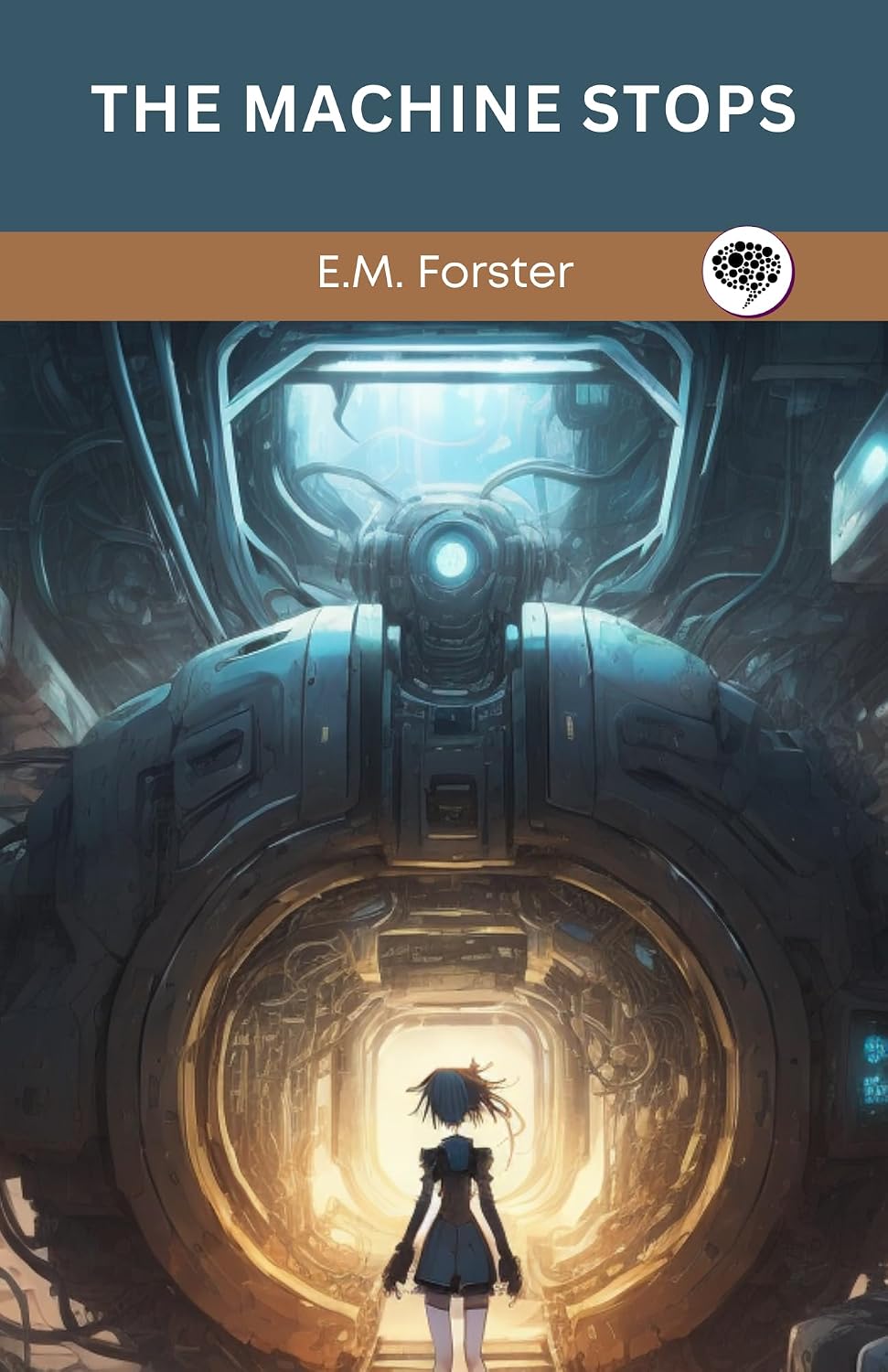
A thought-provoking and prescient short story that envisions a future society entirely dependent on an intricate machine for all aspects of life. As the machine starts to falter, the story follows Vashti, a protagonist questioning the machine-dominated existence. Forster’s gripping narrative explores themes of technology, isolation, and the consequences of relying too heavily on artificial systems, offering a cautionary tale that remains eerily relevant in our increasingly digital age.
I picked up this short story because I was surprised to learn that E. M. Forster had written Science Fiction, and I wanted to see what he’d done with it.
‘The Machine Stopped’ is only forty-five pages long. By modern standards it reads more like a warning than a story. The ideas are more important than the characters. The consequences of the technology are more important than how it works. Forster explains neither the history nor the mechanics of the machine, nor why it needs people.
The power of the story comes from the strength of the idea of a society believing itself to have become more civilised than all previous ages because the machine provides everything they need, freeing them up to engage in an endless exchange of ideas. They live in isolation from one another, never meeting face to face, but they feel more connected than ever because the machine links them to thousands of friends around the world. They consider it a sign of how civilised they have become that they eschew all direct experience, replacing it with the representations of the people and places that they share via the machine. Touch, taste, smell, and interaction with the natural world are at best unnecessary and at worst annoying distractions that prevent them from developing their souls through the exchange of ideas.
I’m old enough to have used the Internet before webpages were invented, back when cyberspace was still the stuff of Science Fiction. Now, as I walk the streets, I find myself surrounded by people whose focus is not on where they are or who they are with or even what they are doing, but on the data and images that their ever-present phones are displaying. And at my heels I hear the baying of the Tech Bros’s hounds, pushing the use of AI to replace creativity and remove the need for either knowledge or thought. So the warnings in this story felt remarkably prescient.
As I read it, I kept asking myself, “How did Forster foresee all of this in 1908?” I realise that part of what makes the story resonate today is that the technology of the machine is largely unexplained, so when it enables people to do things that digital technology allows us to do, I found myself thinking, ‘He’s predicted a form of FaceTime,’ when what he was actually predicting was the emergence of a machine-enabled faux intimacy that weakened and finally replaced physical interaction.
What resonated most with me was that the educated, civilised people in this story were proud of their dependence on the Machine. They saw it as a strength, not a weakness, as progress rather than decline. To me, they sounded like people who’d been persuaded by the evangelical efforts of those who hope to make billions of dollars from AI.
I’ll end with a quote from the heretical son of the main character who holds unconventional views on the Machine. I think this quote gives a feel for the message and the writing style of the story:
“Cannot you see, cannot all you lecturers see, that it is we that are dying, and that down here the only thing that really lives is the Machine? We created the Machine, to do our will, but we cannot make it do our will now. It has robbed us of the sense of space and of the sense of touch, it has blurred every human relation and narrowed down love to a carnal act, it has paralysed our bodies and our wills, and now it compels us to worship it. The Machine develops – but not on our lines. The Machine proceeds – but not to our goal. We only exist as the blood corpuscles that course through its arteries, and if it could work without us, it would let us die.”

