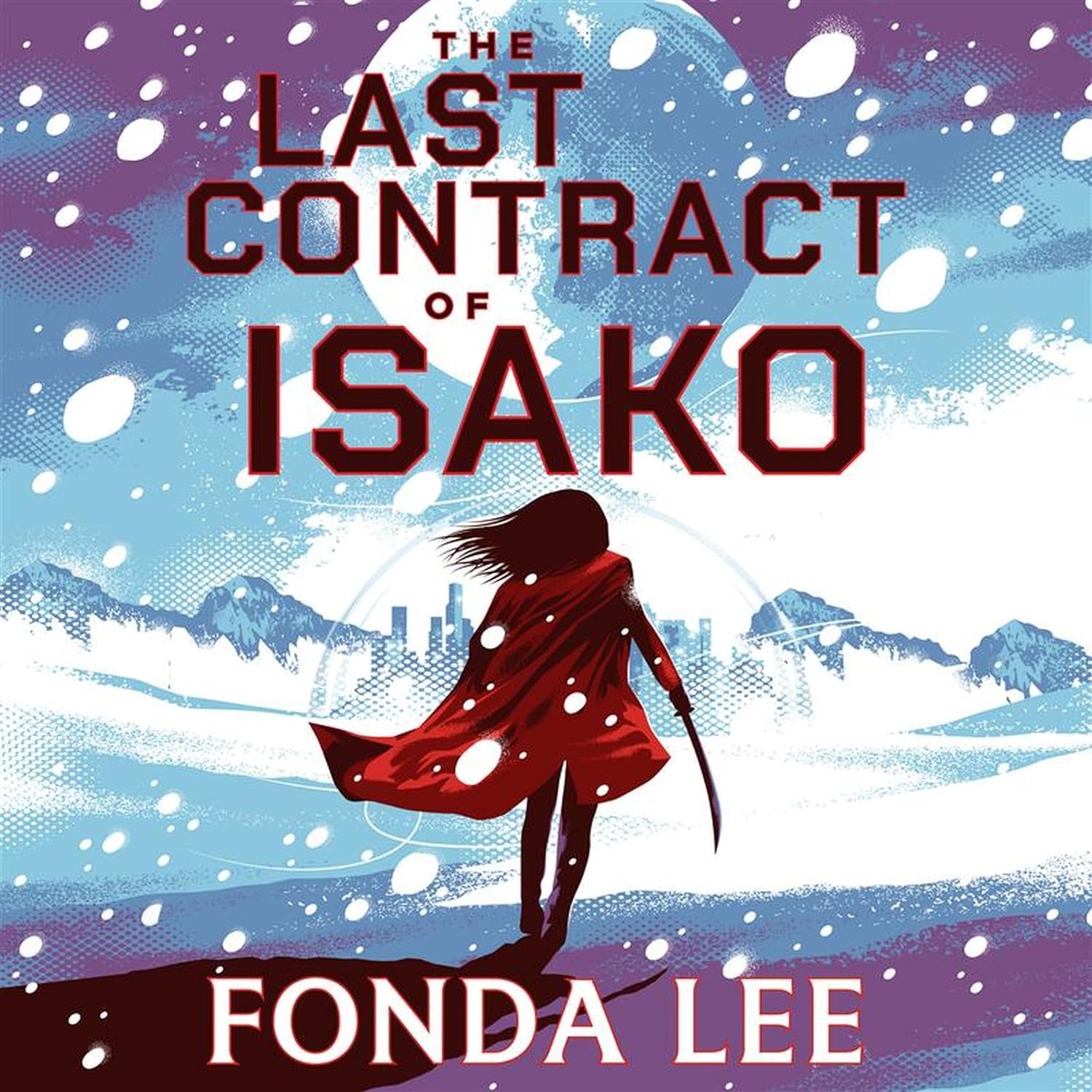
Isako is a legendary swordswoman, but every legend has to come to an end. When her long-time client unexpectedly retires, she plans to follow-to walk out into the frozen wasteland of their planet with her head held high and her family enriched by her legacy. But when a competitor offers her a final mission, it’s one she can’t refuse. Soon, she’s thrust deep into a world of corporate espionage, duty-bound duels, and shadowy secrets. What she uncovers will change humanity’s existence in the stars forever.
‘The Last Contract of Isako’ was a strikingly original piece of Science Fiction, and not just because there are Samurai using swords to terminate employment contracts. This is one of the few books I’ve read that imagines what the hardship of terraforming a planet inimical to human life does to a culture over many generations, especially when that culture has become cut off from the rest of human space.
The culture of this harsh, frozen world was fully imagined, highly plausible and full of surprises that gave me things to think about. A couple of science fiction tropes were taken as starting points – the coercive power of corporations that control all the resources that sustain life, and the impact of life-extending technologies available only to the elite – but they went in unusual directions. I liked that there were no clear good guys and bad guys. Some people were more venal than others. Some needed to be part of a larger cause. Some were interested only in their own careers, and some had been pushed to the margins of society.
The characters were given the time to unfurl, reveal themselves and adapt to the unexpected. I thought Isako was a great creation. I enjoyed watching her perceptions shift as the mystery she was investigating started to erode the certainties she had tried to build her life and her death on. I liked that Isako was more than the fastest blade on the block. She was a mother (albeit one who didn’t raise her own daughter), a mentor (albeit a strict mentor who made no allowances for weakness) and a loyal advisor (albeit to a man who ultimately left her vulnerable when he unilaterally decided his own endgame). She was also a woman in a physical job who was just beginning to feel her age, especially in her knees, at a time when circumstances were forcing her to reassess her past and choose her future.
The mystery at the heart of the story was complex, clever and unusual. It was an interesting mix of detective story and political thriller that also prompted the main characters to question themselves and the world they were helping to keep functioning. There was a major plot twist in the middle of the book that I was initially disappointed with, partly because I saw it coming a long way off and was a little frustrated with how long it took for the twist to be acknowledged and explained; and partly because it moved the focus away from Isako, stalling the momentum of the story. I considered setting the book aside then. I stuck with it and, by the last third of the book, I began to see that what was being revealed about the characters and the motivations for their choices was more important than the change in direction or the loss of pace.
I recommend the audiobook version of ‘The Last Contract of Isako’. Both narrators did well, but I thought Mary Robinette Kowal’s performance was a perfect fit for making Isako real to me.
I was impressed with the quality of the writing and the power of Fonda Lee’s imagination. I’m looking forward to more from her.

