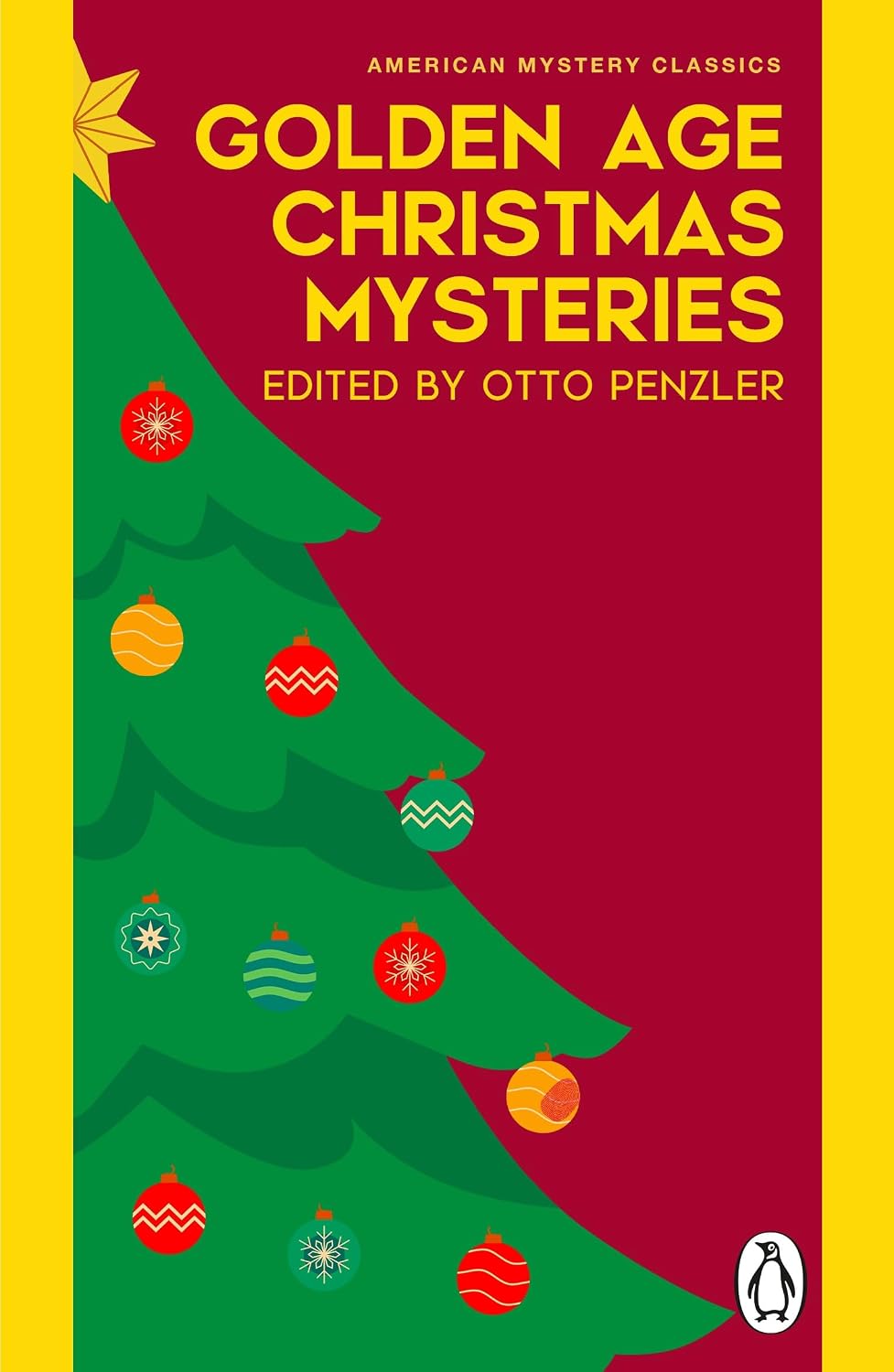
A collection of Christmas-themed mysteries, written by some of the greatest Golden Age authors: Anthony Boucher, Lillian de la Torre, Carter Dickson, Stanley Ellin, Steve Fisher. Pat Frank. Baynard Kendrick. John D. MacDonald, Meredith Nicholson Norvell Page, Ellery Queen, Mary Roberts Rinehart, Damon Runyon, Vincent Starrett
I picked up this collection partly because I was in the mood for some festive crime and partly because I haven’t read much American Golden Age Mysteries, and I thought this might act as a sampler.
Of the fourteen stories in the collection, two were excellent and made me glad that I’d bought the book, four were two-star reads, and I set two aside.
My favourites were ‘Crime’s Christmas Carol‘ by Norvel Page and ‘The Butler’s Christmas Eve’ by Mary Roberts Rinehart.
The brief biographies of the authors improved my enjoyment of the stories.
I’ve given a brief review of each story below.
MYSTERY FOR CHRISTMAS (1943) by Anthony Boucher ★★★.5
This had a ‘Christmas Special’ feel: slick, tongue-in-cheek and driven by insider humour. The humour came from providing an unconventional answer to what sounded like a long-standing debate on whether a script editor adds anything to the creative process. In this case, the creative process was helping a not-so-bright police officer solve a robbery that he’d written up as an unfinished story. I admired the tonal contrast between the polished, knowing cleverness of the narrative and the simplicity of the story the police officer had written. The ideas were larger than life. This was a clever plot idea turned into a smile.
THE STOLEN CHRISTMAS BOX (1946) by Lillian de la Torre ★★
The idea of Doctor Samuel Johnson as an eighteenth-century detective with Boswell as his Watson appealed to me, but the story didn’t hold me. If you enjoy solving puzzles and deciphering codes, then this story has much to offer you. While I admired the eighteenth-century details of language and custom, the mystery bored me.
PERSONS OR THINGS UNKNOWN (1938) by Carter Dickson (John Dickson Carr)★★★
A cleverly told story that weaves historical fiction (Restoration Englas no less), haunted house story telling and long-unsolved murders into a satisfying mystery for a winter’s evening.
DEATH ON CHRISTMAS EVE (1950) by Stanley Ellin ★★★★
A beautifully executed Gothic tale of murder, grief and denial, complete with a decaying Victorian mansion, a scary woman dressed in outdated mourning clothes and a man so distraught he’s unable to leave his own house. The atmosphere was redolent with gloom and suppressed rage. The ending was unexpected and absolutely perfect. My favourite line was from the distraught man who, when he’s told his sister loves him, replies: “She loves me like ivy loves a tree.”
IF CHRISTMAS COMES (1937) by Steve Fisher ★★★
I enjoyed the window into what Christmas was like on Hollywood Boulevard in 1937 (this story was published on Christmas Day 1937). Steve Fisher was writing about what he knew. He was also putting a slick, zinger-in-the-tale story together. I think the former worked better than the latter, but both were entertaining. I thought his writing was at its best in the first four paragraphs when he was describing Hollywood life like this:
“THERE ARE a lot of things we like about Hollywood that the people outside don’t know about, could not know about, because they are just the small every day things of living. They are things bigger than glamor and glory and money, that never make the publicity columns, and yet are the things that bring flesh and blood and breath to we who are idolized, symbolized, fictionized, and looked upon as immortal beings. In the days when I had to struggle to keep body and soul together, I used to think that money and fame would make a difference, but I know now that it doesn’t; it makes it easier, but that is all. There is never anything different. So the little things, the elements around us that we see day in and day out are the things that count. They are the things that make us laugh and weep.
Things like the sunshine, and the careless freedom of Hollywood Boulevard, and the parade of girls in slacks, and the blondes who wait on corners and aren’t afraid to be picked up if you wear a white sweater and have a Packard roadster. The little barbecue stands where you drive in, after a show, and have food brought to your car, and sit there and eat it and laugh far into the night. Like the beaches which are ordinary beaches but can be gone to either winter or summer. Like the mountains and resorts, and places to dance like the Grove, and places to eat like Musso-Franks where even Garbo will sit at the counter to eat her dinner. Things like open air markets that spray floodlights across heaven to advertise oranges ten cents a dozen; or the little movie house that has a surprize preview picture given to them an hour before the second show goes on.
Little things like those, intangibles all, count up, and mean something, and make Hollywood the best place to live and earn your bread in the whole world. The sentiment and the laughter, things too small to mention, things I cannot even remember— and then the very best of all these things. The day that makes the whole year worth living. Christmas Day in Hollywood.
If you ever went away, Tony, could you ever forget Christmas? There is no snow. There is only California grass and trees and flowers and the weather at its worst, but when you walk along Hollywood Boulevard you see Christmas different than you ever did before. In the first place it isn’t Hollywood Boulevard then, it is Santa Claus Lane. All of the street signs are changed to that (remember?) and on each electric lamp for the entire length of the boulevard there is a color picture of a different star. You are a star when your picture is in the gallery along Santa Claus Lane because you’re with the best this town ever turned out.”
THE CHRISTMAS BOGEY (1957) by Pat Frank ★★★
This story was published in the year I was born. Back then, the Cold War might have turned hot at any moment, giving everyone a nuclear Christmas followed by a long nuclear winter. The tone of Pat Frank’s story is light-hearted, leading up to a groan-worthy Christmas punchline, but just beneath the surface is a warning and a reminder that Christmas is the most wonderful time of the year… for an apocalypse. I’d have ignored the warning as unlikely, except I remember how, although everyone tried their best, the USAF wasn’t set up to deal with the planes used in 9/11.
SILENT NIGHT (1953) by Baynard Kendrick ★★★.5
This was one of those ‘magic trick’ crime stories where presenting the solution to the puzzle with a flourish was the main purpose of the story. The puzzle was well constructed and made clever use of what was then the leading-edge recording technology available. The magician performing the trick was made more interesting by being a blind detective (a war hero, blinded in action) who used his exceptionally well-trained hearing to solve the case.
DEAD ON CHRISTMAS STREET (1952) by John D. MacDonald ★★
A competent, hard-boiled crime offering, with only the thinnest of links to Christmas. The characters were all pulp-fiction standard issue. There was a twist, but I can’t say I cared much.
A REVERSIBLE SANTA CLAUS (1917) by Meredith Nicholson DNF
I found the language in this story almost impenetrable. The tone was that of a humorous tall tale as told by Mark Twain. I never have enjoyed Mark Twain, so I set this one aside rather than trying to decode it.
CRIME’S CHRISTMAS CAROL (1939) by Norvell Page ★★★★★
This was a wonderful Christmas tale. It took the spirit of O. Henry’s loving ‘The Gift of the Magi‘ and the sense of benevolent intervention in Charles Dickens’ ‘A Christmas Carol‘ and wove them into something new and uplifting. I liked the empathy for a young couple who have nothing but each other. The understanding of the quiet desperation of poverty and the rage it can produce when surrounded by abundance that you can see but can’t share. Best of all, this was a beautifully crafted tale – the right pace, tension building in tandem with empathy and engagement and finally, the possibility of hope.
THE ADVENTURE OF THE DAUPHIN’S DOLL (1948) by Ellery Queen DNF
This was my first thing I’ve read by Ellery Queen. I’m hoping it wasn’t the best example of their work. I found the tone too smugly jolly to be interesting.
THE BUTLER’S CHRISTMAS EVE (1944) by Mary Roberts Rinehart ★★★★★
I can see why Mary Roberts Rinehart was the second best-selling American writer in the 1920s and 1930s. ‘The Butler’s Christmas Eve‘ is a simple story, told without any magician’s tricks or ‘gotcha’ twists, yet, from the first page, it has weight. This is a story about real people in difficult times. It captures the spirit of a wartime Christmas when people feel what the war is costing but have no idea when it will end. It speaks of decades-long relationships and how they shape the people in them. Oh, and there was a small but important mystery to solve, but it seemed somehow less significant than the unexpected dressing of the Christmas tree.
I have her debut novel ‘The Man in the Lower Ten’ (1906) in my TBR pile. I think I’ll be adding more.
DANCING DAN’S CHRISTMAS (1932) by Damon Runyon ★★
Not my kind of thing. I can see the writing is slick, the tone of voice is distinctive, and the characters are larger than life, but it’s the kind of humour that only makes you smile if you have a roseate view of the antics of drunken men in general and gangster assassins and thieves in particular. Not the Christmas spirit that I find entertaining.
THE WRONG SANTA CLAUS (1944) by Vincent Starrett ★★
This was so slight that there was almost nothing there. It was a cartoon or sketch rather than a story. The sort of Christmas Special that only works if the reader already has an affection for the core cast of characters.

