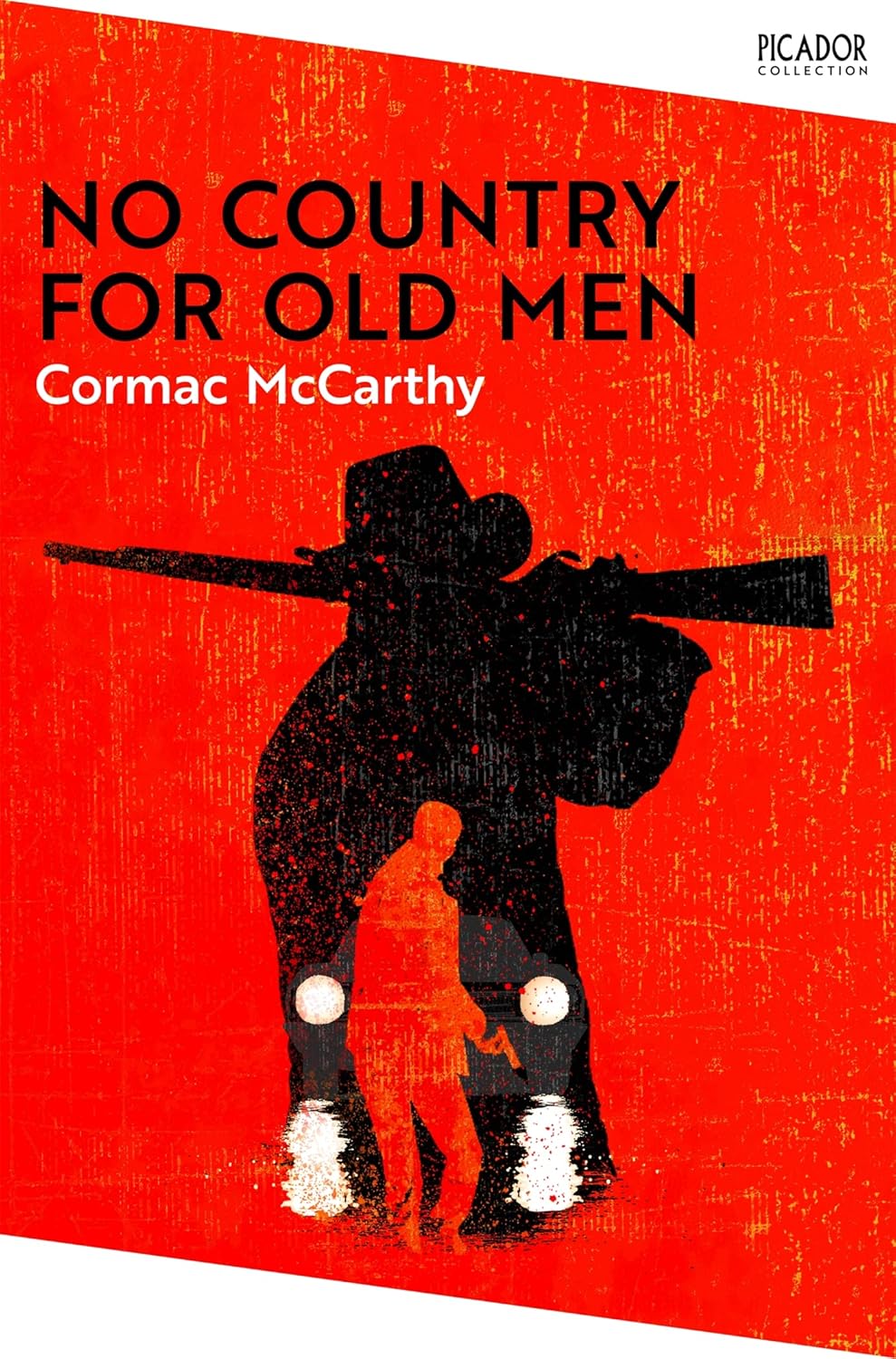
Llewelyn Moss, hunting antelope near the Rio Grande, stumbles upon a transaction gone horribly wrong. Finding bullet-ridden bodies, several kilos of heroin, and a caseload of cash, he faces a choice – leave the scene as he found it, or cut the money and run.
Choosing the latter, he knows, will change everything. And so begins a terrifying chain of events, in which each participant seems determined to answer the question that one asks another: how does a man decide in what order to abandon his life?
‘No Country for Old Men‘ was my first Cormac McCarthy book. I wasn’t sure what to expect. I didn’t expect something so raw and thoughtful, bloody and contemplative, as this.
I’m writing this review a few weeks after finishing the book. I needed some time to get beyond my immediate reactions of “Wow, that was good.” and “How in hell did they make this into a movie?” and “Which of his books should I read next?”. I wanted time to figure out what made Cormac McCarthy’s book so distinctive. I think my answer to that question will change each time I re-read this book, and I’m certain I will re-read this book,
Anyway, here’s where I’ve gotten to so far.
One of the distinctive things about ‘No Country for Old Men‘ is how the narrative is framed by the recollections of a sheriff, an older, widely experienced man with a habit of reflection that felt like an examination of conscience. To me, it seems the sheriff serves the same dramatic function as a Greek Chorus; he is an ‘ideal spectator’, there to prompt the reader to reflect on the meaning of the actions described in the narrative. It’s a narrative filled with calculated violence described vividly but dispassionately, as if violence and death were as inevitable as sunset. These scenes of tense, bloody, desperate, desolate action are punctuated by the sheriff’s reflections, which highlight the transgressive nature of the killings.
The opening to the book demonstrates the power of this structure. We meet the sheriff on the first page, before any of the violence unfolds. His interior monologue displays a man used to danger and to taking a stand against those who cause harm without thought or remorse, but who has learnt that some evils are so profound he doesn’t have the strength or the will to stand against it. Here’s what he says:
“…there is another view of the world out there and other eyes to see it and that’s where this is goin. It has done brought me to a place in my life I would not of thought I’d of come to. Somewhere out there is a true and living prophet of destruction and I dont want to confront him. I know he’s real. I have seen his work. I walked in front of those eyes once. I wont do it again. I wont push my chips forward and stand up and go out to meet him.“
We move from the sheriff’s thoughts to a first chapter filled with vivid, bloody, context-free killing carried out by a man who seems to know neither fear nor remorse. The perspective shifts again, immersing the reader in the mind of a hunter in the desert who has happened across a landscape filled with dead or dying men. He examines it with the same dispassionate focus he would use to track deer. There’s no philosophising here, no moral calculus, just a systematic reconstruction of events and a decision on what to do next.
The hunter’s decision, driven by greed and misplaced confidence, dooms him. From that point on, the hunter and the killer from the first chapter are locked in a dance of escalating violence, with the sheriff following their trail of destruction.
The storyline and the structure are almost operatic, but the story is told in lean, efficient prose and pitch-perfect dialogue that strips away any potential for melodrama. The prose is powerful, almost hypnotic in its simplicity, like the hum of tyres on tarmac. It doesn’t diminish the impact of the violence and the blood, but it prompts an unemotional evaluation of it, which I found much more chilling.
The result is a story that’s hard to look away from and easy to believe in. What makes it so powerful is that, although the word evil isn’t used, the presence of unprecedented, unhesitating, unstoppable transgression animates the story.
When I started the book, I was puzzled and irritated by Cormac McCarthy’s refusal to punctuate direct speech. I couldn’t see the point of it. It seemed to me it added nothing except unnecessary work for me to figure out who was saying what. I’ve abandoned other books for this kind of gimmicky treatment of punctuation. I didn’t abandon this one because the writing was too good to set aside. I wasn’t very far into the book when I realised that I’d fallen under the spell of dialogue written with such precision that the punctuation was unnecessary. The absence of punctuation and the excision of all “he said,” “she said” verbiage require the dialogue to be clear and sharp. It’s a discipline that doesn’t tolerate padding and which makes the conversation flow naturally and powerfully.
I was interested in how Cormac McCarthy came to this approach. I found this article on openculture.com: The Three Punctuation Rules of Cormac McCarthy (RIP), and How They All Go Back to James Joyce


Excellent review and convinced me of the need to add Cormac McCarthy to my tbr list. The additional article link was also a fab’ segway to an understanding of the author’s approach. Thank you!
LikeLike
Thank you. I hope you enjoy him. I’m going to be reading more of his books over the next few months.
LikeLike